
What Is Crypto Arbitrage Trading? How Do Arbitrage Bots Work?

 Prefer us on Google
Cryptocurrency markets operate across many exchanges, and the same asset may sometimes trade at slightly different prices on different platforms. Crypto arbitrage trading attempts to capture these temporary price differences by buying an asset at a lower price and selling it at a higher price elsewhere.
Because these price differences are often short-lived, many traders use crypto arbitrage bots to monitor markets and execute trades automatically.
However, arbitrage is not a guaranteed profit strategy. The final result depends on factors such as trading fees, execution speed, liquidity, and market conditions.
Why Do Crypto Prices Differ Between Exchanges?
Price differences between exchanges exist because each market has different trading activity and liquidity.
For example, if a large number of users suddenly buy Bitcoin on one exchange, its price may rise slightly before other exchanges adjust. During this short period, a price gap may appear.
The main reasons include:
| Factor | Explanation |
|---|---|
| Liquidity differences | Exchanges with different trading volumes may react at different speeds |
| Trading activity | Regional demand and user behavior can affect prices |
| Market volatility | Rapid price movements can create temporary differences |
These price gaps are usually small and disappear quickly, which is why automated systems are often used to monitor opportunities.
How Does a Crypto Arbitrage Bot Work?
A crypto arbitrage bot is a program that automatically searches for price differences and executes trades based on predefined rules.
The process usually includes three stages.
First, the bot collects market data from different exchanges, including prices, order books, and liquidity information.
Next, it calculates whether the price difference is large enough after considering costs such as trading fees and possible slippage.
Finally, if the conditions are met, the bot sends orders automatically.
For example:
- BTC price on Exchange A: $60,000
- BTC price on Exchange B: $60,200
Theoretical price difference: $200
However, the actual result depends on whether the $200 difference is larger than all related costs.
A price difference does not always mean a profitable opportunity.
Common Types of Crypto Arbitrage Strategies
Cross-Exchange Arbitrage
Cross-exchange arbitrage is the most common type.
A trader buys an asset on one exchange where the price is lower and sells it on another exchange where the price is higher.
Although the concept is simple, execution can be challenging because transferring assets between platforms takes time, and the price difference may disappear before the trade is completed.
Triangular Arbitrage
Triangular arbitrage uses price differences between different trading pairs within the same exchange.
For example, a bot may analyze the relationship between BTC/USDT, ETH/BTC, and ETH/USDT. If the conversion prices become temporarily inconsistent, the system may attempt to complete multiple trades to capture the difference.
This strategy requires fast calculations and accurate execution.
Statistical Arbitrage
Statistical arbitrage uses historical data and mathematical models to identify unusual price movements.
Instead of directly looking for price differences between exchanges, it analyzes whether assets are trading differently from their historical patterns.
This approach usually requires more advanced quantitative knowledge.
Advantages and Limitations of Arbitrage Bots
Arbitrage bots mainly improve speed and automation.
A bot can monitor multiple markets continuously, react faster than manual trading, and execute predefined rules without emotional decisions.
However, automation does not remove the main challenges of arbitrage.
The biggest limitation is cost. Since arbitrage often involves multiple trades, fees and slippage can significantly reduce potential returns.
Another challenge is liquidity. A displayed price difference does not always mean enough orders are available at that price.
For example, a trader may see a higher selling price on one exchange but find that only a small amount can actually be sold before the price changes.
How Do APIs Support Crypto Arbitrage Bots?
Crypto arbitrage bots need a connection to exchanges to receive market data and submit orders. APIs provide this communication channel.
Through an API, trading programs can access functions such as:
- Market data retrieval;
- Order submission;
- Account information.
For developers building automated trading systems, the WEEX API provides resources for connecting programs with trading functions and market data.
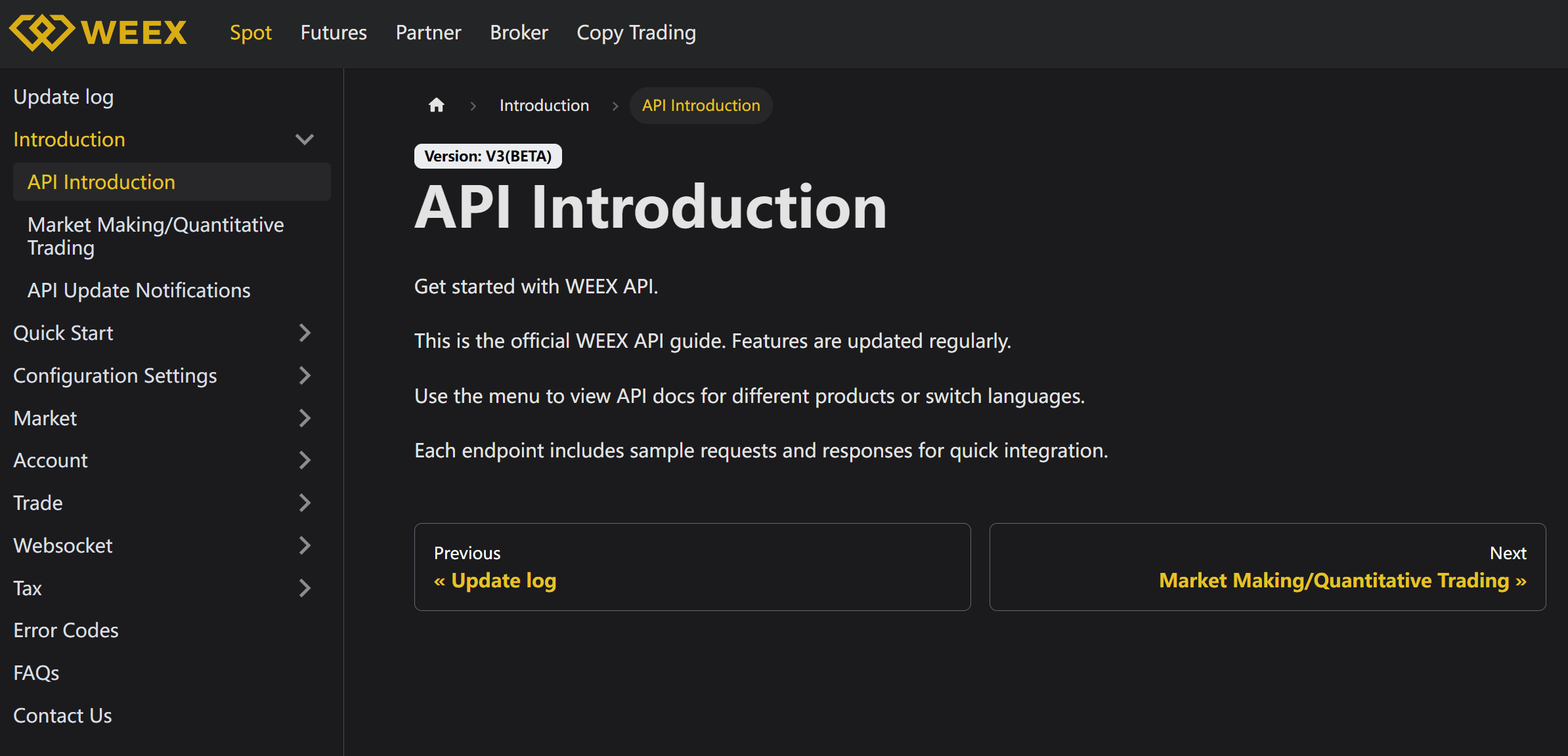
A typical workflow is: Collect market data → Compare prices → Check trading conditions → Execute orders
However, APIs only provide technical infrastructure. They do not create arbitrage opportunities or guarantee trading results.
The strategy itself still depends on market analysis, cost calculation, and risk management.
When using API-based trading systems, users should also pay attention to security. API permissions should be limited to necessary functions, and API credentials should be properly protected.
Is Crypto Arbitrage Trading Suitable for Beginners?
Crypto arbitrage may appear attractive because it focuses on price differences rather than predicting market direction.
However, successful arbitrage trading requires understanding several technical factors, including:
| Area | Why It Matters |
|---|---|
| Trading fees | Small costs can eliminate price differences |
| Execution speed | Opportunities may disappear quickly |
| Liquidity | Orders may not fill at expected prices |
| API stability | Technical issues can affect execution |
For beginners, learning the basics of trading costs and automation is important before using arbitrage strategies.
A practical approach is to first understand how arbitrage works, test strategies with limited exposure, and evaluate results carefully.
Conclusion
Crypto arbitrage trading uses price differences between markets to search for potential opportunities. Arbitrage bots help automate this process by monitoring multiple markets and executing trades quickly.
However, arbitrage is not a simple way to generate guaranteed returns. Fees, execution delays, liquidity, and technical factors all influence the final outcome.
APIs such as WEEX API can provide the connection needed for automated trading systems, but the effectiveness of any arbitrage strategy still depends on strategy design, market conditions, and risk management.
For beginners, the most important step is not finding a “perfect” arbitrage bot, but understanding how the strategy works and testing it under realistic conditions.
This content is provided for general informational purposes only and doesn't constitute financial, investment, legal, or tax advice. Any events, rewards, online promotions, or related information mentioned herein should not be considered a recommendation, solicitation, or invitation to purchase, sell, trade, or otherwise deal in any crypto assets. Crypto assets are highly volatile and may result in loss. The availability of WEEX services, products, and related events may vary by region. You are responsible for ensuring that your participation is in accordance with applicable local laws and regulations.
You may also like

SpaceX Stock Could Be Worth Tens of Trillions in the 2030s: What the Mach33 Forecast Actually Claims
SpaceX Stock Has 66% Upside According to Wall Street: What the $231 Consensus Target Actually Requires

Morgan Stanley Says SpaceX Stock Can More Than Double: What the Overweight Thesis Actually Requires

SpaceX Stock Price Targets Range From $62 to $800: What the Analyst Disagreement Actually Reveals

XST Coin vs Akash Network: How Two AI Infrastructure Tokens Compare

XST Coin Tokenomics Explained: What 1 Billion Supply and 100% Circulation Actually Mean
How to Sell XST Coin: When and How to Exit Your XSolut Position

XST Ticker Confusion: Stealth Coin vs XSolut — Which One Are You Actually Buying

XST Coin Has Rallied More Than 600% From Its Lows: What Happens to Low-Cap Tokens After a Parabolic Move

Is NBIS Stock a Buy After Falling From Its All Time High? What the $37 Billion RPO Actually Implies

Nebius Stock Surges After Q2 Earnings: What 454% Revenue Growth and a $37 Billion Backlog Actually Mean
How to Convert BTC to USD: Which Payment Rail Decides When Your Money Lands
What Is XST Coin? A $54M Valuation on $760,000 of Liquidity

United States Water Reserve Coin: 98% Down and $1,053 Deep
Cisco Stock After Q4 FY26: Record AI Orders, Thinner Margins
Can You Buy Anthropic Stock? The Confidential Filing, the SPVs and Anthropic's Own Warning
Is OpenAI Publicly Traded? The Foundation That Controls It, and the Ticker That Isn't Theirs
Anduril Stock and the Anduril IPO: What the Company Says, and What Is Actually on File

How to Build a Crypto Trading Bot With WEEX API: A Beginner’s Guide
Crypto Quantitative Trading Tools: How Data, Backtesting, and APIs Build Automated Strategies
How Much Money Do You Need to Start Crypto Quantitative Trading?
REST API vs WebSocket API for Crypto Trading: What’s the Difference?
How to Secure a Crypto Trading Bot? API Key Safety Guide
How to Use Crypto Trading APIs? A Beginner’s Guide
What Is a Grid Trading Bot? How Does Crypto Grid Trading Work?
Kioxia Stock and SK Hynix: What Rivals Sharing the Same Shareholder Actually Means
Is HIMS Stock a Buy After the Earnings Selloff? What the Full-Year Guidance Raise Actually Implies
ASTS Stock Falls After Missing Q2 Estimates: What the Revenue Miss and Japan Launch Actually Mean
Intel Stock Is Up Over 170% in 2026: What the AI Foundry Turnaround Actually Required
Intel Stock Sale Draws Over $100 Billion in Demand: What the 5x Oversubscription Actually Signals
SpaceX Stock Could Be Worth Tens of Trillions in the 2030s: What the Mach33 Forecast Actually Claims
SpaceX Stock Has 66% Upside According to Wall Street: What the $231 Consensus Target Actually Requires
Morgan Stanley Says SpaceX Stock Can More Than Double: What the Overweight Thesis Actually Requires
SpaceX Stock Price Targets Range From $62 to $800: What the Analyst Disagreement Actually Reveals
XST Coin vs Akash Network: How Two AI Infrastructure Tokens Compare
XST Coin Tokenomics Explained: What 1 Billion Supply and 100% Circulation Actually Mean
Contents
Popular coins
Latest articles