
How to Use Crypto Trading APIs? A Beginner’s Guide

 Prefer us on Google
As cryptocurrency trading becomes more automated, many traders and developers are exploring ways to connect their own programs with exchanges. A crypto trading API provides the connection that allows software to communicate with a trading platform.
Instead of manually checking prices and placing orders, a program can use an API to receive market data, analyze conditions, and execute trades automatically.
However, an API is not a strategy that generates profits. It is only a technical tool that connects a trading system with an exchange. The final performance still depends on strategy design, market conditions, execution quality, and risk management.
For beginners, understanding how trading APIs work is an important step before building trading bots or quantitative trading systems.
What Is a Crypto Trading API?
A crypto trading API is a set of programming interfaces that allows applications to interact with an exchange.
In simple terms:
Manual trading: User → Exchange platform → Place order
API trading: Trading program → API → Exchange platform → Execute order
Through an API, a program can access market information, check account data, and send trading instructions.
Common API functions include:
| API Function | Purpose |
|---|---|
| Market Data API | Receive prices, candlestick data, and market information |
| Account API | Check balances and account status |
| Trading API | Create, cancel, and manage orders |
| WebSocket API | Receive real-time market updates |
For example, a Bitcoin trading bot may use an API to monitor BTCUSDT price changes and automatically place orders when specific conditions are reached.
Why Do Traders Use Crypto Trading APIs?
The main reason traders use APIs is automation.
For example, a trader may create a strategy:
“If Bitcoin falls below a certain price, buy automatically.”
Without an API, the trader needs to monitor the market manually. With an API connection, a program can continuously check prices and execute the rule automatically.
APIs are also widely used in quantitative trading. A developer can collect market data, test trading models, and connect a strategy with an exchange execution system.
For users managing multiple trading pairs, APIs can also improve efficiency by allowing programs to process market information faster than manual operations.
However, automation does not remove trading risks. A poorly designed strategy can still produce losses even if the execution process is fully automated.
REST API vs WebSocket API: What Is the Difference?
Two common types of trading APIs are REST API and WebSocket API.
The main difference is how they exchange information.
| API Type | How It Works | Typical Use |
|---|---|---|
| REST API | The program sends requests when it needs information | Placing orders, checking balances, retrieving data |
| WebSocket API | The exchange continuously sends updates | Real-time prices, order book changes |
For example, a trading bot may use WebSocket API to receive live BTC price updates and use REST API to submit a buy or sell order.
A complete automated trading system often uses both methods together.
What Is an API Key and How Does It Work?
An API Key is a credential that allows a program to access exchange services. Usually, API authentication includes an API Key, Secret Key, and permission settings.
Different permissions control what a program can do. A market monitoring tool may only need access to public market data, while a trading bot may require permission to create and manage orders.
Security is one of the most important considerations when using APIs. Users should avoid sharing API credentials, protect Secret Keys, and only enable the permissions required for their actual use case.
For example, if a trading program does not need withdrawal functions, those permissions should not be enabled.
How to Connect a Trading Bot With an Exchange API?
Building an API-based trading system usually follows a simple process:
Understand API documentation → Create API Key → Connect market data → Test order execution
The first step is understanding the exchange API structure, including available endpoints, authentication methods, request formats, and error handling.
For developers using WEEX API, the WEEX API provides information about API integration methods and available trading functions. Developers can review API documentation, sample requests, and error codes before building their applications.
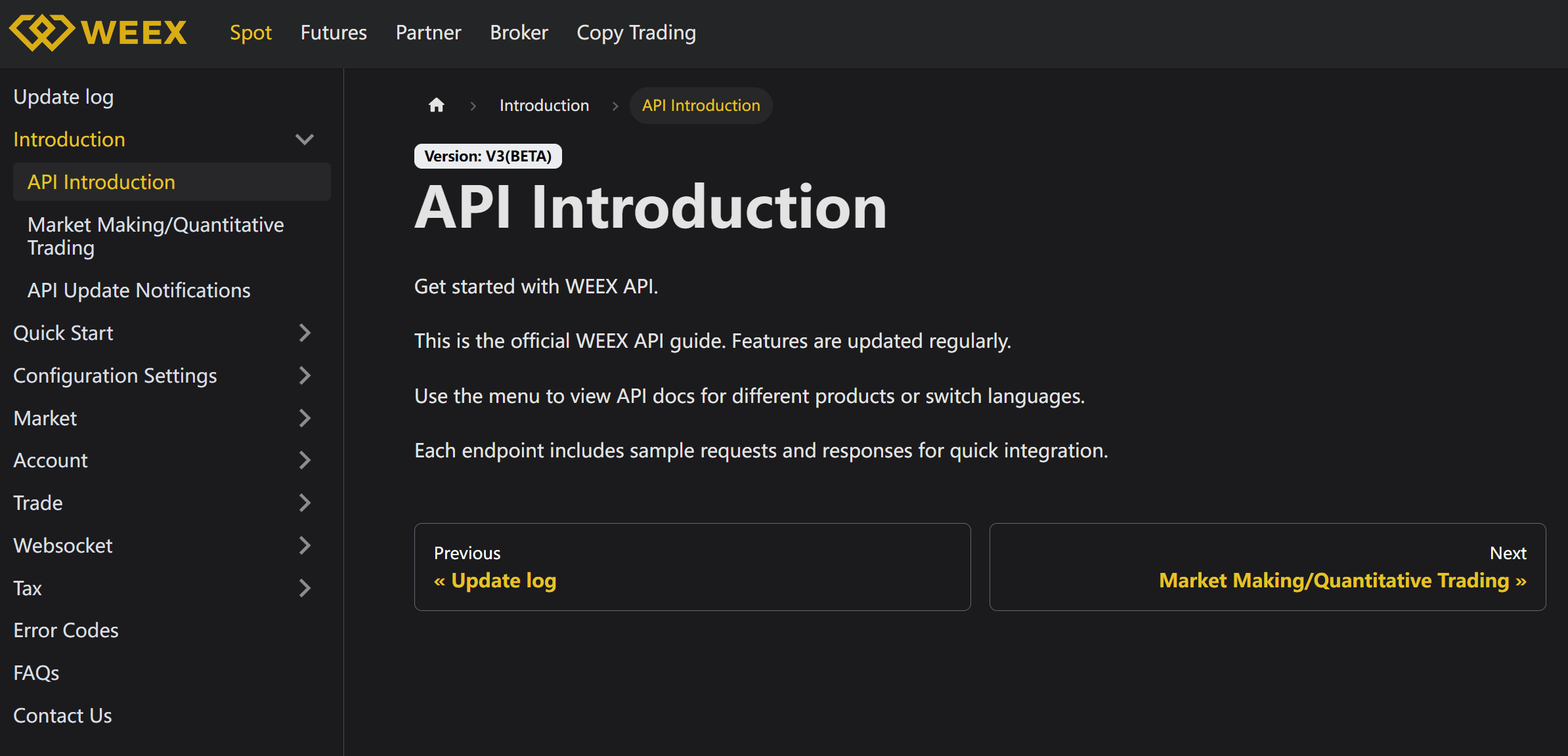
After creating an API Key, the program can connect to market data and trading interfaces. For example, a bot may receive BTCUSDT price updates, analyze market conditions, and submit orders based on predefined rules.
During development, testing is essential. Developers should verify whether orders are created correctly, whether errors are handled properly, and whether the system behaves as expected during unexpected situations.
When integrating with WEEX API, developers should pay attention to practical details such as using the correct trading pair symbol format. For example, API requests should use the latest symbol format, such as BTCUSDT.
Order management also requires attention. If multiple orders are created, identifiers such as newClientOrderId should be handled correctly to avoid conflicts.
Common Challenges When Using Crypto Trading APIs
Although APIs make automation possible, users may encounter several technical challenges.
One common issue is failed API requests. This can happen because of incorrect parameters, insufficient permissions, or exceeding API limits. Developers should check error messages and adjust requests accordingly.
Another challenge is order execution. A successful API request does not always mean a successful trade. Market prices can change quickly, and factors such as liquidity and network delays may affect execution results.
Security is another important concern. API credentials should be managed carefully. Users should regularly review permissions and remove unused API Keys.
WEEX API users can choose different API permissions depending on their needs, including public data access, spot trading, and futures trading permissions. Selecting only necessary permissions helps reduce unnecessary risks.
Are Crypto Trading APIs Suitable for Beginners?
Crypto trading APIs are not only for professional developers, but beginners should understand the basics before using them.
APIs are useful for users who want to learn automated trading, build simple trading tools, or experiment with quantitative strategies.
However, connecting an API does not automatically create a profitable trading system.
A complete automated trading workflow still requires:
Reliable data → Clear strategy → API connection → Risk management → Performance evaluation
Beginners should start with simple strategies, test their systems carefully, and understand how each component works before increasing complexity.
Conclusion
A crypto trading API is the bridge between a trading program and an exchange. It allows applications to access market data, manage trading operations, and build automated trading systems.
For developers and quantitative traders, APIs provide the infrastructure needed for automation. Platforms such as WEEX API can help connect trading programs with exchange services and market functions.
However, APIs are only a technical foundation. Successful automated trading still depends on strategy quality, testing, security management, and risk control.
For beginners, the best approach is to first understand API basics, build small experiments, and gradually develop more advanced trading systems.
This content is provided for general informational purposes only and doesn't constitute financial, investment, legal, or tax advice. Any events, rewards, online promotions, or related information mentioned herein should not be considered a recommendation, solicitation, or invitation to purchase, sell, trade, or otherwise deal in any crypto assets. Crypto assets are highly volatile and may result in loss. The availability of WEEX services, products, and related events may vary by region. You are responsible for ensuring that your participation is in accordance with applicable local laws and regulations.
You may also like

SpaceX Stock Could Be Worth Tens of Trillions in the 2030s: What the Mach33 Forecast Actually Claims
SpaceX Stock Has 66% Upside According to Wall Street: What the $231 Consensus Target Actually Requires

Morgan Stanley Says SpaceX Stock Can More Than Double: What the Overweight Thesis Actually Requires

SpaceX Stock Price Targets Range From $62 to $800: What the Analyst Disagreement Actually Reveals

XST Coin vs Akash Network: How Two AI Infrastructure Tokens Compare

XST Coin Tokenomics Explained: What 1 Billion Supply and 100% Circulation Actually Mean
How to Sell XST Coin: When and How to Exit Your XSolut Position

XST Ticker Confusion: Stealth Coin vs XSolut — Which One Are You Actually Buying

XST Coin Has Rallied More Than 600% From Its Lows: What Happens to Low-Cap Tokens After a Parabolic Move

Is NBIS Stock a Buy After Falling From Its All Time High? What the $37 Billion RPO Actually Implies

Nebius Stock Surges After Q2 Earnings: What 454% Revenue Growth and a $37 Billion Backlog Actually Mean
How to Convert BTC to USD: Which Payment Rail Decides When Your Money Lands
What Is XST Coin? A $54M Valuation on $760,000 of Liquidity

United States Water Reserve Coin: 98% Down and $1,053 Deep
Cisco Stock After Q4 FY26: Record AI Orders, Thinner Margins
Can You Buy Anthropic Stock? The Confidential Filing, the SPVs and Anthropic's Own Warning
Is OpenAI Publicly Traded? The Foundation That Controls It, and the Ticker That Isn't Theirs
Anduril Stock and the Anduril IPO: What the Company Says, and What Is Actually on File
How to Build a Crypto Trading Bot With WEEX API: A Beginner’s Guide
Crypto Quantitative Trading Tools: How Data, Backtesting, and APIs Build Automated Strategies
How Much Money Do You Need to Start Crypto Quantitative Trading?
REST API vs WebSocket API for Crypto Trading: What’s the Difference?
How to Secure a Crypto Trading Bot? API Key Safety Guide
What Is Crypto Arbitrage Trading? How Do Arbitrage Bots Work?
What Is a Grid Trading Bot? How Does Crypto Grid Trading Work?
Kioxia Stock and SK Hynix: What Rivals Sharing the Same Shareholder Actually Means
Is HIMS Stock a Buy After the Earnings Selloff? What the Full-Year Guidance Raise Actually Implies
ASTS Stock Falls After Missing Q2 Estimates: What the Revenue Miss and Japan Launch Actually Mean
Intel Stock Is Up Over 170% in 2026: What the AI Foundry Turnaround Actually Required
Intel Stock Sale Draws Over $100 Billion in Demand: What the 5x Oversubscription Actually Signals
SpaceX Stock Could Be Worth Tens of Trillions in the 2030s: What the Mach33 Forecast Actually Claims
SpaceX Stock Has 66% Upside According to Wall Street: What the $231 Consensus Target Actually Requires
Morgan Stanley Says SpaceX Stock Can More Than Double: What the Overweight Thesis Actually Requires
SpaceX Stock Price Targets Range From $62 to $800: What the Analyst Disagreement Actually Reveals
XST Coin vs Akash Network: How Two AI Infrastructure Tokens Compare
XST Coin Tokenomics Explained: What 1 Billion Supply and 100% Circulation Actually Mean
Contents
Popular coins
Latest articles