
What Is XST Coin? A $54M Valuation on $760,000 of Liquidity

 Prefer us on Google


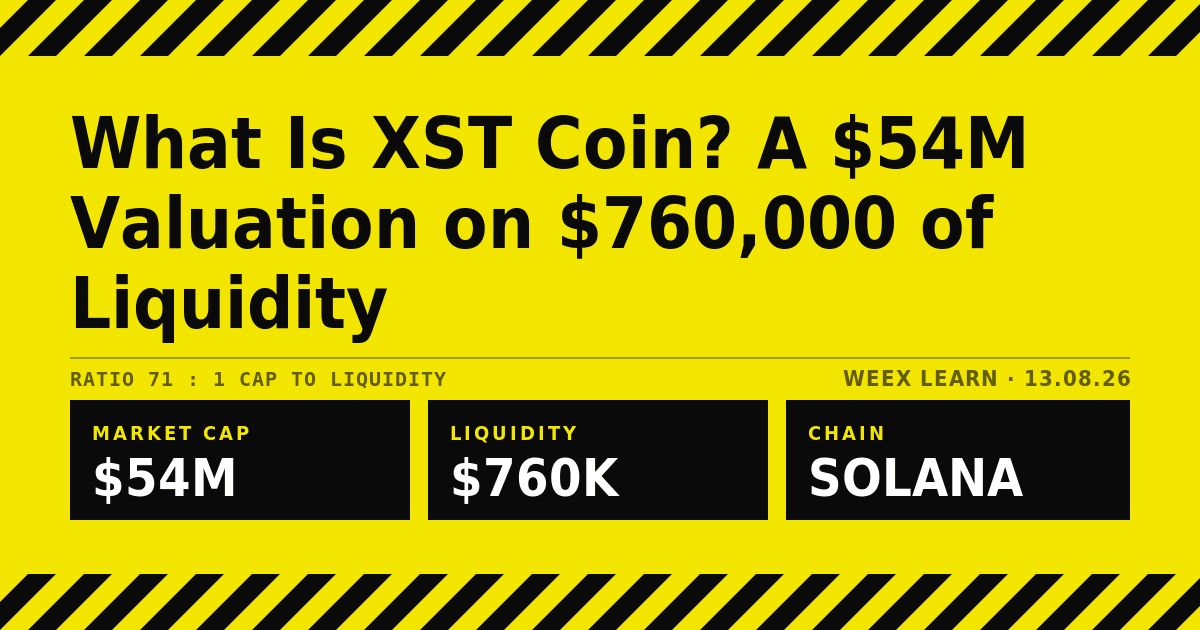
XST coin is the native Solana token of XSolut, a project that says it is building a marketplace for physical AI infrastructure — data centres, power generation, cooling, fibre, semiconductors, land, construction and security. The token launched into on-chain trading in late July 2026 and, as of 13 August 2026, carries a headline valuation near $54 million.
That valuation is the part worth slowing down on. On the same day, every XSolut liquidity pool on Solana held roughly $760,000 in combined value. The market is pricing about $72 of XST for every $1 of capital actually sitting in a pool to trade against.
This piece answers what XST coin is, what holding it entitles you to, where the supply came from, and how to verify the asset before committing anything. It is a research guide, not a recommendation.
What Is XST Coin? The Short Answer
XST coin is an SPL token on Solana, contract address XSTuo1fV7HHMhs4BYiwtrWSLsMCJNrooH2AssWTYZqP, with a total supply of 999,999,999 tokens. It is the asset associated with XSolut, which markets itself as "the world's largest tokenized marketplace" for AI infrastructure records.
One warning before anything else: the XST ticker is not unique. Stealth (XST) has held it since 2014 as a standalone privacy coin, and contracts using the XSolut name also exist on Base. Prices quoted for one are not prices for the other. If you are unsure which asset a page is describing, WEEX has a dedicated breakdown of which token the XST ticker actually refers to. Check the contract string, not the logo.
| XST coin key facts | Detail (as of 13 Aug 2026) |
|---|---|
| Chain | Solana |
| Contract | XSTuo1fV7HHMhs4BYiwtrWSLsMCJNrooH2AssWTYZqP |
| Total supply | 999,999,999 XST |
| Price | ~$0.054 across the main pools |
| Headline valuation | ~$54.5M (fully diluted) |
| Combined pool liquidity | ~$760,000 across 19 pools |
| First liquidity pool created | 23 July 2026 |
| Centralised exchange listings | None |
Sources: DexScreener pool data and CryptoRank, both checked 13 August 2026.
What Does Holding XST Coin Actually Entitle You To?
Nothing enforceable against physical infrastructure. This is the single most misread thing about the project.
XSolut's own framing is careful: tokenization on the platform is described as a digital representation of real-world infrastructure records, not an operating regulated investment product. Records, not deeds. Holding XST does not make you a fractional owner of a data centre, does not entitle you to power-purchase revenue, and does not create a claim on any asset in the marketplace XSolut describes.
Published materials position XST as a token for payments, incentives and governance inside the XSolut ecosystem. Those are forward-looking roles that depend on a platform existing to use them in. Today the token's only demonstrated function is being traded.
That distinction matters because "RWA" is doing heavy lifting in how this token is marketed. Real-world-asset tokenization covers everything from tokenized Treasuries with a custodian and an auditor, to a token that merely indexes information about assets someone else owns. XSolut, by its own description, sits at the second end of that range. Anyone buying XST on the assumption that AI data centres back the price is buying something different from what the project claims to be selling.
XST Tokenomics: One Billion Tokens, No Public Schedule
The supply figure is the one number every tracker agrees on: roughly one billion XST, with circulating supply generally reported as equal to total supply. What is missing is everything that gives a supply figure meaning.
There is no published vesting schedule, no disclosed team or treasury allocation, no stated emission plan, and no independently verified holder-distribution report. WEEX's earlier risk analysis noted 1,700-plus holders on Solscan in late July; CoinCodex, reviewing the same token in early August, could not source a verified concentration breakdown either.
The practical consequence: when circulating supply equals total supply and distribution is undisclosed, the "no unlocks ahead" reading is not a comfort. It means the sell pressure is already live and unscheduled — whoever holds large balances can move at any time, with no cliff to watch for and no calendar to plan around. Watching a token unlock calendar is a poor substitute for reading the top wallets on Solscan here, because there is no calendar.
Where XST Coin Trades: 19 Pools, One That Matters
XST has no centralised exchange listing. All trading happens on Solana decentralised exchanges, and the pool structure is unusually fragmented for a token this young.
Nineteen XSolut pools were live across Meteora, Orca, Raydium and PumpSwap on 13 August 2026. Five of them held 99.5% of the liquidity. The other fourteen held under $2,100 each, several under $50.
| Pool (13 Aug 2026) | Venue | Liquidity | 24h volume |
|---|---|---|---|
| XST/USDC (DYN2) | Meteora | ~$577,800 | ~$253,000 |
| XST/SOL (DLMM) | Meteora | ~$80,600 | ~$2,865,000 |
| XST/USDC | Meteora | ~$44,900 | ~$96,400 |
| XST/USDC | Orca | ~$35,300 | ~$451,000 |
| XST/SOL (DLMM) | Meteora | ~$17,500 | ~$121,000 |
| 14 remaining pools | Meteora / Orca / Raydium / PumpSwap | ~$4,000 combined | negligible |
Source: DexScreener, 13 August 2026.
Read rows one and two together, because that is where the risk lives. The deepest pool holds about three-quarters of all XST liquidity but sees under 7% of the flow. The pool carrying roughly 75% of daily volume holds about $80,600 — turning over more than thirty-five times its own depth in a day. Volume has concentrated in the shallowest venue, which is exactly the configuration that produces violent price marks on modest order flow.
Fragmentation also breaks price agreement. At a single moment on 13 August, quoted prices across XST pools ranged from $0.0431 to $0.0569 — a spread of over 30% between the extremes, and still over 3% among the five pools that actually hold liquidity. There is no single XST price; there is a cluster of pool prices that a router averages for you.
The age of these pools explains a lot. The first XST pool was created on 23 July 2026. The most recent was created on 12 August — one day before this snapshot. This is a market being assembled in real time, not one that has settled.
Is XSolut a Working Business Yet?
Not visibly. XSolut's site, xsolut.ai, returns essentially no server-rendered content beyond the tagline "Building America's AI Future." As of August 2026 there is no publicly verifiable evidence of an operating marketplace, named infrastructure partners, disclosed revenue, a named security audit, or identified leadership.
Absence of public evidence is not proof of fraud, and it should not be reported as such. CoinCodex's 5 August review reached the same non-conclusion from the same gap — the author found no proof either way and declined to participate. WEEX's own risk analysis of XST coin landed in the same place.
What can be stated plainly is the shape of the bet. XST currently trades on a stated plan in two of the most crowded narrative categories in this cycle — AI infrastructure and RWA — with no demonstrated throughput underneath it. That is a legitimate thing to speculate on. It is not the same thing as an investment in AI infrastructure, and the price does not respond to AI capex; it responds to flow into a $760,000 liquidity base.
How to Check XST Coin Before You Buy
The order below catches the most common mistakes first.
- Match the full contract string. Spoofed Solana tokens are built to match the first and last few characters that wallets display. Compare all of
XSTuo1fV7HHMhs4BYiwtrWSLsMCJNrooH2AssWTYZqP. - Confirm the chain. A Base or Ethereum address using the XSolut name is not the contract the quoted prices describe.
- Read depth, not volume. Open the specific pool your route will hit and check liquidity within 2% of price. Volume tells you how much churn happened; depth tells you what you can exit.
- Size against that depth. If your order is more than a low single-digit percentage of the pool's usable band, split it or skip it.
- Check the top wallets on Solscan. With no published distribution, this is the only way to see concentration. Separate liquidity and exchange wallets from wallets that look like deployers or early buyers.
- Test small first. One minimal swap confirms the token, the route and the wallet display before real size is exposed.
The operational mechanics — wallet setup, funding with SOL, routing through Meteora or Jupiter, confirming the fill — are covered step by step in WEEX's guide to buying XST coin.
What traders usually miss: the failure mode on a token like this is not being wrong about the thesis. It is raising slippage tolerance until a stuck swap finally clears. On a pool with $80,600 of depth and thirty-five-times daily turnover, a 15% tolerance is not a workaround — it is written permission for a sandwich bot to take the difference. If a swap keeps failing at 1%, the pool is too thin for your size. That is information, not an error.
What Matters Most About XST Coin
Rank the facts and one dominates. The AI infrastructure thesis, the RWA framing and the price targets all resolve over years, if they resolve at all. The liquidity question resolves the moment you try to sell — and on 13 August 2026 the answer was a ~$54 million valuation standing on roughly $760,000 of pooled capital, spread across nineteen pools, in a token whose oldest market was twenty-one days old.
XST coin is a speculation on attention flowing into a very small market, and it should be sized as one. If you want exposure to AI and Solana narratives with an exit you can rely on, compare pool depth and order-book depth on WEEX against the size you actually intend to trade before you commit capital to a token whose volume dwarfs its liquidity.
Frequently Asked Questions
1. What is XST coin used for?
XSolut positions XST as a token for payments, incentives and governance within its planned AI infrastructure marketplace. As of August 2026 none of those functions is live. Holding XST does not grant ownership of, or a claim on, any physical infrastructure — the project describes tokenization as a digital representation of infrastructure records, not of assets.
2. Is XST coin the same as Stealth?
No. Stealth (XST) is a privacy coin launched in July 2014 with its own blockchain. XSolut (XST) is a Solana SPL token that began trading in late July 2026. They share only a ticker, and their quoted prices differ by roughly an order of magnitude.
3. Can you buy XST coin on a centralised exchange?
Not as of 13 August 2026. All XST trading takes place on Solana decentralised exchanges — chiefly Meteora, with additional pools on Orca, Raydium and PumpSwap. Acquiring it requires a Solana wallet and an on-chain swap.
4. Why does XST show a different price on every site?
Because there is no single market. Nineteen separate pools quote XST independently, and on 13 August 2026 their prices ranged from $0.0431 to $0.0569 at the same moment. Trackers also disagree on valuation: CryptoRank showed roughly $43.6M earlier that day while DexScreener's main pools implied about $54.5M hours later.
5. What is XST coin's total supply?
999,999,999 XST, with circulating supply generally reported as equal to total supply. No vesting schedule, team allocation or emission plan has been published, and no independently verified holder-distribution report exists.
6. How old is XST coin?
Its first liquidity pool was created on 23 July 2026, making the tradeable market three weeks old as of 13 August 2026. Its all-time low of $0.005381 was set on 26 July and its all-time high of $0.06575 on 11 August — a range of more than twelve times inside sixteen days.
Risk Warning
Crypto assets are highly volatile and may result in partial or total loss of capital. XST coin carries risks materially above those of an established asset. Liquidity risk is the most immediate: roughly $760,000 of combined pool depth against a ~$54.5 million valuation as of 13 August 2026 means exits can fill far below the quoted price, and can fail entirely when everyone reaches for one at once. Identity risk is real, because the XST ticker is used by at least two unrelated assets across three chains, and an unverified contract can leave you holding something with no market. Concentration risk is unquantifiable here, since no distribution data has been published and circulating supply equals total supply, so large holders can sell at any time without a scheduled unlock. Execution risk on decentralised venues includes sandwich attacks, wrong-network transfers and self-custody loss, none of which any support desk can reverse. Fundamental risk remains open: as of August 2026 there is no publicly verifiable evidence of an operating XSolut marketplace, revenue, audit or named team, so the valuation rests entirely on a stated plan. Never commit capital you cannot afford to lose in full, and size positions against pool depth rather than headline volume.
This content is provided for general informational purposes only and doesn't constitute financial, investment, legal, or tax advice. Any events, rewards, online promotions, or related information mentioned herein should not be considered a recommendation, solicitation, or invitation to purchase, sell, trade, or otherwise deal in any crypto assets. Crypto assets are highly volatile and may result in loss. The availability of WEEX services, products, and related events may vary by region. You are responsible for ensuring that your participation is in accordance with applicable local laws and regulations.
You may also like

SpaceX Stock Could Be Worth Tens of Trillions in the 2030s: What the Mach33 Forecast Actually Claims
SpaceX Stock Has 66% Upside According to Wall Street: What the $231 Consensus Target Actually Requires

Morgan Stanley Says SpaceX Stock Can More Than Double: What the Overweight Thesis Actually Requires
SpaceX Stock Price Targets Range From $62 to $800: What the Analyst Disagreement Actually Reveals
XST Coin vs Akash Network: How Two AI Infrastructure Tokens Compare

XST Coin Tokenomics Explained: What 1 Billion Supply and 100% Circulation Actually Mean
How to Sell XST Coin: When and How to Exit Your XSolut Position
XST Ticker Confusion: Stealth Coin vs XSolut — Which One Are You Actually Buying
XST Coin Has Rallied More Than 600% From Its Lows: What Happens to Low-Cap Tokens After a Parabolic Move

Is NBIS Stock a Buy After Falling From Its All Time High? What the $37 Billion RPO Actually Implies

Nebius Stock Surges After Q2 Earnings: What 454% Revenue Growth and a $37 Billion Backlog Actually Mean
How to Convert BTC to USD: Which Payment Rail Decides When Your Money Lands
United States Water Reserve Coin: 98% Down and $1,053 Deep
Cisco Stock After Q4 FY26: Record AI Orders, Thinner Margins
Can You Buy Anthropic Stock? The Confidential Filing, the SPVs and Anthropic's Own Warning
Is OpenAI Publicly Traded? The Foundation That Controls It, and the Ticker That Isn't Theirs
Anduril Stock and the Anduril IPO: What the Company Says, and What Is Actually on File
How to Build a Crypto Trading Bot With WEEX API: A Beginner’s Guide
Crypto Quantitative Trading Tools: How Data, Backtesting, and APIs Build Automated Strategies
How Much Money Do You Need to Start Crypto Quantitative Trading?
REST API vs WebSocket API for Crypto Trading: What’s the Difference?
How to Secure a Crypto Trading Bot? API Key Safety Guide
What Is Crypto Arbitrage Trading? How Do Arbitrage Bots Work?
How to Use Crypto Trading APIs? A Beginner’s Guide
What Is a Grid Trading Bot? How Does Crypto Grid Trading Work?
Kioxia Stock and SK Hynix: What Rivals Sharing the Same Shareholder Actually Means
Is HIMS Stock a Buy After the Earnings Selloff? What the Full-Year Guidance Raise Actually Implies
ASTS Stock Falls After Missing Q2 Estimates: What the Revenue Miss and Japan Launch Actually Mean
Intel Stock Is Up Over 170% in 2026: What the AI Foundry Turnaround Actually Required
Intel Stock Sale Draws Over $100 Billion in Demand: What the 5x Oversubscription Actually Signals
SpaceX Stock Could Be Worth Tens of Trillions in the 2030s: What the Mach33 Forecast Actually Claims
SpaceX Stock Has 66% Upside According to Wall Street: What the $231 Consensus Target Actually Requires
Morgan Stanley Says SpaceX Stock Can More Than Double: What the Overweight Thesis Actually Requires
SpaceX Stock Price Targets Range From $62 to $800: What the Analyst Disagreement Actually Reveals
XST Coin vs Akash Network: How Two AI Infrastructure Tokens Compare
XST Coin Tokenomics Explained: What 1 Billion Supply and 100% Circulation Actually Mean



