
TradFi Perpetual Futures API: 26 Symbols and How to Wire Them

 Prefer us on Google

Desk note: Compiled by the WEEX markets desk from the WEEX contract API (V3 BETA) and official WEEX TradFi product pages. Every live figure below was pulled on 28 July 2026 and is timestamped where it appears. This article documents which contracts are currently supported for trading. It is not a recommendation to trade any of them.
WEEX now runs 26 TradFi perpetual contracts alongside its crypto book — NVDA, TSLA and AMZN sitting next to WTI crude, Brent, silver and copper, all USDT-margined, all reachable from the same contract API you already use for BTCUSDT. For a discretionary trader that is a UI change. For anyone running a bot it is a schema change: new symbol strings, a different funding profile, and one eligibility check that will silently break an order router if you skip it.
This is the integration reference — the exact API symbol for each of the 26 contracts, the endpoints worth wiring, what real funding data looked like on 28 July 2026, and the failure modes that appear when a crypto-native bot meets a market that closes on weekends.
Which TradFi Perps Are API-Tradable on WEEX?
Twenty-six, spread across metals, energy, equities and ETFs. Every symbol below returned a live mark price from GET /capi/v3/market/symbolPrice when checked on 28 July 2026, which confirms the contract exists and is quoting.
API symbol | Underlying | Class |
|---|---|---|
| Tether Gold / gold | Precious metals |
| Silver | Precious metals |
| WTI crude oil | Energy |
| Brent crude oil | Energy |
| Natural gas | Energy |
| Copper | Industrial metals |
| NVIDIA | US-listed equity |
| Tesla | US-listed equity |
| Amazon | US-listed equity |
| Broadcom | US-listed equity |
| Micron | US-listed equity |
| Intel | US-listed equity |
| Marvell | US-listed equity |
| SanDisk | US-listed equity |
| IBM | US-listed equity |
| Take-Two Interactive | US-listed equity |
| Uber | US-listed equity |
| Hims & Hers | US-listed equity |
| Rivian | US-listed equity |
| Berkshire Hathaway Class B | US-listed equity |
| Alibaba (ADR) | US-listed equity |
| Nokia (ADR) | US-listed equity |
| SpaceX | US-listed equity |
| SK Hynix | Non-US equity |
| Leveraged semiconductor ETF | ETF |
| Inverse leveraged Nasdaq-100 ETF | ETF |
That is 17 US-listed equities, one non-US equity, two leveraged ETFs, three energy contracts, two precious metals and one industrial metal.
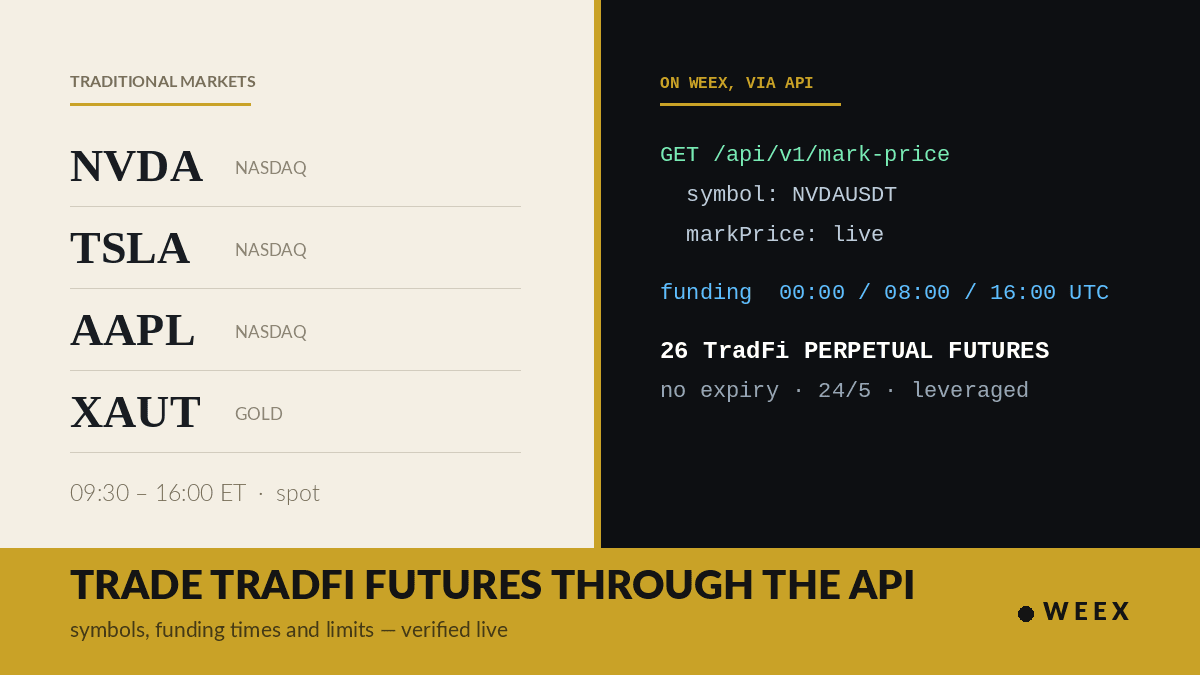
Read the composition for what it is. There is a semiconductor cluster here — NVDA, AVGO, MU, INTC, MRVL, SNDK, SKHYNIX, plus SOXL, which is itself a leveraged basket of the same names — and an energy cluster in CL, BZ and NATGAS. These have historically moved together far more tightly than an equally sized basket of altcoins. A risk engine that treats symbols as independent will concentrate exposure faster on a TradFi book than on a crypto book of the same nominal size.
Availability is a disclosure, not a view. WEEX supporting RIVNUSDT says nothing about Rivian, and nothing here forecasts a price.
How WEEX Builds TradFi Symbol Strings, and Where It Bites
The rule is the platform's ticker plus USDT, uppercase, no separator. NVDA becomes NVDAUSDT. Web pair pages use a hyphen — weex.com/futures/NVDA-USDT — so if you scrape URLs to build a symbol map, strip the hyphen before you send an order.
Several entries will not match a map keyed off home-market tickers:
SKHYNIXUSDT— SK Hynix trades in Seoul as000660.KS. WEEX spells the name out instead.BRKBUSDT— Berkshire's Class B share isBRK.BorBRK-Bdepending on the vendor. Both the dot and the dash are dropped.COPPERUSDT,NATGASUSDT,CLUSDT,BZUSDT— commodities mix plain-English names with CME-style roots (CLfor WTI,BZfor Brent), so neither convention alone covers the set.
The safe pattern is to stop deriving symbols and start fetching them. GET /capi/v3/market/exchangeInfo returns a symbols array carrying symbol, displaySymbol, baseAsset, pricePrecision, quantityPrecision, contractVal, minLeverage, maxLeverage, minOrderSize, maxOrderSize, maxPositionSize and both fee rates. Cache it, refresh it on a schedule, and reject any hard-coded string that is absent from the response.
The Endpoints You Need for a TradFi Bot
Base URL is https://api-contract.weex.com. The WEEX contract API documentation covers the full surface; these are the calls that carry a TradFi integration.
| Endpoint | Why it matters for TradFi | IP weight |
|---|---|---|
/capi/v3/market/apiTradingSymbols | Authoritative list of pairs eligible for API futures trading | 5 |
/capi/v3/market/exchangeInfo | Per-symbol precision, contract size, leverage bounds, fee rates | 1 |
/capi/v3/market/symbolPrice | Index or mark price via priceType=INDEX|MARK | 1 |
/capi/v3/market/fundingRate | Funding history at 8-hour granularity | — |
/capi/v3/market/openInterest | Positioning check before sizing into a thin session | — |
/capi/v3/market/depth | Real book depth, which is where weekend liquidity shows up | — |
One call deserves special attention. Get API Trading Symbols returns a flat array of the pairs currently eligible for API futures trading, and a contract quoting on the market endpoints is not automatically on that list. Order-placement eligibility is gated separately from market-data availability. Treat apiTradingSymbols as the gate: intersect it with your intended universe at startup and on every refresh, then log the diff rather than assuming it. A bot built on "it returns a price, therefore I can trade it" fails at the order rather than at the quote, which is the expensive place to find out.
WEEX also exposes a demo-mode branch of the account and trade endpoints. Point a new TradFi strategy there first. Symbol handling is the part most likely to be wrong, and proving it costs nothing.
-- Price
Funding on Stock and Commodity Perps Behaves Differently
Funding settles every eight hours, at 00:00, 08:00 and 16:00 UTC. That comes out of the data rather than the marketing: consecutive fundingTime values on NVDAUSDT were 28,800,000 ms apart, landing exactly on those UTC boundaries.
The rates themselves are the interesting part. Three contracts, most recent settlement at 00:00 UTC on 28 July 2026, from /capi/v3/market/fundingRate:
| Symbol | Funding rate (per 8h) | Who pays | Annualised, arithmetic only — not a yield on offer |
|---|---|---|---|
NVDAUSDT | −0.01097% | Shorts pay longs | ≈ −12% |
XAUTUSDT | +0.003009% | Longs pay shorts | ≈ +3.3% |
CLUSDT | +0.000152% | Longs pay shorts | ≈ +0.17% |
The right-hand column is one settlement multiplied out over a year. It is not a rate anyone is offering, not a forecast, and not achievable as stated — funding changes every eight hours and can invert.
NVDA funding had been negative at roughly −0.009% to −0.011% for most of the preceding week, with occasional flips positive. A persistently negative print means the perp has been trading under its index and shorts pay longs — the mirror image of the structural long bias that keeps crypto perp funding positive most of the time. Treat it as a cost input to measure each cycle, not a constant to hard-code.
Note also the two-order-of-magnitude spread between NVDA and CL. A funding-cost model calibrated on crypto majors will misprice a TradFi book at both ends.
What Breaks First When a Crypto Bot Meets TradFi Perps
Four things, roughly in the order they bite.
The market runs 24/7 but the underlying does not. WEEX quotes these contracts continuously, and its own TradFi FAQ states that liquidity can be lower during weekend and holiday closures in the traditional markets. Depth thins, spreads widen, and a market order sized off Tuesday-afternoon book data will slip on a Sunday. Size from live /depth.
Leverage caps vary per symbol, and no single number covers the set. Checked on 28 July 2026, the advertised cap on the NVDA/USDT perpetual pair page is up to 100×; the XAUT pair page shows up to 400×; the SPCX pair page shows up to 20×. The WEEX TradFi page meanwhile groups caps by class — up to 400× for XAUT and XAG, up to 50× for tokenized stocks. Marketing pages, class-level FAQs and pair pages drift out of sync with each other. maxLeverage from exchangeInfo is the number your position sizer should read, per symbol, every refresh.
Fees are a live field rather than a headline. The WEEX TradFi page advertises zero fees on gold, stocks and oil, and that offer is dated and campaign-linked. makerFeeRate and takerFeeRate in exchangeInfo are what apply to your fills.
Index and mark prices diverge, and only one liquidates you. symbolPrice defaults to INDEX, while liquidation runs off mark. If your monitoring reads the default while your risk sits on mark, the dashboard stays calm through a liquidation. Set priceType=MARK explicitly wherever a decision depends on it.
Wire the Parameters, Not the Symbol List
The headline is 26 new contracts. What determines whether your integration survives contact with them is smaller: fetch the symbol universe from exchangeInfo, gate it through apiTradingSymbols, read maxLeverage and the fee fields per symbol instead of from any page, and re-measure funding per contract instead of importing a crypto assumption. TradFi perpetual futures on the WEEX API are the same plumbing as crypto perps with different parameters, and the parameters are where the money leaks.
To build against it, create a key from the WEEX API page, run the strategy in demo mode until symbol handling is provably correct, then go live on one contract before twenty-six.
FAQ
1. Which TradFi perpetual contracts can I trade through the WEEX API?
Twenty-six as of 28 July 2026, namely: XAUT and XAG in precious metals; CL, BZ and NATGAS in energy; COPPER in industrial metals; seventeen US-listed equities — NVDA, TSLA, AMZN, AVGO, MU, INTC, MRVL, SNDK, IBM, TTWO, UBER, HIMS, RIVN, BRKB, BABA, NOK and SPCX; SKHYNIX in non-US equities; and two ETFs, SOXL and SQQQ. Each trades as the ticker plus USDT, so XAUT is XAUTUSDT. Confirm the current set programmatically before trading, since listings change.
2. What is the symbol format for TradFi perps on the WEEX API?
Ticker plus USDT, uppercase, no separator — TSLAUSDT, CLUSDT, SKHYNIXUSDT. Web pair pages use a hyphenated form such as NVDA-USDT, which is a display convention only. Fetch the canonical strings from /capi/v3/market/exchangeInfo rather than deriving them.
3. How often does funding settle on TradFi perpetual futures?
Every eight hours, at 00:00, 08:00 and 16:00 UTC, measured from consecutive fundingTime values returned by /capi/v3/market/fundingRate. Rates differ sharply by contract and can be negative, meaning shorts pay longs.
4. Do I need a separate account or margin asset for TradFi trading?
No. Per the WEEX TradFi FAQ there is no separate TradFi account, and USDT is the only supported margin asset. You trade from the USDT already sitting in your spot or futures balance.
5. Does a TradFi perp give me any shareholder rights?
No. These are USDT-settled perpetual contracts that track a price. You hold no underlying share, ETF unit or barrel, and you receive no dividends, voting rights or physical delivery.
Risk Warning
Trading perpetual futures on stocks, ETFs and commodities carries a high risk of loss, and you can lose part or all of your margin. Leverage magnifies both directions: at the caps available on some of these contracts, a small adverse move can liquidate a position entirely. Because these are USDT-settled synthetic contracts, you hold no share, ETF unit or physical commodity and receive no dividends, voting rights or delivery, and your exposure depends on the platform's index and mark price methodology rather than on an exchange-traded share price. Liquidity is not uniform across the clock — the contracts quote 24/7 while the underlying markets close on weekends and holidays, so spreads can widen and gap risk concentrates around reopens and scheduled events such as earnings, inventory reports and macro releases. Funding is a recurring cost or credit that can change sign and magnitude without notice. API trading adds its own failure modes: compromised keys, rate-limit rejections, stale symbol caches and unmonitored order state can all cause losses independent of market direction. Contract availability, leverage caps, fee rates and API eligibility are subject to change at any time. The listings described here disclose what is currently supported and are not investment advice, a recommendation, or any assurance of profit. Trade only capital you can afford to lose.
This content is provided for general informational purposes only and doesn't constitute financial, investment, legal, or tax advice. Any events, rewards, online promotions, or related information mentioned herein should not be considered a recommendation, solicitation, or invitation to purchase, sell, trade, or otherwise deal in any crypto assets. Crypto assets are highly volatile and may result in loss. The availability of WEEX services, products, and related events may vary by region. You are responsible for ensuring that your participation is in accordance with applicable local laws and regulations.
You may also like
NVDA Stock Jumps 7% After Earnings: Is $250 Next?
Why Is Raini Studios Token (RST) Up Today Despite Low Trading Volume?
Before You Buy CyberLeek: You Should Know CYBERLEEK Token Risks First
Is CyberLeek (CYBERLEEK) Safe? Price Crash and Key Token Risks Explained
CyberLeek Price Prediction 2026: Can CYBERLEEK Recover After the Crash?
Why Is CyberLeek Price Falling Today? CYBERLEEK Crash Explained
SEC Sends Crypto Custody Rule to White House: What the Review Means for Investment Advisers
NVDA Earnings Call Recap: Revenue Guidance, AI Demand and Key Takeaways
Hamster Kombat Is Down 97% From Its Peak: What Happened to Crypto's Biggest Web3 Onboarding Experiment?
Nvidia Earnings Report Today: Did NVDA Beat Revenue and EPS Estimates?
Did Nvidia Beat Earnings? NVDA Q2 Results and Stock Reaction Explained

How to Buy USDT with Easypaisa Using PKR in 2026
Easypaisa Crypto Guide: How to Use the Mobile Wallet for P2P Trading in Pakistan
How to Log In to MetaMask: Unlock, Troubleshooting and Recovery (2026)
WEEX Mini App Launch Rewards: Trial Funds, BTC Airdrops, and an iPhone 17 Pro Giveaway Explained
How to Buy USDT with JazzCash in Pakistan Safely in 2026
JazzCash Crypto Guide: How PKR-to-USDT P2P Payments Work in Pakistan
H/USDT After the Unlock: What Humanity Protocol’s New Supply Means for Traders
Why Is DGrid AI (DGAI) Trending After Its Exchange Debut?
XSolut Coin Extends Its Decline to 7 Straight Days: What Continued Selling Pressure Actually Signals
MORTY After Viral Meme Rally: Overvalued or Growth Story?
SPCX Stock Keeps Swinging Around Its $135 IPO Price : What the Lockup Schedule Still Ahead Actually Means
What Is TermMax (TMX)? Inside the New Fixed-Rate DeFi Token Launching Today
What Is XST Coin? Why There Are Multiple Tokens Using the XSolut Name on Coinbase
What Is IMX Crypto? How Immutable's Layer 2 Became the Largest Web3 Gaming Blockchain
Michael Saylor Sold 1,690 Bitcoin at a Loss: What Strategy Inc.'s August Bitcoin Sale Actually Reveals

How High Can Sandisk Stock Go? 2026 Price Target and Analyst Outlook
CLARITY Act: What Happens in the Senate's September Window
WEEX API Guide: From API Key to Your First Signed Order
WEEX API Integration Guide: Auth, Limits, and the 403 Trap
NVDA Stock Jumps 7% After Earnings: Is $250 Next?
Why Is Raini Studios Token (RST) Up Today Despite Low Trading Volume?
Before You Buy CyberLeek: You Should Know CYBERLEEK Token Risks First
Is CyberLeek (CYBERLEEK) Safe? Price Crash and Key Token Risks Explained
CyberLeek Price Prediction 2026: Can CYBERLEEK Recover After the Crash?
Why Is CyberLeek Price Falling Today? CYBERLEEK Crash Explained


