
Easypaisa Crypto Guide: How to Use the Mobile Wallet for P2P Trading in Pakistan

 Prefer us on Google


Easypaisa works as a P2P payment rail the same basic way JazzCash does, a buyer sends PKR directly to a seller's Easypaisa account while an exchange holds USDT in escrow, but the account behind that payment works differently enough that it's worth understanding on its own terms. Easypaisa is Pakistan's original mobile wallet, now sitting inside a bank that recently earned a full digital banking license, and its tiered, biometric-heavy verification system directly affects how smoothly a P2P trade goes.
What Is Easypaisa, and Why Does Its Background Matter for Crypto Traders?
Easypaisa launched in 2009 as Pakistan's first mobile wallet, predating JazzCash by three years, and is operated by Telenor Microfinance Bank, a bank backed jointly by Telenor and Ant Group, the fintech company behind Alipay. That Ant Group backing is a detail worth knowing, since it reflects deeper investment in payments infrastructure and fraud-detection technology than a typical regional mobile wallet, which shows up in how seriously Easypaisa treats identity verification.
The January 2025 Digital Bank License Shift
In January 2025, Telenor Microfinance Bank secured Pakistan's first digital retail bank license from the State Bank of Pakistan, a milestone that pushes Easypaisa beyond a simple mobile wallet and toward a fuller digital banking platform. For P2P crypto traders, this matters practically: as Easypaisa's underlying institution takes on more formal banking status, its transaction monitoring and compliance systems are likely to keep tightening rather than loosening, making clean, verifiable payment behavior more important over time, not less.
How Easypaisa's Tiered Verification System Works
Easypaisa accounts operate on a tiered structure set by State Bank of Pakistan regulations, starting at a basic Level 0 account opened instantly with just a CNIC and registered mobile number, and moving up to Asaan and Premium tiers that unlock higher transaction limits with additional documentation. Which tier a trader's account sits at directly determines how large a single P2P purchase can comfortably go through in one transfer.
Level 0 vs Higher Verification Tiers
A Level 0 account can be opened in minutes through the Easypaisa app or by dialing the *786# USSD code and entering CNIC details, but it carries the lowest transaction limits of any tier, historically capped in the tens of thousands of rupees per month. Moving to a higher tier, such as Asaan or Premium, requires proof of address, like a utility bill or rental agreement, and unlocks meaningfully higher sending and receiving limits, which matters directly for anyone planning P2P trades larger than a small test amount.
Why Biometric Verification Matters More for Easypaisa P2P Users
Pakistan's telecom regulator and the State Bank both require biometric verification for full Easypaisa account access, matching a fingerprint scan against NADRA's national identity database, either through the Easypaisa app itself or in person at one of the roughly 20,000 Easypaisa agent locations nationwide. An account that hasn't completed this biometric step can face restricted functionality, including limits on receiving funds, which is directly relevant to P2P sellers who need reliable inbound transfers to complete trades smoothly.
| Verification Level | How It's Completed | What It Affects for P2P Trading |
|---|---|---|
| Level 0 (basic) | App registration or *786# with CNIC | Lowest limits, may restrict larger trade sizes |
| Biometric verification | In-app fingerprint scan or agent visit | Required for full send/receive functionality |
| Asaan / Premium tier | Address proof plus biometric verification | Higher limits suited to regular P2P trading |
How Does a P2P Trade Using Easypaisa Actually Work?
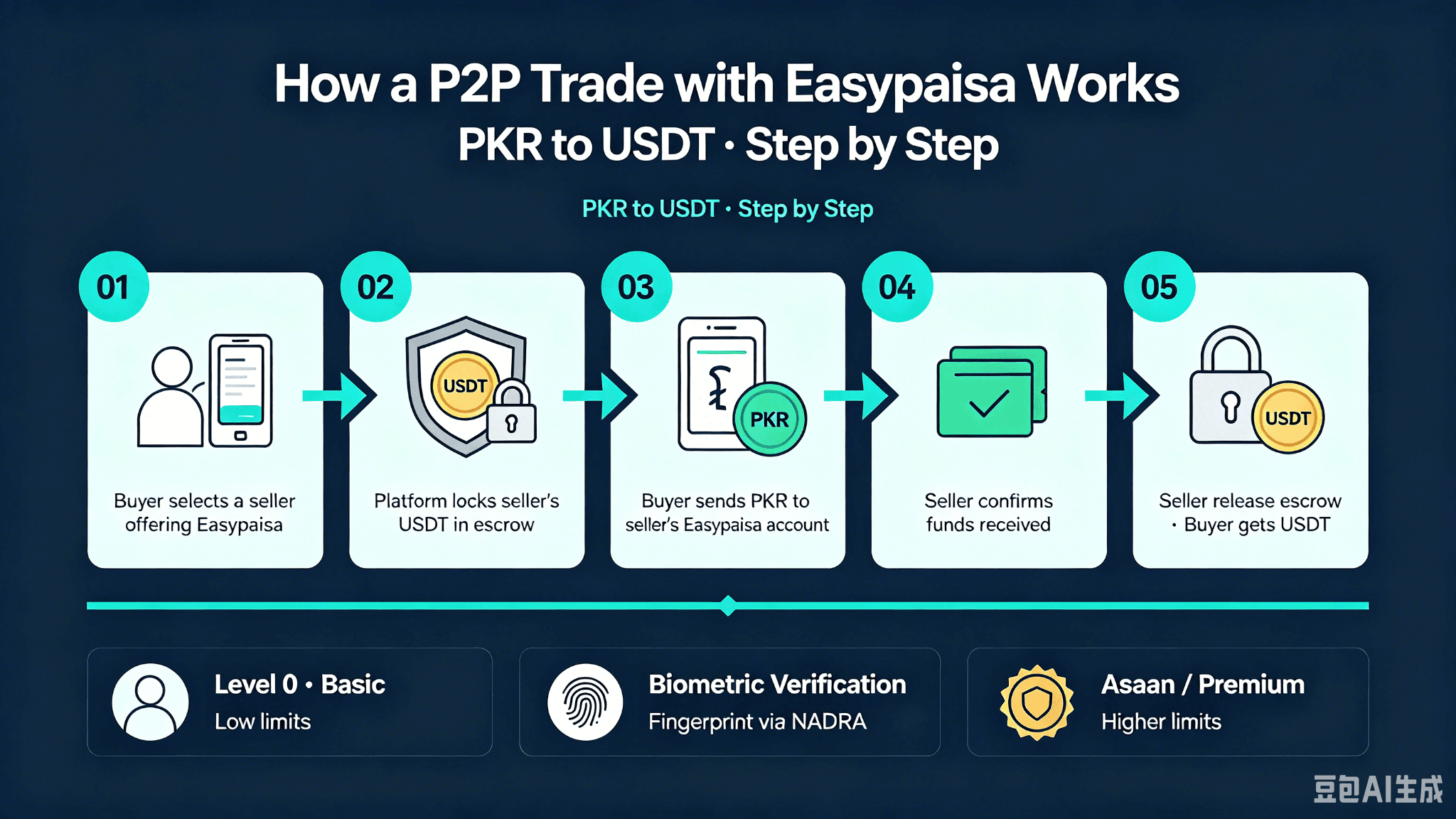
The trading mechanism itself mirrors any other mobile wallet payment method on a P2P marketplace: a buyer selects a seller offering Easypaisa as a payment option, the platform locks that seller's USDT in escrow, the buyer sends the exact PKR amount to the seller's verified Easypaisa account, and the seller releases escrow only after independently confirming the funds landed. The mechanics of escrow protection don't change based on which wallet is used, what changes is how quickly and reliably the payment itself clears, which depends heavily on both parties' verification status.
Matching the Receiving Name Precisely
Before sending payment, a buyer should confirm the name displayed for the Easypaisa account inside the trade chat matches the account holder's registered name exactly, since Easypaisa's biometric-linked verification means a mismatched name is a stronger warning sign here than it might be on a less strictly verified payment method. A seller whose displayed account name doesn't match what appears in the trade chat, or who asks a buyer to send funds to a different number at the last minute, should be treated as a reason to pause and double-check before sending anything.
-- Price
What Happens If Your Easypaisa Account Isn't Fully Verified?
An Easypaisa account stuck at Level 0 or missing biometric verification can face transaction restrictions that disrupt a P2P trade mid-process, including caps on how much can be received in a given period or, in some cases, a full block on incoming transfers until verification is completed. This is a more common cause of a stalled P2P trade than most beginners expect, since the issue isn't with the exchange or the P2P marketplace at all, it's a limit sitting entirely on the wallet side.
Completing Biometric Verification Before You Trade, Not During
Completing biometric verification through the Easypaisa app or at an agent location before attempting a P2P trade, rather than discovering a limit mid-transaction, avoids a frustrating situation where a trade is already underway and payment can't fully clear. This is a straightforward, one-time step that removes one of the more preventable reasons a legitimate trade stalls partway through.
Is Using Easypaisa for Crypto P2P Legal in Pakistan?
The same regulatory picture that applies to JazzCash applies here: holding and trading crypto is generally treated as legal, but no exchange currently holds a full operating license from the Pakistan Virtual Assets Regulatory Authority following the Virtual Assets Act, 2026, while Easypaisa itself is a fully licensed, SBP-regulated financial institution simply processing an ordinary domestic transfer. The uncertainty in this picture sits entirely with the crypto trading platform layer, not with Easypaisa as a payment method, which continues operating exactly as it does for any other transfer between two account holders.
Understanding Easypaisa's tiered verification and biometric requirements before your first trade does more to prevent a stalled or restricted transaction than any amount of caution applied during the trade itself. Treating full verification as a prerequisite, not an afterthought, is the single most effective step an Easypaisa-based P2P trader can take.
Frequently Asked Questions About Easypaisa Crypto P2P Trading
1. Can I use Easypaisa for P2P crypto trading without completing biometric verification
You can technically hold a Level 0 Easypaisa account without biometric verification, but this limits your transaction capacity and can restrict your ability to receive funds, which directly interferes with completing a P2P trade smoothly.
Completing biometric verification, either through the Easypaisa app or at an agent location, is strongly recommended before attempting any P2P trade of meaningful size.
2. What is the difference between Easypaisa and JazzCash for crypto P2P trading
Both function as payment rails for P2P trades in essentially the same way, but Easypaisa is Pakistan's original mobile wallet operated by a bank that recently gained a full digital banking license, while JazzCash is operated by Jazz's microfinance banking arm with its own separate verification structure.
The practical difference for traders comes down to each wallet's specific tiered verification requirements and transaction limits rather than any difference in how P2P escrow itself functions.
3. Why did my Easypaisa account restrict a payment I was trying to receive during a trade
This typically happens when an account hasn't completed full biometric verification or has reached a limit tied to its current tier, both of which cap how much can be received within a given period regardless of what the P2P platform itself allows.
Checking your account's current verification level and limits before starting a larger trade helps avoid discovering this restriction in the middle of a transaction.
4. How long does biometric verification take for an Easypaisa account
Biometric verification can often be completed within minutes directly through the Easypaisa app using a fingerprint scan matched against NADRA records, or in person at an Easypaisa agent location if the in-app option isn't available on your device.
Completing this step in advance, rather than during an active P2P trade, avoids delays that could leave a trade partially stuck.
5. Is Easypaisa safer than other mobile wallets for P2P crypto trading
Easypaisa's biometric verification requirements and its underlying bank's digital banking license suggest a relatively strict compliance environment, but safety in P2P trading depends much more on escrow discipline and merchant vetting than on which specific wallet is used to send payment.
Regardless of the payment method, verifying that funds have actually cleared before releasing escrow and checking a seller's trading history remain the most important safety practices.
This content is provided for general informational purposes only and doesn't constitute financial, investment, legal, or tax advice. Any events, rewards, online promotions, or related information mentioned herein should not be considered a recommendation, solicitation, or invitation to purchase, sell, trade, or otherwise deal in any crypto assets. Crypto assets are highly volatile and may result in loss. The availability of WEEX services, products, and related events may vary by region. You are responsible for ensuring that your participation is in accordance with applicable local laws and regulations.
You may also like
How to Buy USDT with Easypaisa Using PKR in 2026

How to Log In to MetaMask: Unlock, Troubleshooting and Recovery (2026)
WEEX Mini App Launch Rewards: Trial Funds, BTC Airdrops, and an iPhone 17 Pro Giveaway Explained
How to Buy USDT with JazzCash in Pakistan Safely in 2026
JazzCash Crypto Guide: How PKR-to-USDT P2P Payments Work in Pakistan
H/USDT After the Unlock: What Humanity Protocol’s New Supply Means for Traders
Why Is DGrid AI (DGAI) Trending After Its Exchange Debut?
XSolut Coin Extends Its Decline to 7 Straight Days: What Continued Selling Pressure Actually Signals
MORTY After Viral Meme Rally: Overvalued or Growth Story?
SPCX Stock Keeps Swinging Around Its $135 IPO Price : What the Lockup Schedule Still Ahead Actually Means
What Is TermMax (TMX)? Inside the New Fixed-Rate DeFi Token Launching Today
What Is XST Coin? Why There Are Multiple Tokens Using the XSolut Name on Coinbase
What Is IMX Crypto? How Immutable's Layer 2 Became the Largest Web3 Gaming Blockchain
Michael Saylor Sold 1,690 Bitcoin at a Loss: What Strategy Inc.'s August Bitcoin Sale Actually Reveals
How High Can Sandisk Stock Go? 2026 Price Target and Analyst Outlook
CLARITY Act: What Happens in the Senate's September Window
Is WEEX Safe? Verify the Reserves and 1,000 BTC Fund Yourself
How to Call a Crypto Exchange API Without Getting Blocked
Crypto Exchange API: Permissions, Signing and Rate Limits
What Is a Crypto Exchange API and Which Permissions to Enable
WEEX Daily Lucky Wheel and Event Airdrops: How the Rewards Actually Work
What Is ISOR Coin (Iran Strategic Oil Resource)? Facts, Risks and Where It Trades
How to Earn WXT Rewards with WEEX Trade to Earn S6 Futures Event
Roblox Stock Is Down 68% in the Past Year: What Age Verification and Sands Capital's Exit Actually Signal
Is XST Crypto a Long-Term Opportunity or Short-Term Hype?
Meta Stock Price Is Down 30% From Its 52 Week High: Is META a Buy After the Child Safety Trial Drop
Is PROM Coin Safe? What Can and Cannot Be Verified About Prom
MicroStrategy's STRC Unpegged: Buy the Dip or Brace for Impact?
How to Buy Crypto on WEEX Exchange 2026: Complete Guide
How to Buy USDT with Easypaisa Using PKR in 2026
How to Log In to MetaMask: Unlock, Troubleshooting and Recovery (2026)
WEEX Mini App Launch Rewards: Trial Funds, BTC Airdrops, and an iPhone 17 Pro Giveaway Explained
How to Buy USDT with JazzCash in Pakistan Safely in 2026
JazzCash Crypto Guide: How PKR-to-USDT P2P Payments Work in Pakistan
H/USDT After the Unlock: What Humanity Protocol’s New Supply Means for Traders



