
How to Buy USDT with Easypaisa Using PKR in 2026

 Prefer us on Google


The mechanics of buying USDT with Easypaisa are straightforward once you've completed verification, but the part most guides skip is understanding what price you're actually paying. The PKR-per-USDT rate on a P2P marketplace is not the same number you'd see quoted as "the exchange rate," and knowing why that gap exists, and how to tell if a specific offer is fair, matters more to your actual cost than any step in the payment process itself.
Why the USDT Price You See Isn't Just "The Exchange Rate"
A P2P seller's advertised PKR-per-USDT rate typically sits above the raw market conversion rate you'd find on a price tracker, and that gap is a real, expected premium rather than a sign something is wrong. As of mid-August 2026, broad market data pegged USDT at roughly 277 PKR, while P2P listings earlier in the year were commonly quoted in the 279 to 283.5 PKR range, a premium of one to three percent that shows up consistently rather than occasionally.
Three Different PKR Rates That Get Confused
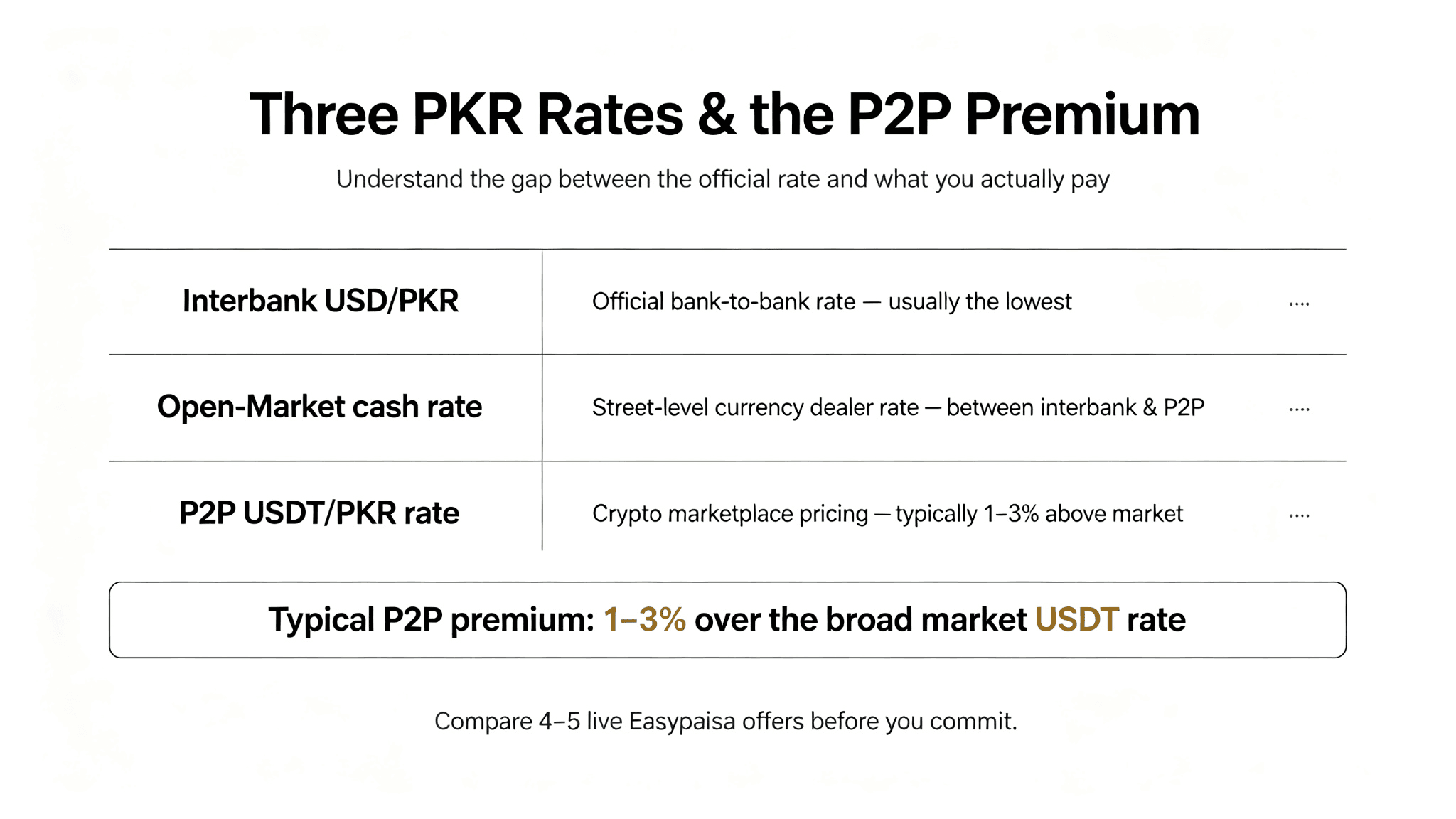
Pakistan effectively has three distinct USD-to-PKR reference points that traders often mix up: the official interbank rate set through the banking system, the open-market cash rate quoted by currency dealers, and the P2P crypto rate seen on exchange marketplaces. These three numbers move somewhat together but are not identical, and checking a P2P offer against the wrong one of the three is the most common reason a buyer misjudges whether they're getting a reasonable deal.
Why P2P USDT Carries a Premium in Pakistan
The premium exists because a meaningful share of P2P demand isn't purely speculative trading, it's people using USDT functionally as a digital dollar to preserve value against rupee depreciation, which adds steady buy-side pressure beyond what pure crypto trading volume would create on its own. Additional factors that push the premium up or down include the State Bank's foreign exchange reserve levels, since lower reserves generally make dollar-equivalent assets more expensive to acquire locally, and broader moves in the US Dollar Index that ripple through to USDT's local pricing indirectly.
How to Tell If You're Paying a Fair Price
Judging a fair price means comparing an offer against the going P2P rate at that specific moment, not against the official bank rate, since a one-to-three-percent premium over the official rate is normal rather than a red flag on its own. What should actually catch your attention is a rate sitting well above what other sellers are simultaneously offering for the same payment method.
Comparing Multiple Merchant Quotes Before You Commit
Opening the P2P marketplace and scanning at least four or five active listings for Easypaisa before selecting one gives a quick, practical sense of where the current going rate actually sits, since individual sellers set their own prices within a range rather than at one fixed number. A listing priced noticeably above that visible cluster, without a clear reason like unusually large trade limits or premium support, is worth skipping in favor of a more competitively priced seller with a solid track record.
What a Reasonable Premium Range Looks Like
Based on rates observed through 2026, a premium in the rough range of one to three percent over the broader market USDT rate has been fairly typical for Pakistani P2P listings, with the exact figure shifting alongside forex reserve news and overall rupee sentiment. A quote sitting five percent or more above that day's visible cluster of other offers deserves a second look, either because the seller is pricing in unusually low liquidity or because the listing simply isn't competitive that day.
| Rate Type | What It Reflects | Typical Relationship to P2P Rate |
|---|---|---|
| Interbank USD/PKR rate | Official bank-to-bank exchange rate | Usually the lowest of the three |
| Open-market cash rate | Street-level currency dealer rate | Sits between interbank and P2P |
| P2P USDT/PKR rate | Crypto marketplace pricing | Typically 1–3% above broad market USDT rate |
A Quick Walkthrough: Buying USDT with Easypaisa
Once you understand pricing, the purchase itself follows the same core steps already used across Pakistani P2P trading generally: select a well-reviewed seller offering Easypaisa, let the platform lock their USDT in escrow, send the exact PKR amount to the verified Easypaisa account shown in the trade chat, and wait for the seller to confirm receipt before escrow releases to your wallet. The one Easypaisa-specific detail worth double-checking is that your own account has completed biometric verification beforehand, since an unverified account can hit receiving or sending restrictions mid-trade regardless of how well you've picked your seller.
-- Price
Should You Buy All at Once or in Batches?
Splitting a larger intended purchase into two or three smaller trades across different sellers, rather than committing the full amount to a single listing, reduces exposure to any one seller's pricing or reliability while also letting you compare real execution rates rather than just advertised ones. This approach costs a small amount of extra time but gives a more accurate read on the going rate than trusting a single quote, particularly for a first-time buyer still learning what a normal premium looks like on a given day.
One Easypaisa-Specific Note: Bank-Level Monitoring on Larger Transfers
Because Easypaisa now sits inside a fully licensed digital bank following its January 2025 licensing upgrade, larger or more frequent transfers are more likely to draw automated monitoring attention than they might on a less formally regulated payment channel. This isn't a reason to avoid larger trades, but it is a reason to expect that consistent, verifiable trading patterns, using your own verified account and dealing with established sellers, matter more on Easypaisa specifically than they might on a payment method with lighter institutional oversight.
Understanding the gap between the official exchange rate and the price actually quoted on a P2P listing is the difference between feeling like you're being overcharged and knowing exactly what you're paying for. Comparing a handful of live offers before committing to one remains the simplest, most repeatable way to buy USDT with Easypaisa at a fair price rather than an inflated one.
Frequently Asked Questions About Buying USDT with Easypaisa Using PKR
1. Why is the USDT price on P2P higher than the exchange rate I see online
P2P prices run higher because they reflect real trading activity between individual buyers and sellers rather than a single, centrally set exchange rate, and a meaningful share of that demand comes from people using USDT as a practical hedge against rupee depreciation.
A premium of roughly one to three percent over the broader market USDT rate has been fairly typical throughout 2026, so seeing a P2P price above a raw rate tracker is expected rather than unusual.
2. How do I know if a specific Easypaisa P2P offer is priced fairly
The most reliable check is comparing several active listings for the same payment method at the same time, since the going rate is best judged against other current offers rather than against the official bank exchange rate.
An offer sitting well above the visible cluster of other sellers' prices that day, without a clear reason like unusually large trade limits, is worth skipping in favor of a more competitively priced alternative.
3. Does the PKR premium on USDT change over time
Yes, the premium shifts along with factors like the State Bank of Pakistan's foreign exchange reserve levels and broader moves in the US dollar globally, both of which influence how much buyers are willing to pay for dollar-equivalent exposure locally.
Checking current listings rather than relying on a premium figure from weeks or months earlier gives a more accurate picture of what's actually reasonable to pay today.
4. Is it better to buy USDT in one large Easypaisa transaction or several smaller ones
Splitting a larger purchase into a few smaller trades across different sellers generally gives a clearer sense of the true going rate and reduces reliance on any single seller's pricing or availability.
This approach takes a bit more time than a single large trade but is a reasonable trade-off for buyers still learning what a fair premium looks like on a given day.
5. Does Easypaisa's new digital bank status affect how I should trade
Since Easypaisa now operates under a fully licensed digital bank following its 2025 licensing upgrade, consistent and verifiable trading patterns, using a fully verified account and established sellers, matter more than they might on a less formally regulated payment channel.
This doesn't change the trading mechanics themselves, but it does mean keeping your account fully verified is a more practically important step than it might be elsewhere.
This content is provided for general informational purposes only and doesn't constitute financial, investment, legal, or tax advice. Any events, rewards, online promotions, or related information mentioned herein should not be considered a recommendation, solicitation, or invitation to purchase, sell, trade, or otherwise deal in any crypto assets. Crypto assets are highly volatile and may result in loss. The availability of WEEX services, products, and related events may vary by region. You are responsible for ensuring that your participation is in accordance with applicable local laws and regulations.
You may also like
Easypaisa Crypto Guide: How to Use the Mobile Wallet for P2P Trading in Pakistan

How to Log In to MetaMask: Unlock, Troubleshooting and Recovery (2026)
WEEX Mini App Launch Rewards: Trial Funds, BTC Airdrops, and an iPhone 17 Pro Giveaway Explained
How to Buy USDT with JazzCash in Pakistan Safely in 2026
JazzCash Crypto Guide: How PKR-to-USDT P2P Payments Work in Pakistan
H/USDT After the Unlock: What Humanity Protocol’s New Supply Means for Traders
Why Is DGrid AI (DGAI) Trending After Its Exchange Debut?
XSolut Coin Extends Its Decline to 7 Straight Days: What Continued Selling Pressure Actually Signals
MORTY After Viral Meme Rally: Overvalued or Growth Story?
SPCX Stock Keeps Swinging Around Its $135 IPO Price : What the Lockup Schedule Still Ahead Actually Means
What Is TermMax (TMX)? Inside the New Fixed-Rate DeFi Token Launching Today
What Is XST Coin? Why There Are Multiple Tokens Using the XSolut Name on Coinbase
What Is IMX Crypto? How Immutable's Layer 2 Became the Largest Web3 Gaming Blockchain
Michael Saylor Sold 1,690 Bitcoin at a Loss: What Strategy Inc.'s August Bitcoin Sale Actually Reveals
How High Can Sandisk Stock Go? 2026 Price Target and Analyst Outlook

CLARITY Act: What Happens in the Senate's September Window
Is WEEX Safe? Verify the Reserves and 1,000 BTC Fund Yourself
How to Call a Crypto Exchange API Without Getting Blocked
Crypto Exchange API: Permissions, Signing and Rate Limits
What Is a Crypto Exchange API and Which Permissions to Enable
WEEX Daily Lucky Wheel and Event Airdrops: How the Rewards Actually Work
What Is ISOR Coin (Iran Strategic Oil Resource)? Facts, Risks and Where It Trades
How to Earn WXT Rewards with WEEX Trade to Earn S6 Futures Event
Roblox Stock Is Down 68% in the Past Year: What Age Verification and Sands Capital's Exit Actually Signal
Is XST Crypto a Long-Term Opportunity or Short-Term Hype?
Meta Stock Price Is Down 30% From Its 52 Week High: Is META a Buy After the Child Safety Trial Drop
Is PROM Coin Safe? What Can and Cannot Be Verified About Prom
MicroStrategy's STRC Unpegged: Buy the Dip or Brace for Impact?
How to Buy Crypto on WEEX Exchange 2026: Complete Guide
Easypaisa Crypto Guide: How to Use the Mobile Wallet for P2P Trading in Pakistan
How to Log In to MetaMask: Unlock, Troubleshooting and Recovery (2026)
WEEX Mini App Launch Rewards: Trial Funds, BTC Airdrops, and an iPhone 17 Pro Giveaway Explained
How to Buy USDT with JazzCash in Pakistan Safely in 2026
JazzCash Crypto Guide: How PKR-to-USDT P2P Payments Work in Pakistan
H/USDT After the Unlock: What Humanity Protocol’s New Supply Means for Traders



