
Robinhood Stock (HOOD): Prediction Markets Just Out-Earned Crypto

 Prefer us on Google

Robinhood stock closed at $86.30 on August 2, 2026, valuing the company near $77.9 billion — and roughly 44% below the $153.86 it touched at its 52-week high. That gap is the whole story. Robinhood just printed its best quarter ever, and the stock is still trading like something broke.
Something did change, though it isn't breakage. In the second quarter of 2026, Robinhood's prediction-markets business generated more revenue than its crypto business for the first time. For anyone who has been treating Robinhood stock as a liquid, regulated proxy for crypto beta, that single fact should force a re-underwrite.
Why Robinhood stock fell after a record quarter
Robinhood reported Q2 2026 results on July 29, 2026: total net revenue of $1.31 billion, a company record, with diluted EPS of $0.62 against a consensus that sat around $0.39–$0.41. Transaction-based revenue rose 44% year over year to $776 million. Total platform assets reached $369 billion, up 32%, and Gold subscribers hit 4.8 million, up 39%.
The stock fell about 4% in extended trading anyway.
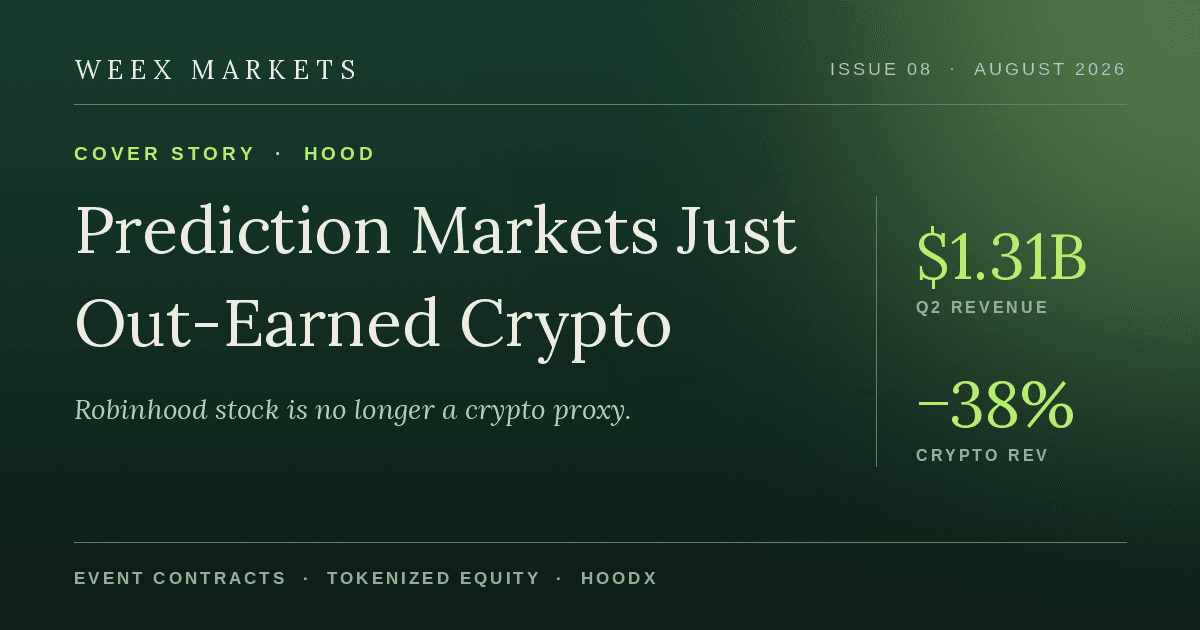
The reason is concentrated in one line item. Crypto transaction revenue came in at $100 million, down 38% from $160 million a year earlier — and that decline happened on roughly $40 billion of crypto trading volume. Volume held up; the revenue per unit of volume did not. That is a margin story, not a demand story, and margin stories are harder to fix.
Where Robinhood's Q2 2026 revenue actually came from
| Revenue line | Q2 2026 | Note |
|---|---|---|
| Options | $342M | Largest transaction line |
| Event contracts | $156M | Record; 13.6B contracts traded |
| Equities | $129M | |
| Crypto | $100M | Down 38% year over year |
| Total transaction revenue | $776M | Up 44% year over year |
| Total net revenue | $1.31B | Company record |
Source: Robinhood Q2 2026 results, reported July 29, 2026.
The ordering matters more than the totals. Options are now more than three times crypto. Event contracts — real-world outcome markets — passed crypto for the first time in company history. Crypto has slipped to fourth place in a business where it was once the swing factor that decided whether a quarter was good or bad.
Is Robinhood stock still a crypto proxy?
Increasingly, no — and traders positioning HOOD as a Coinbase substitute or a leveraged Bitcoin expression should stop.
The correlation logic that made Robinhood stock a crypto proxy in 2024 and 2025 rested on crypto being a large, high-take-rate slice of transaction revenue. At $100 million out of $776 million, crypto is now roughly 13% of transaction revenue. A 50% swing in crypto revenue moves total transaction revenue by about six percentage points. The same swing in options would move it by more than twenty.
The better reading is that Robinhood is converting from a cyclical crypto-and-meme-stock brokerage into a diversified retail derivatives platform, and the market has not settled on what multiple that deserves. Some of the selling pressure since the 52-week high is the crypto-beta crowd leaving. Some of the buying is a different crowd arriving. That handoff is messy, and messy handoffs produce wide ranges.
What Robinhood Chain and Stock Tokens changed for HOOD
Robinhood launched the public mainnet of Robinhood Chain — an Ethereum layer-2 — on July 1, 2026, one day after the quarter closed, and rolled out Stock Tokens to users in more than 120 countries. CoinDesk reported on July 25, 2026 that real-world assets on the chain had jumped roughly fivefold as tokenized stocks began trading in meaningful size.
Two cautions belong next to that headline. First, none of it is in the Q2 numbers — the chain launched after the quarter ended, so it cannot explain the print and cannot rescue it. Second, early Robinhood Chain volume came mostly from memecoins, which is the same activity mix that produced the take-rate compression in the crypto line. Infrastructure that mostly attracts memecoin flow does not obviously fix a memecoin-driven revenue problem.
If Stock Tokens work, the payoff is a distribution business — order flow from 120+ countries that Robinhood previously could not touch. That is a 2027 question, not a 2026 one.
Why HOOD analyst targets range from $52 to $160
Sell-side compilations in early August 2026 put the average 12-month target on Robinhood stock somewhere in the $117–$122 range across roughly 20–26 covering analysts, with a low of $52 and a high of $160. A three-times spread between the bear and bull case is unusual for a $78 billion company.
The spread traces to a single disagreement: how to value the prediction-markets business. Robinhood and Susquehanna International Group completed the purchase of 90% of MIAX Derivatives Exchange (MIAXdx) on January 21, 2026, and are operating it as a CFTC-licensed designated contract market and clearinghouse. Previously, when Robinhood routed event contracts to Kalshi, Kalshi kept the exchange revenue. Owning the venue lets Robinhood capture execution and clearing economics on the same contract.
Bulls capitalize that as a structurally higher-margin annuity. Bears note the stock still trades near 48x trailing earnings and that event-contract volumes are unproven across a full cycle — 13.6 billion contracts in a quarter that included the start of a World Cup is not obviously a run-rate.
Three ways to trade Robinhood stock exposure
Most articles on Robinhood stock stop at the brokerage account. Crypto-native traders have two other routes, and the differences are not cosmetic.
| Route | What you hold | Trading hours | Main trade-off |
|---|---|---|---|
| HOOD shares via a broker | Actual Class A shares, voting rights, dividends if declared | U.S. market hours | Requires a brokerage account and local eligibility |
| HOODX tokenized stock | A token backed 1:1 by custodied shares — economic exposure, no shareholder rights | Roughly 24/5 | Thin secondary liquidity; premium/discount to the underlying |
| USDT-margined stock contracts | A derivative position on the price, no ownership at all | Extended | Leverage and funding costs; liquidation risk |
The tokenized route is worth a hard look at the numbers rather than the pitch. On the Robinhood tokenized stock (HOODX) page on WEEX, HOODX was quoted at $87.79 as of 00:35 UTC on August 3, 2026, against HOOD's $86.30 close the prior session — a premium of roughly 1.7%.
| HOODX metric (WEEX) | Value as of Aug 3, 2026 |
|---|---|
| Price | $87.79 |
| 24h trading volume | $1.21M |
| Market cap | $7.11M |
| Fully diluted market cap | $168.21M |
| Total supply | 1.92M HOODX |
| All-time high | $151.15 (Oct 8, 2025) |
| 30-day change | +29.49% |
Source: WEEX HOODX token page, last updated 2026-08-03 00:35 UTC.
That $1.21 million of daily volume is the number to sit with. Robinhood's own shares turn over hundreds of millions of dollars a day. The tokenized wrapper is a rounding error against the underlying, which is exactly why it can carry a 1.7% premium and why a size order will move it. If you want to understand why that gap exists structurally — market makers cannot cleanly hedge on-chain tokens against a closed stock exchange — the mechanics are laid out in how tokenized US stocks are issued and custodied.
The third route is USDT-margined contracts on traditional-market prices. WEEX TradFi is built around that model — stocks, indices, forex and commodities margined in USDT from an existing account, with leverage on stock products listed at up to 50x in WEEX's product materials. Costs are trading fees plus periodic funding fees, and product availability differs by region. It is a price-exposure tool, not an ownership tool, and the TradFi label should be read literally: you are trading a traditional-market price inside a crypto account, not becoming a Robinhood shareholder.
What HOOD traders usually miss
Two things, repeatedly.
The first is treating the tokenized version as interchangeable with the stock. HOODX gives economic exposure through a custodied 1:1 backing, but no voting rights and no direct claim on the issuer's balance sheet — you are also taking issuer and custodian risk on top of Robinhood's own equity risk. The premium is the market charging you for convenience and thin float.
The second is anchoring on the 52-week high. HOOD ran to $153.86 during a period when crypto and event-contract revenue were both accelerating and the market was pricing the two together. Crypto has since decelerated hard. Getting back to that level is not a recovery trade — it requires the prediction-markets business to independently justify a valuation that two different businesses used to share.
The bottom line on Robinhood stock
Robinhood stock is no longer priced on crypto, and pretending otherwise is the most expensive mistake available on this name right now. The Q2 2026 print — $1.31 billion in record revenue, crypto down 38% to $100 million, event contracts up to $156 million — describes a company where the growth engine has been swapped mid-flight. Owning Rothera, the Robinhood–Susquehanna exchange built from MIAXdx, is the reason bulls can defend a $160 target; a 48x trailing multiple on unproven event-contract durability is the reason bears can defend $52.
For traders who want exposure without a U.S. brokerage account, HOODX and USDT-margined stock contracts on WEEX are workable routes — provided you size for the liquidity you can actually see rather than the liquidity the underlying stock has. Check the live HOODX quote and volume before you assume you can get out at the price you got in.
FAQ
1. Why did Robinhood stock fall after beating Q2 2026 earnings?
Because crypto transaction revenue fell 38% year over year to $100 million despite roughly $40 billion in crypto volume. The market read that as take-rate compression rather than a temporary volume dip, and sold the print even though total revenue hit a record $1.31 billion.
2. Is Robinhood stock still a good way to get crypto exposure?
It is a weakening one. Crypto was about 13% of Robinhood's $776 million in Q2 2026 transaction revenue, behind options and event contracts. HOOD now trades more on prediction-markets economics than on crypto volumes.
3. What is HOODX and how is it different from HOOD?
HOODX is a tokenized stock backed 1:1 by custodied Robinhood Class A shares. It tracks the price and can trade roughly 24/5, but it carries no voting rights, adds issuer and custodian risk, and traded at about a 1.7% premium to HOOD on August 3, 2026 with only $1.21 million of 24-hour volume.
4. What is Rothera and why does it matter for HOOD?
Rothera is the CFTC-licensed exchange and clearinghouse operated as a Robinhood–Susquehanna joint venture, assembled from the MIAXdx acquisition completed on January 21, 2026. It lets Robinhood keep exchange and clearing revenue on event contracts that previously went to Kalshi, which is the core of the bull case.
5. Can I trade Robinhood stock exposure without a brokerage account?
Yes, through tokenized stocks like HOODX or USDT-margined stock contracts. Neither gives you share ownership, both carry different risks than holding equity, and availability depends on your region.
Risk Warning
Robinhood stock and any tokenized or derivative product referencing it are volatile and can result in partial or total loss of capital. HOODX and similar tokenized equities carry risks that holding the underlying share does not: thin secondary liquidity (roughly $1.21 million of 24-hour volume as of August 3, 2026), persistent premiums or discounts to the reference price, issuer and custodian counterparty risk, no shareholder or voting rights, and no guarantee that redemption will be available when markets are stressed. USDT-margined stock contracts add leverage and liquidation risk — adverse moves can wipe out margin faster than in the underlying equity — plus recurring funding costs on held positions. Regulatory treatment of tokenized equities differs sharply by jurisdiction and continues to change; product availability, trading hours, and fees may be restricted or withdrawn in your region. Company-specific risk is real too: Robinhood's earnings are concentrated in transaction revenue that falls when volatility falls, and the prediction-markets business driving its current valuation has not yet been tested across a full market cycle. Verify current prices, fees, and eligibility before trading, and size positions to the liquidity you can actually observe.
This content is provided for general informational purposes only and doesn't constitute financial, investment, legal, or tax advice. Any events, rewards, online promotions, or related information mentioned herein should not be considered a recommendation, solicitation, or invitation to purchase, sell, trade, or otherwise deal in any crypto assets. Crypto assets are highly volatile and may result in loss. The availability of WEEX services, products, and related events may vary by region. You are responsible for ensuring that your participation is in accordance with applicable local laws and regulations.
You may also like

How Yen Strength and Weakness Move Bitcoin: The FX–Crypto Relationship Explained

Samsung Stock Price Prediction 2026-2027: Can Samsung Reach $250 After the July Selloff?

Is Samsung Stock a Buy After Falling 30% From Its All Time High? What the July Selloff Left Behind
Samsung Stock and the 99.7% Problem: When One Business Unit Drives Everything

KOSPI Price Prediction 2026-2027: Can the Index Recover to 7,000 After Its Worst Month Since 2008?
WEEX Exchange: Complete Introduction for Taiwan Users (2026)

GPU Token on BNB Chain: The Memecoin Priced in Tokenized NVIDIA
Is WEEX a Scam? Safety, Regulation and Withdrawals Explained (2026)
How to Identify Fake WEEX Websites and Customer Service Impersonators

Samsung and SK Hynix Are Half the KOSPI: Why That Concentration Is Now the Market's Biggest Problem
KOSPI Falls 5% as Samsung and SK Hynix Each Drop 9%: What Is Happening to South Korea's Stock Market?

SK Hynix Stock Is Down 35% in July: Is the Worst Finally Over?

South Korea Apologizes for SK Hynix Leveraged ETFs: What It Means for SKHA SKHN Holders

SK Hynix Stock Price Targets Range From $152 to $355: What the Widest Analyst Gap in the Sector Reveals
SK Hynix Stock Has 70% Upside According to UBS: Should You Listen After the July Selloff?
Top Forex Brokers Ranked in 2026: What the Rankings Actually Measure and What They Miss
What Is Broker Trading? A Beginner's Guide to Trading Through a Broker
KOSPI Stock Boom vs Crypto: Korea's 2026 Liquidity Loop

GRVT Token Explained: The 11% Float Behind a $242M Valuation
Crypto Exchange API Key Leaked? What Attackers Can Actually Do

Microsoft Stock Price Prediction 2026-2027: Can MSFT Reach $600 After the Azure Beat?
Microsoft Stock Jumps After Azure Grows 43%: What the Biggest Cloud Beat in Years Actually Means
Apple Stock Price Prediction 2026-2027: Can AAPL Recover to $380 After the Earnings Drop?
AAPL Stock at $5 Trillion Market Cap Falls 6%: Is Now the Time to Buy or Wait?
AAPL Stock Falls 6% After Beating Estimates: What the Disconnect Between Results and Reaction Means
Should You Buy XST Coin at $0.007? What XSolut's AI and RWA Narrative Actually Means
XST Coin Price Prediction 2026-2027: Can XSolut Reach $0.05 After the AI Infrastructure Narrative?
Amazon Stock Price Prediction 2026-2030: Can AMZN Reach $600 After the AWS Acceleration?
Cathie Wood Sold AMZN Stock and Bought SPCX Today: What ARK's Reshuffling Actually Signals
AMZN Stock Soars 10% After Q2 Earnings: What the AWS 37% Growth and $220 Billion Capex Mean for Amazon
How Yen Strength and Weakness Move Bitcoin: The FX–Crypto Relationship Explained
Samsung Stock Price Prediction 2026-2027: Can Samsung Reach $250 After the July Selloff?
Is Samsung Stock a Buy After Falling 30% From Its All Time High? What the July Selloff Left Behind
Samsung Stock and the 99.7% Problem: When One Business Unit Drives Everything
KOSPI Price Prediction 2026-2027: Can the Index Recover to 7,000 After Its Worst Month Since 2008?
WEEX Exchange: Complete Introduction for Taiwan Users (2026)


