
GPU Token on BNB Chain: The Memecoin Priced in Tokenized NVIDIA

 Prefer us on Google

GPU (trading as GPUBSC on WEEX) is a BNB Chain memecoin built on the NVIDIA and AI-compute narrative. It owns no hardware, rents no compute and generates no revenue. What makes it worth a closer look is not the meme — it is the plumbing: almost all of GPU's on-chain liquidity is quoted against NVDAb, a tokenized NVIDIA share, rather than against USDT or BNB. That single design choice changes how the token prices, how it gaps, and where a careless buyer loses money.
This piece covers what GPU actually is, why its quote asset is unusual, how to tell it apart from the half-dozen other tokens trading under the "GPU" ticker, and what the on-chain liquidity picture looked like on August 3, 2026.
What Is the GPU Token (GPUBSC) on BNB Chain?
GPU is a BEP-20 memecoin at contract 0x9DbeF6496134C151b9F9855cc5a1Ee77f0324444, tied to the NVIDIA, AI chip and data-center narrative. Its supply is 1,000,000,000 tokens, fully circulating — market cap and fully diluted valuation are the same number, so there is no unlock schedule hanging over it. That is genuinely unusual for a new listing and it is the one structural point in GPU's favour.
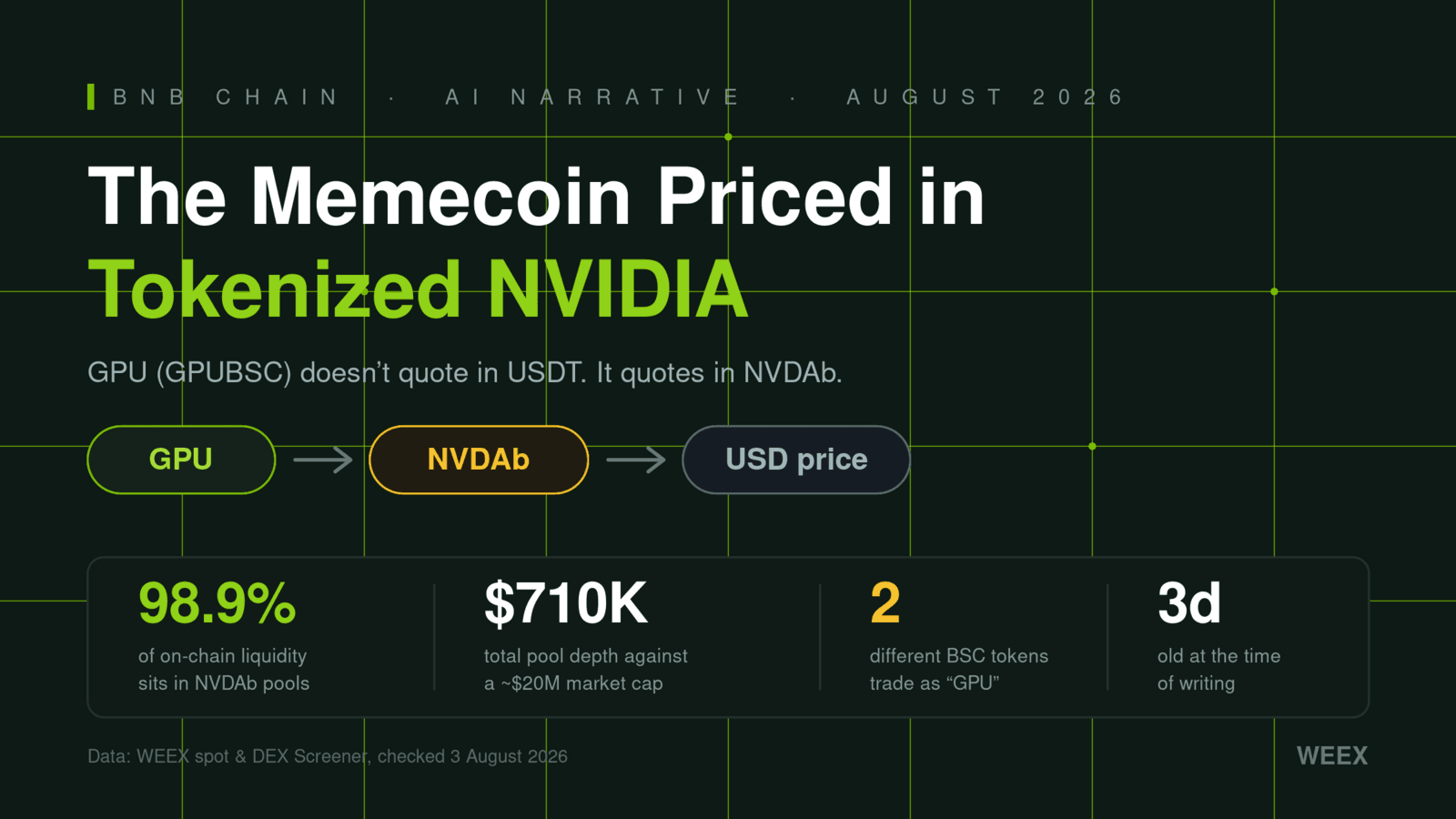
It is also very new. The main PancakeSwap v2 pool was created on July 31, 2026 at 15:38 UTC, and the USDT-quoted pools only appeared on August 2. As of this writing the token is roughly three days old.
| GPU (GPUBSC) key facts | Snapshot, August 3, 2026 |
|---|---|
| Chain | BNB Chain (BEP-20) |
| Contract | 0x9DbeF6496134C151b9F9855cc5a1Ee77f0324444 |
| Price on WEEX spot | $0.024863 (06:31 UTC) |
| Price on PancakeSwap | $0.0199–0.0200 (06:32 UTC) |
| Circulating supply | 1.000B of 1.000B max (100%) |
| Market cap / FDV | ~$20.0M on-chain; $24.86M as shown on WEEX |
| Total on-chain liquidity | ~$710,000 |
| 24h on-chain volume | ~$4.60M |
| Main quote asset | NVDAb (tokenized NVIDIA share) |
| Oldest pool | July 31, 2026 |
| Website | None listed; X account @GPUonBSC |
Sources: WEEX GPUBSC/USDT spot page and DEX Screener, both checked August 3, 2026.
Two things in that table deserve attention. The first is the price line: at effectively the same minute, the exchange quote and the DEX quote were about 24% apart. The second is the liquidity-to-market-cap ratio — roughly $710,000 of pooled depth supporting a $20 million valuation, or about 3.5%. Both are consequences of how thin and how young this market is.
Why GPU Is Priced in NVDAb, Not USDT
Most BNB Chain memecoins pair against BNB, WBNB or USDT. GPU pairs against NVDAb — a tokenized NVIDIA stock issued by BTech Holdings under the bStocks brand, backed 1:1 by NVDA shares held with a US-regulated broker-dealer. NVDAb traded around $193.60–194.67 on August 3, 2026, with a market cap near $7.35 million.
The concentration is not marginal. It is nearly total.
| GPU pool | Venue | Liquidity (USD) | 24h volume | Share of liquidity |
|---|---|---|---|---|
| GPU / NVDAb (v2) | PancakeSwap | $454,469 | $3.43M | 64.0% |
| GPU / NVDAb (v3) | PancakeSwap | $248,443 | $1.15M | 35.0% |
| GPU / USDT (v3) | PancakeSwap | $3,518 | $18,972 | 0.5% |
| GPU / USDT | Uniswap (BSC) | $4,031 | $2,161 | 0.6% |
DEX Screener data, August 3, 2026. NVDAb-quoted pools hold 98.9% of total on-chain liquidity.
So GPU's dollar price is not quoted directly — it is derived. The chain prices GPU in NVDAb, and NVDAb is separately priced in USDT. Anyone reading a USD figure for GPU is reading the product of two markets, one of which tracks a US equity that stops trading at the closing bell while the token pool never does.
That creates a mechanic worth understanding before you size a position. NVDA gaps on earnings, guidance and macro news while the equity market is shut. NVDAb, and therefore every pool quoted in it, has to absorb that gap the moment liquidity reprices — which on a Sunday night means it happens against whoever is holding the other side. Tokenized equities are designed to give round-the-clock exposure to a nine-to-five asset; if you want the mechanics of that in plain terms, WEEX's explainer on Meta Platforms tokenized stock covers the same 1:1 minting-and-redemption model NVDAb uses.
The practical takeaway: GPU is a leveraged bet on a narrative, quoted in an asset that carries its own separate risk. Two sources of volatility, one price.
Two Different Tokens Trade as "GPU" on BSC
This is the part that costs people money, and almost nothing on the first page of search results mentions it.
At least two BEP-20 tokens use the symbol GPU and both are quoted against NVDAb on PancakeSwap. The one WEEX lists is 0x9DbeF...0324444, named simply "GPU." A separate token named "GPU Coin," also ticker GPU, sits at 0xf2E5aF875a262b50eD7724F3da903689239F7777. On August 3, 2026 they moved +145% and +454% respectively over 24 hours. Same ticker, same chain, same quote asset, wildly different outcomes.
Widen the lens and the pattern is clearer: NVDAb has become a de facto quote currency for an entire cluster of NVIDIA-themed BNB Chain memecoins launched in the last week of July 2026.
| NVDAb-quoted token | Symbol | 24h change vs NVDAb |
|---|---|---|
| GPU Coin | GPU | +454% |
| Rubinstein Agent | RAgent | +430% |
| GPU (the WEEX-listed one) | GPU | +145% |
| NVDA | 女大 | +144% |
| CHIPS | CHIPS | +87% |
| Artificial Inu | AI | +32% |
| Just a jacket | Jacket | −93% |
PancakeSwap v2 pairs, DEX Screener, August 3, 2026. NVDAb itself moved +0.46% over the same window, so these figures approximate dollar moves.
A dispersion range of +454% to −93% inside one 24-hour window, across tokens that share a theme and a quote asset, tells you what this cluster is: a fast rotation, not a sector. Beyond the ticker collision, the broader "GPU" name is also taken by GPUnet on Ethereum, GPU.net on Base and Node AI — all unrelated projects. Paste the contract address into a block explorer and match it character for character before you buy anything; WEEX's guide to reading BscScan walks through the check.
GPU Is a Memecoin, Not an AI Compute Token
Search "GPU crypto" and the results blend three categories that behave nothing alike. Separating them is the most useful thing a reader can take from this page.
| Category | Example | What backs it | What you own |
|---|---|---|---|
| Narrative memecoin | GPU (GPUBSC) | Attention and liquidity | A meme with no cash flow |
| AI-infrastructure credit | USD.AI (CHIP) | Loans against physical GPUs | Governance over a lending market |
| Tokenized equity | NVDAb | NVDA shares in custody | 1:1 claim on a real share |
The distinction is not academic. NVIDIA's own business is doing what the narrative claims — data-center revenue hit a record $62.3 billion in fiscal Q4 2026, up 75% year over year. Tokens with a real link to that economy exist: USD.AI's CHIP token governs a protocol that has lent against B300 GPUs as collateral. GPU has no such link. It borrows the story, and that is the whole product. There is nothing dishonest about that as long as you price it correctly — memecoins are momentum instruments, and treating one as AI infrastructure exposure is the error.
How to Buy GPU (GPUBSC) on WEEX
The listed pair is GPUBSC/USDT on spot, which sidesteps the NVDAb routing entirely — you quote and settle in USDT rather than through a tokenized equity.
- Sign in to WEEX and complete identity verification.
- Fund the account with USDT, by card, bank transfer or on-chain deposit.
- Open the GPUBSC/USDT spot pair on WEEX.
- Use a limit order rather than a market order. On a token this thin, a market order is how you discover the spread the hard way.
- Set your exit before you enter. Decide the level at which you are wrong and the level at which you take profit, and place both.
If you would rather trade on-chain, note that the USDT-quoted DEX pools held under $8,000 of combined depth on August 3, 2026. Routing a meaningful order through them means going via NVDAb whether you intended to or not.
Where GPU Traders Actually Get Hurt
Four specific traps, in the order people fall into them.
The wrong contract. Covered above, and it is the fastest way to lose everything. Two GPU tickers, one chain.
Depth, not price. About $710,000 of pooled liquidity against a $20 million market cap means a sell order in the tens of thousands moves the print. The token being up 145% in a day is not evidence you can exit at the quoted price.
Venue divergence. WEEX showed $0.024863 while PancakeSwap showed $0.0200 within the same two-minute window. Do not treat that as free money. On a three-day-old BEP-20 token, the gap is usually consumed by withdrawal time, network fees, slippage on the DEX leg and the risk that the spread closes against you mid-transfer. Read it as a warning about price reliability, not an opportunity.
The quote asset's own calendar. GPU's pools are denominated in a tokenized US equity. NVDA's earnings dates, guidance and after-hours moves reach this memecoin through the pool, and they do it when the equity market is closed and on-chain liquidity is thinnest.
The Bottom Line on GPU (GPUBSC)
GPU is a clean example of a 2026 pattern: tokenized equities becoming the quote currency for on-chain meme markets. That is a real structural development and it makes GPU more interesting than the average dog-themed launch. It does not make GPU a claim on NVIDIA, on AI compute, or on anything except the liquidity of a pool that is three days old.
If you trade it, trade it as what it is — a momentum position with a fully circulating supply, thin depth, a duplicated ticker and a quote asset that answers to Wall Street's calendar. Size it accordingly, verify the contract, and keep the GPUBSC/USDT pair on WEEX as the reference quote rather than a screenshot from a DEX aggregator.
FAQ
1. What is the GPU token on BNB Chain?
GPU is a BEP-20 memecoin at contract 0x9DbeF6496134C151b9F9855cc5a1Ee77f0324444, built on the NVIDIA and AI-compute narrative. It has 1 billion tokens, all circulating, and no product, revenue or hardware behind it. It trades on WEEX as GPUBSC/USDT.
2. Is GPU the same as NVIDIA's stock or an official NVIDIA token?
No. NVIDIA has not issued a cryptocurrency. GPU is an unaffiliated memecoin that references the brand. Regulated on-chain exposure to NVIDIA shares comes from tokenized equities such as NVDAb, which is a different asset with a different issuer and a 1:1 backing model.
3. Why is GPU paired with NVDAb instead of USDT?
Its deepest pools were built that way. On August 3, 2026, 98.9% of GPU's on-chain liquidity sat in NVDAb-quoted PancakeSwap pools, with under $8,000 combined in USDT pools. It means GPU's dollar price is derived through NVDAb rather than quoted directly.
4. How do I make sure I am buying the right GPU token?
Match the contract address character for character on BscScan. At least two BSC tokens use the GPU ticker, and unrelated projects called GPUnet, GPU.net and Node AI also trade as GPU on other chains. The ticker alone is not identification.
5. Does GPU give exposure to the AI compute market?
Only narratively. GPU does not own GPUs, operate data centers or finance hardware. Protocols like USD.AI lend against physical GPU collateral; GPU does not. Its price tracks attention flow, not compute demand.
6. What is GPU's supply and are there unlocks coming?
Supply is 1,000,000,000 tokens with 100% circulating as of August 3, 2026, so market cap and fully diluted valuation match and there is no vesting overhang. Thin liquidity, not future supply, is the dominant risk here.
Risk Warning
Crypto assets are highly volatile and you can lose part or all of the money you put in. GPU (GPUBSC) carries risks well above those of an established token: it is a memecoin with no revenue, product or team accountability; it was days old at the time of writing; its on-chain depth of roughly $710,000 against a $20 million market cap means exits can be far worse than the quoted price; at least two BSC tokens share the GPU ticker, creating a real risk of buying the wrong contract; and because its main pools are quoted in NVDAb, a tokenized NVIDIA share, GPU also inherits equity-market gap risk and the issuer, custody and redemption-eligibility risks attached to that tokenized stock. Prices, liquidity figures and pool data cited here were checked on August 3, 2026 and change continuously. Verify the contract address on a block explorer before trading, never commit funds you cannot afford to lose, and confirm that trading these products is permitted where you live.
This content is provided for general informational purposes only and doesn't constitute financial, investment, legal, or tax advice. Any events, rewards, online promotions, or related information mentioned herein should not be considered a recommendation, solicitation, or invitation to purchase, sell, trade, or otherwise deal in any crypto assets. Crypto assets are highly volatile and may result in loss. The availability of WEEX services, products, and related events may vary by region. You are responsible for ensuring that your participation is in accordance with applicable local laws and regulations.
You may also like
How Yen Strength and Weakness Move Bitcoin: The FX–Crypto Relationship Explained
Samsung Stock Price Prediction 2026-2027: Can Samsung Reach $250 After the July Selloff?

Is Samsung Stock a Buy After Falling 30% From Its All Time High? What the July Selloff Left Behind
Samsung Stock and the 99.7% Problem: When One Business Unit Drives Everything
KOSPI Price Prediction 2026-2027: Can the Index Recover to 7,000 After Its Worst Month Since 2008?
WEEX Exchange: Complete Introduction for Taiwan Users (2026)
Is WEEX a Scam? Safety, Regulation and Withdrawals Explained (2026)
How to Identify Fake WEEX Websites and Customer Service Impersonators
Samsung and SK Hynix Are Half the KOSPI: Why That Concentration Is Now the Market's Biggest Problem
KOSPI Falls 5% as Samsung and SK Hynix Each Drop 9%: What Is Happening to South Korea's Stock Market?

SK Hynix Stock Is Down 35% in July: Is the Worst Finally Over?
South Korea Apologizes for SK Hynix Leveraged ETFs: What It Means for SKHA SKHN Holders

SK Hynix Stock Price Targets Range From $152 to $355: What the Widest Analyst Gap in the Sector Reveals
SK Hynix Stock Has 70% Upside According to UBS: Should You Listen After the July Selloff?
Top Forex Brokers Ranked in 2026: What the Rankings Actually Measure and What They Miss
What Is Broker Trading? A Beginner's Guide to Trading Through a Broker
KOSPI Stock Boom vs Crypto: Korea's 2026 Liquidity Loop

Robinhood Stock (HOOD): Prediction Markets Just Out-Earned Crypto
GRVT Token Explained: The 11% Float Behind a $242M Valuation
Crypto Exchange API Key Leaked? What Attackers Can Actually Do
Microsoft Stock Price Prediction 2026-2027: Can MSFT Reach $600 After the Azure Beat?
Microsoft Stock Jumps After Azure Grows 43%: What the Biggest Cloud Beat in Years Actually Means
Apple Stock Price Prediction 2026-2027: Can AAPL Recover to $380 After the Earnings Drop?
AAPL Stock at $5 Trillion Market Cap Falls 6%: Is Now the Time to Buy or Wait?
AAPL Stock Falls 6% After Beating Estimates: What the Disconnect Between Results and Reaction Means
Should You Buy XST Coin at $0.007? What XSolut's AI and RWA Narrative Actually Means
XST Coin Price Prediction 2026-2027: Can XSolut Reach $0.05 After the AI Infrastructure Narrative?
Amazon Stock Price Prediction 2026-2030: Can AMZN Reach $600 After the AWS Acceleration?
Cathie Wood Sold AMZN Stock and Bought SPCX Today: What ARK's Reshuffling Actually Signals
AMZN Stock Soars 10% After Q2 Earnings: What the AWS 37% Growth and $220 Billion Capex Mean for Amazon
How Yen Strength and Weakness Move Bitcoin: The FX–Crypto Relationship Explained
Samsung Stock Price Prediction 2026-2027: Can Samsung Reach $250 After the July Selloff?
Is Samsung Stock a Buy After Falling 30% From Its All Time High? What the July Selloff Left Behind
Samsung Stock and the 99.7% Problem: When One Business Unit Drives Everything
KOSPI Price Prediction 2026-2027: Can the Index Recover to 7,000 After Its Worst Month Since 2008?
WEEX Exchange: Complete Introduction for Taiwan Users (2026)


