
Nebius Stock After a 34% Pop: What the Capex Math Says

 Prefer us on Google

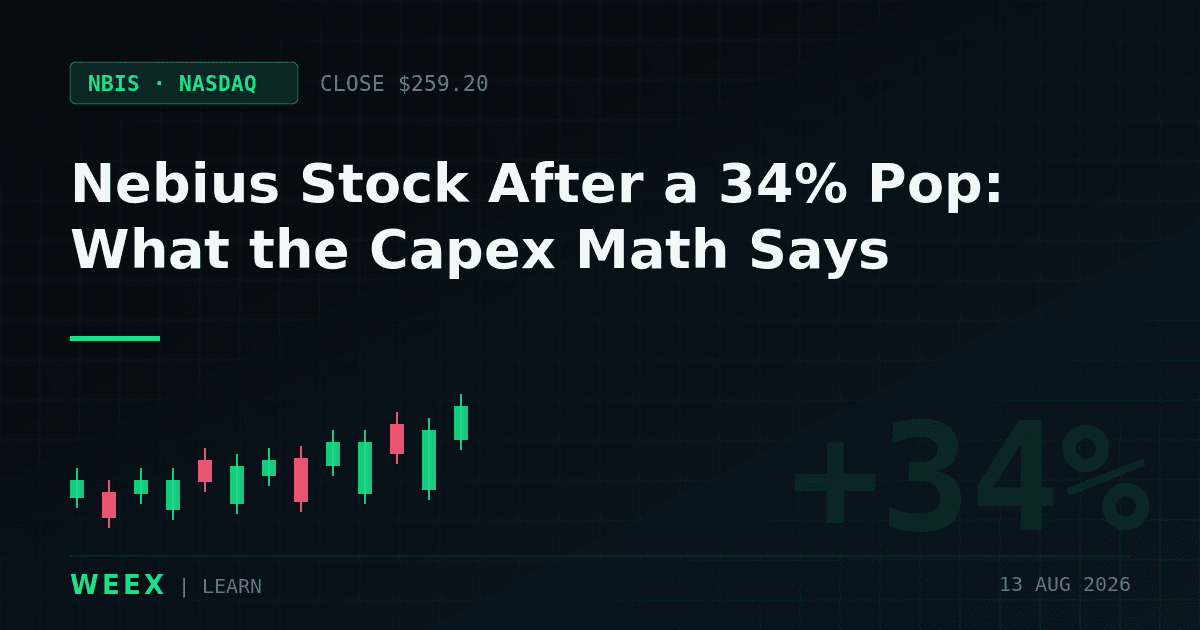
Nebius stock closed at $259.20 on 12 August 2026, up 34.14% in a single session after the AI cloud company reported second-quarter revenue of $582.3 million — a 454% jump from a year earlier. It was one of the largest one-day moves in the neocloud group this year, and it left the stock in an unusual position: above the average price target of the 18 analysts who cover it.
That detail matters more than the headline beat. A 34% gap does not just reprice a company; it repositions every open trade around it, and it pulls the crypto-side wrappers — the tokenized NBISon share and the NBIS perpetual — into a very different risk profile than they had the day before. This piece covers what the quarter actually showed, why the capex line is the thing to watch next, and how the 24/7 markets in Nebius stock behaved across the gap.
Why Nebius stock jumped 34% after Q2 earnings
The beat was broad. Revenue of $582.3 million came in ahead of the $572.75 million consensus, and the adjusted loss of $0.12 per share was a fraction of the $0.62 loss the Street had modeled. Adjusted EBITDA margin landed at 41%.
The number management leaned on hardest was annualized run-rate revenue: $3 billion at the end of June, up 56% from $1.9 billion at the end of March. Three months of 56% sequential growth in run-rate is what convinces a market that a backlog is real rather than aspirational. Nebius also raised its contracted power target to 5 GW by year-end 2026 and told analysts on the call that its 2027 capacity could effectively be sold out today.
| Metric (Q2 2026, reported 12 Aug 2026) | Result | Context |
|---|---|---|
| Revenue | $582.3M | +454% YoY; beat $572.75M consensus |
| AI cloud revenue | $574.9M | +514% YoY; ~98% of group revenue |
| Annualized run-rate revenue | $3.0B | Up from $1.9B at end-March |
| Adjusted EBITDA margin | 41% | — |
| Adjusted EPS | –$0.12 | Consensus was –$0.62 |
| GAAP net loss, continuing ops | –$190.4M | Widened; expenses ~$758M |
| Q2 capital expenditure | ~$5.66B | H1 capex above $8.1B |
Read those last two rows next to the first one. Revenue quintupled and the GAAP loss got wider, because depreciation, energy, and go-to-market spending are all landing ahead of the capacity that will pay for them. That is not a scandal — it is the shape of an infrastructure build — but it is the reason the stock trades on a forward story rather than on earnings.
There was also a mechanical contributor. Michael Burry disclosed a short position in Nebius stock ahead of the print, arguing that AI infrastructure companies may be flattering profits by depreciating GPUs too slowly. A crowded short into a large beat produces forced covering, and some portion of Wednesday's 34% was that rather than a fundamental re-rating. The after-hours print of $254.45, down 1.83% from the close, is a small hint that not all of the move stuck.
Nebius stock has already passed the analyst price target
Here is the awkward arithmetic. The consensus 12-month price target across 18 analysts sits at $261.44. The stock closed at $259.20. That is 0.86% of implied upside — from a rating pool that still reads "Buy."
Targets get revised after a quarter like this, and several will move higher. But the state of the board as of 13 August 2026 is that the sell side's published year-ahead view was consumed in one afternoon. Anyone buying Nebius stock at these levels is not buying into a gap between price and consensus; they are betting the consensus itself is about to be marked up.
| Level (as of 13 Aug 2026) | Value |
|---|---|
| Last close | $259.20 |
| After-hours | $254.45 |
| Consensus 12-month target | $261.44 (18 analysts) |
| 52-week range | $62.01 – $299.86 |
| Market capitalization | $66.37B |
| Trailing twelve-month revenue | $1.36B |
| Beta | 1.43 |
The trailing revenue line explains the valuation debate in one glance: a $66 billion market cap against $1.36 billion of trailing revenue, roughly 88x sales on the numbers circulating after the print. Multiples like that are not inherently wrong for a company growing 454%, but they leave no margin for a missed quarter.
The $25 billion capex bet behind NBIS stock
Nebius has guided to $20–25 billion of capital expenditure for 2026 against roughly $8 billion of cash on the balance sheet. Q2 alone consumed about $5.66 billion. During the quarter the company took its first senior secured debt facility, around $775 million, and moved from a net cash position to net debt.
That combination — enormous fixed spending, a cash pile smaller than one year of it, and a freshly opened debt channel — means the funding question is now permanent rather than occasional. Nebius will be issuing debt, arranging equipment financing, or selling equity on a recurring basis to keep the build on schedule. Each route carries a cost: high-yield spreads, vendor financing terms, or dilution.
Management has also said 2026 capacity additions are back-end weighted, which puts the monetization timeline at the mercy of three things Nebius does not fully control — data center completions, power grid interconnections, and Nvidia delivery schedules. Nvidia is a shareholder after investing about $2 billion in March 2026, which helps on allocation but does not remove the physical constraint.
The more useful framing for the next two quarters: revenue growth is no longer the variable in question. Conversion is. Watch whether contracted power actually energizes on the announced timeline, and whether the run-rate keeps compounding once the easy backlog conversion is done. If capacity slips a quarter while depreciation and energy costs accrue on schedule, the same margin profile that looked strong in Q2 inverts quickly.
Can you trade Nebius stock 24/7? NBISon and NBIS perps explained
Nasdaq closes at 4:00 p.m. Eastern. The story around Nebius did not. That mismatch is why crypto-native routes to NBIS exposure exist, and it is also where most of the practical risk sits.
There are three distinct instruments, and they are not interchangeable:
| Route | What you own | Hours | Leverage | Practical constraint |
|---|---|---|---|---|
| NBIS shares on Nasdaq | Actual equity, voting rights | 9:30–16:00 ET, weekdays | Margin only | Needs a brokerage with US market access |
| NBISON/USDT spot on WEEX | Ondo-issued tokenized share (ERC-20) | 24/7 | None | Very small float — see below |
| NBIS/USDT perpetuals on WEEX | A derivative on the price, no share | 24/7 | Up to 100× | Funding costs, liquidation risk |
The tokenized route is the one people misunderstand. NBISon is issued by Ondo as an ERC-20 token on Ethereum (contract 0xE4babaa960bA7D37860f3fe00D7b95D3868e8EDc), giving holders economic exposure similar to holding NBIS, with dividends reinvested. As of 13 August 2026, the WEEX NBISON page showed a total and circulating supply of 26,200 tokens and a market capitalization of roughly $6.66 million.
Set that against the $66.37 billion equity. The tokenized wrapper represents about one ten-thousandth of the underlying company's market value. That is the single most important number for anyone planning to size a position in it, and it does not appear on any of the mainstream Nebius stock pages.
Where NBIS traders actually get hurt: gaps, funding, thin float
Three failure modes, in the order people encounter them.
The overnight gap. Nebius stock opened at $226.00 on 12 August against a prior close of $193.23. Anyone holding a leveraged NBIS perp position through the print was marked against a 17% opening move before they could react. Perpetual markets trade through that window, so the gap does not wait for you — it prices in, often violently, in thin overnight liquidity. Reduce leverage into scheduled events, or size the position so a two-standard-deviation gap does not liquidate it.
Funding drift. Perpetuals hold their peg to the underlying through a periodic funding payment between longs and shorts. In a market where everyone wants the same direction after an earnings beat, funding turns expensive for the crowded side. A directionally correct trade held for weeks can still lose money to funding. Check the rate before you assume a swing trade is cheap to carry.
Float and slippage. A $6.66 million tokenized float is not a market you can exit in size during stress. It is fine for small, sized exposure; it is not fine as a substitute for a brokerage position if you expect to move meaningful capital. The same thinness means the token's quote can drift from the Nasdaq print rather than tracking it tick-for-tick.
That last point showed up in the data. When checked on 13 August 2026, the WEEX NBISON quote sat at $254.33 — close to the $254.45 after-hours print rather than the $259.20 official 4:00 p.m. close. That is the tokenized market doing its job, pricing continuously, but it is a reminder that "the price of Nebius stock" is not one number once you leave the exchange the shares are listed on. Compare quotes across WEEX markets before assuming parity.
What matters most from here
The Q2 quarter answered the demand question convincingly. It did not answer the funding question, and it made the valuation question harder by moving the stock past where analysts said it should be in a year. For anyone holding or considering Nebius stock, the next two prints matter more than this one: watch capacity energization against the 5 GW target, watch whether the $3 billion run-rate keeps compounding, and watch how the $20–25 billion of capex gets funded.
For crypto-side traders, the discipline is simpler and less forgiving. Know which of the three instruments you are actually holding, size the tokenized position against a $6.7 million float rather than a $66 billion company, and treat scheduled earnings as a leverage-reduction event rather than an opportunity to add.
FAQ
1. Why is Nebius stock going up?
Nebius stock rose 34.14% on 12 August 2026 after Q2 revenue of $582.3 million beat estimates, AI cloud revenue grew 514% year over year, and annualized run-rate revenue reached $3 billion. Short covering — Michael Burry had disclosed a bearish position before the print — likely amplified the move.
2. Is Nebius stock overvalued?
At a $66.37 billion market cap on $1.36 billion of trailing revenue, Nebius trades near 88x sales. Whether that is justified depends entirely on backlog conversion. The consensus 12-month target of $261.44 sits just 0.86% above the 12 August close, so the sell side is not currently signaling much headroom at these levels.
3. Can I buy Nebius stock 24/7?
Not the actual shares — Nasdaq trades 9:30 a.m. to 4:00 p.m. ET on weekdays. Tokenized NBISon and NBIS/USDT perpetual futures trade continuously, but they are different instruments with different risks, and neither confers share ownership or voting rights.
4. What is the difference between NBIS and NBISon?
NBIS is the Nasdaq-listed equity of Nebius Group N.V. NBISon is an Ondo-issued ERC-20 token that gives economic exposure similar to holding NBIS, with dividends reinvested. As of 13 August 2026 the NBISon float was about 26,200 tokens, roughly $6.66 million.
5. What is the biggest risk in Nebius stock right now?
Funding the build. Nebius guided to $20–25 billion of 2026 capex against roughly $8 billion of cash, took its first senior secured debt facility of about $775 million in Q2, and shifted from net cash to net debt. Any delay in data center completions, grid interconnection, or Nvidia deliveries stretches that gap.
6. What did analysts say after the Q2 report?
The consensus rating across 18 analysts remained "Buy" with an average target of $261.44 as of 13 August 2026, with published targets ranging as high as $410. Targets are likely to be revised following the quarter.
Risk Warning
Nebius stock and its tokenized and derivative equivalents are volatile instruments, and you may lose part or all of the capital you commit. NBIS moved 34% in a single session on 12 August 2026 and holds a 52-week range of $62.01 to $299.86 — position sizing that assumes normal equity volatility is not appropriate here.
Specific risks for this asset: the tokenized NBISon market is extremely thin, with roughly $6.66 million of float as of 13 August 2026, so exits in size may incur severe slippage or fail entirely during stress. NBIS perpetual futures carry leverage of up to 100×, funding costs that accrue against crowded positioning, and liquidation risk across overnight gaps when the underlying Nasdaq market is closed. Tokenized equities introduce issuer and smart-contract risk that direct share ownership does not, and they do not carry voting rights or the investor protections attached to a brokerage account. Regulatory treatment of tokenized securities varies by jurisdiction and may change. Nothing here is investment advice; do your own research and only commit capital you can afford to lose.
This content is provided for general informational purposes only and doesn't constitute financial, investment, legal, or tax advice. Any events, rewards, online promotions, or related information mentioned herein should not be considered a recommendation, solicitation, or invitation to purchase, sell, trade, or otherwise deal in any crypto assets. Crypto assets are highly volatile and may result in loss. The availability of WEEX services, products, and related events may vary by region. You are responsible for ensuring that your participation is in accordance with applicable local laws and regulations.
You may also like

Zhipu, Z.ai and GLM: One Company, and Which Name Is Actually on the Ticker

Tencent Stock (0700): Where the Shares Actually Trade, and What Each Venue Owes You

Lenovo Stock (0992): The German Subsidiary, the Pension Liability and the Segments That Report

SMCI Stock After Q4 FY26: Why Margins Beat the Revenue Miss
Is PROM Coin Safe? What Can and Cannot Be Verified About Prom

RKLB Stock After Q2: Record Revenue, Wider Loss, Narrower Window
TSMC Stock After Record Q2: Price, Valuation and 24/7 Access

Metaplanet (3350): What the Japanese Retail Boards Argue About — and How to Check Each Claim
How Euro-Area Macro Moves Bitcoin: ECB Rates, Energy, and the Euro-Denominated View (2026)
Hardware Wallet Security After the Coldcard Exploit: Custody Options Explained (2026)

What Is the Yen Carry Trade? How It Moves Bitcoin, Explained
Stock Market Futures: What They Price and When They Go Dark
Meme Coin Guide: Opportunities, Risks, and Strategy in 2026
Circle Stock Analysis: Business Model and Valuation in 2026

WEEX Trade to Earn Phase 2: Trade More but Pay Less in Futures Trading Markets
What is Canton Network: Pioneering Institutional Crypto with Canton Coin (CC) and Privacy-Preserving Blockchain Innovation
Introduction to Canton Network: A New Era for Institutional-Grade Digital Assets
What Is Recall Coin Crypto? A Deep Dive Into RECALL Token & the Recall Network
One-Click Margin Mode Setup for All Futures Pairs
Get Up To 100% APR On WEEX Auto Earn USDT
Crypto Trading vs.Traditional Investment, What's the Difference?

Why Celebrity Memecoins Often End in scandal and What Traders Can Learn?

What Is Swing Trading in Crypto?
Market Insight: Will ETH Break to New Highs?





Zhipu, Z.ai and GLM: One Company, and Which Name Is Actually on the Ticker
Tencent Stock (0700): Where the Shares Actually Trade, and What Each Venue Owes You
Lenovo Stock (0992): The German Subsidiary, the Pension Liability and the Segments That Report
SMCI Stock After Q4 FY26: Why Margins Beat the Revenue Miss
Is PROM Coin Safe? What Can and Cannot Be Verified About Prom
RKLB Stock After Q2: Record Revenue, Wider Loss, Narrower Window


