
Is Crypto Legal in Pakistan? PVARA Rules Traders Must Know

 Prefer us on Google


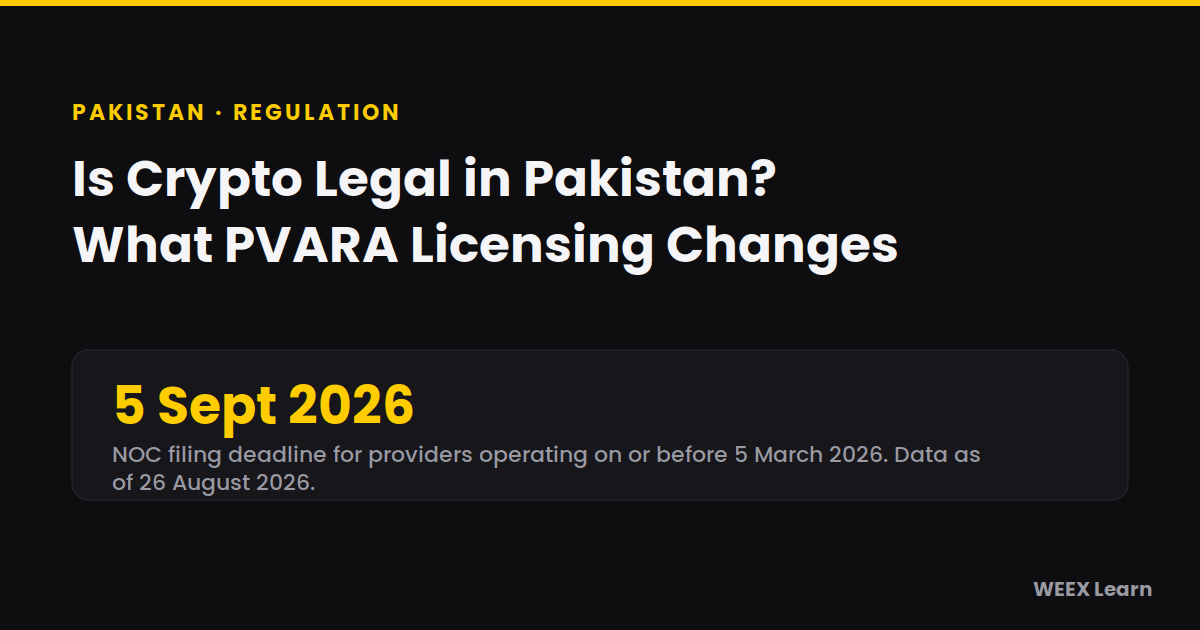
Yes — holding and trading crypto is legal in Pakistan, and since 2026 it sits inside a real statutory framework rather than a grey zone. The Virtual Assets Act 2026 created the Pakistan Virtual Assets Regulatory Authority (PVARA), which now licenses the platforms you trade on. The rule that actually affects ordinary PKR traders is not about you at all: it decides which exchanges are still permitted to serve Pakistan after 5 September 2026. Below: what the law covers, what changed at the banking layer, what the deadline means for your account, and what to check before you fund one.
What the Virtual Assets Act 2026 actually made legal
The Act regulates service providers, not individual holders. PVARA started as a presidential ordinance in July 2025 and became a permanent statutory body when Parliament passed the Virtual Assets Act 2026 in March 2026, superseding that ordinance. Nothing in it criminalises owning USDT or Bitcoin.
What it does is make unlicensed operation illegal for the businesses. Every virtual asset service provider must hold a formal licence before offering services in Pakistan. On 22 August 2026, PVARA chairman Bilal bin Saqib announced that the licensing regulations had been notified, setting out ten licence categories covering exchange, custody, broker-dealer, advisory, lending and borrowing, and derivatives activity. His framing of the starting point was blunt: millions of Pakistanis were already trading digital assets while regulation was, in his words, non-existent.
One distinction that trips people up: legal to hold is not the same as legal tender. Crypto is treated as property, not money, and no merchant has to accept it in place of rupees.
Pakistan's crypto rules in 2026: The dates that matter
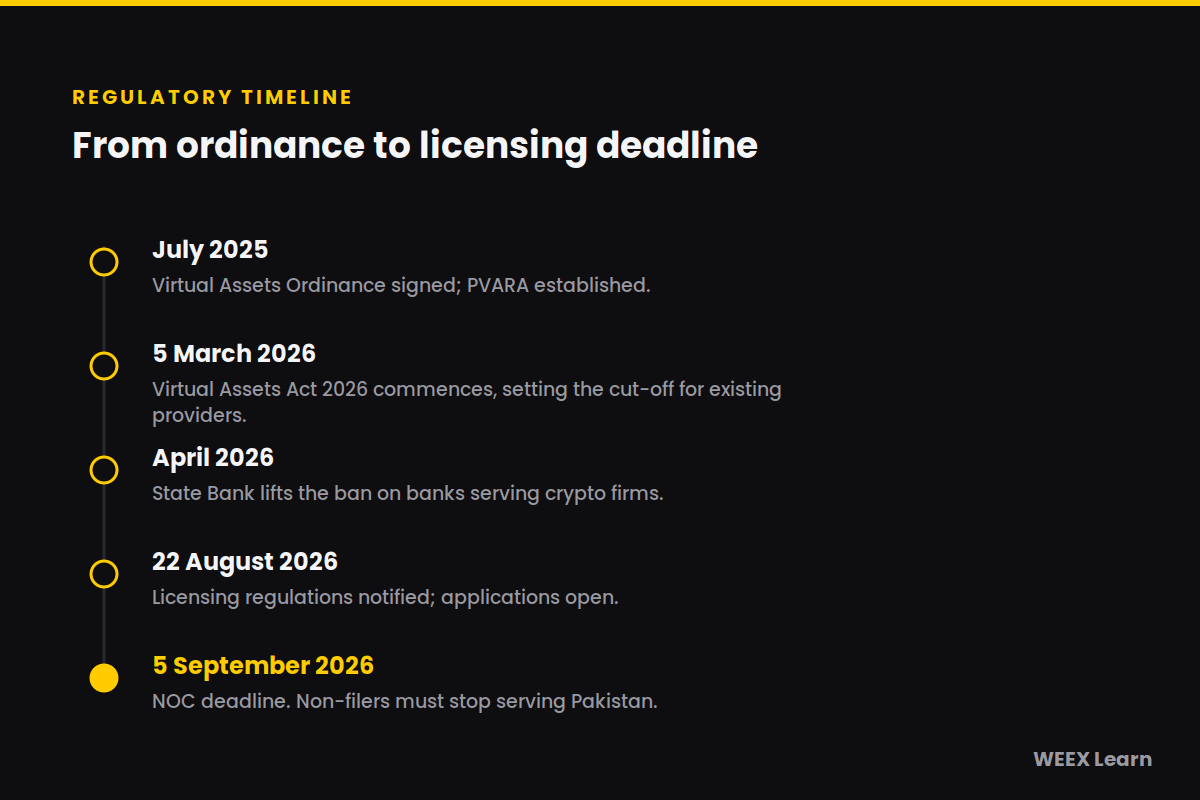
- July 2025 — Virtual Assets Ordinance signed and PVARA established. This is where the pure grey zone ends.
- 5 March 2026 — the Virtual Assets Act 2026 commences, setting the cut-off date that defines an "existing" provider.
- April 2026 — the State Bank lifts its ban on banks serving crypto firms, making legal banking rails possible.
- 22 August 2026 — licensing regulations notified and applications open; platforms begin formal licensing.
- 5 September 2026 — NOC deadline for firms that were operating on or before 5 March. Non-filers must stop serving Pakistan.
The banking change is the underrated one. For roughly seven years the practical problem was never legality — it was that no bank would move rupees to an exchange, which is why the entire retail market runs on peer-to-peer trades settled over Easypaisa, JazzCash, Raast, SadaPay and direct bank transfer. That constraint is now being dismantled at the policy level. A policy change and a working bank rail are not the same thing, though, and in August 2026 the large majority of retail funding still goes through P2P.
What the 5 September 2026 deadline means for your account
PVARA's rule is specific: firms that were already providing virtual asset services on or before 5 March 2026 must file a no-objection certificate (NOC) application by 5 September 2026, and those that do not must cease operations.
Read this as a platform-continuity question, not a personal legal risk. If a venue decides Pakistan is not worth the compliance cost, the symptoms usually arrive in a predictable order: PKR ad volume thins out, then fiat or withdrawal features get restricted, then service stops. What you lose is access and optionality, rarely the coins themselves — but access is what you need on the day you want to sell.
Two cautions worth carrying. An NOC is permission to keep operating while an application is assessed; it is not a licence, and the two get conflated constantly in marketing. And PVARA does not maintain a public running list of NOC holders, so a "PVARA verified" badge circulating in a Telegram group proves nothing. Reports name large global exchanges among early NOC recipients, but the only claims worth relying on are ones you can trace to the regulator or to the platform's own formal announcement.
-- Price
Does the new law change how you buy crypto with PKR?
Not in day-to-day mechanics. You still pick a merchant advertisement, send rupees through your usual wallet or bank, and the platform's escrow releases the crypto once the seller confirms payment. On WEEX P2P, which added PKR support in October 2025, buyers pay no platform trading fee — the seller side carries it — and the full order flow is set out in this step-by-step PKR guide.
What regulation should change is your selection criteria. In an unregulated market people picked a platform on price. In a licensed one, the sensible weighting moves toward whether the venue will still be serving Pakistan next quarter, whether client funds are segregated from company funds, and whether a complaint has anywhere to go beyond a support ticket. Licensed providers are expected to meet standards on client-fund segregation, fee transparency, cybersecurity and complaint resolution. That does not guarantee nobody gets defrauded; it creates a tier of the market where the risk is lower than in the unregulated one.
What matters most between now and year-end
Documentation. Regulation and taxation are being built in parallel — you cannot tax an industry whose participants are not identified — so the trader with clean records of every rupee in and out will be in a far better position than one reconstructing three years of P2P history from memory and screenshots.
Concretely: export your trade history each quarter, keep the bank and mobile-wallet statements that correspond to it, and only ever pay from or receive into accounts in your own name. It is unglamorous, and it is the step most people skip until it costs them.
Frequently asked questions
1. Is crypto legal in Pakistan for individuals?
Yes. The Virtual Assets Act 2026 regulates service providers rather than banning ownership or trading. Crypto is not legal tender, and gains are treated as taxable, so legal is not the same as unregulated or untaxed.
2. Is P2P trading with PKR still allowed?
Yes. P2P remains the main route from rupees into crypto and is not prohibited. What the framework requires is that the platform hosting those trades be authorised.
3. What happens to my funds if a platform misses the 5 September deadline?
The likely outcome is loss of Pakistan-specific services rather than confiscation. If a platform goes quiet about its filing status, move funds to a wallet or another venue instead of waiting for an announcement.
4. Does a PVARA licence mean my crypto is protected?
No. Licensing raises the operational floor — segregation, disclosure, complaints handling. It does not insure you against price falls, your own errors, or a counterparty scam inside a P2P trade.
5. Do I have to complete identity verification?
In practice, yes. KYC is required for P2P on regulated venues, and both PVARA and FBR rules point the same way: identified, documented participation.
Risk Warning
Crypto assets are volatile and you can lose part or all of the money you commit. Pakistan's framework is new and still moving — licence conditions, permitted activities and tax treatment can change at short notice, and a platform's ability to serve Pakistani users may end for regulatory rather than commercial reasons. P2P settlement adds counterparty risk, with forged payment proofs and third-party transfers the two most common ways buyers and sellers get hurt, and bank or mobile-wallet accounts used for crypto flows can be flagged or frozen while a transfer is reviewed. This article is general information, not legal, tax or investment advice; confirm your position with PVARA, the FBR or a qualified adviser before acting.
This content is provided for general informational purposes only and doesn't constitute financial, investment, legal, or tax advice. Any events, rewards, online promotions, or related information mentioned herein should not be considered a recommendation, solicitation, or invitation to purchase, sell, trade, or otherwise deal in any crypto assets. Crypto assets are highly volatile and may result in loss. The availability of WEEX services, products, and related events may vary by region. You are responsible for ensuring that your participation is in accordance with applicable local laws and regulations.
You may also like
NVIDIA (NVDA) Earnings Date: When Q2 FY2027 Reports and What to Watch

JazzCash P2P Trading: Merchant Vetting, Payment Limits, and the Hidden Account Freeze Risk

Plasma Released 88.89 Million XPL Tokens Today—Why the Allocation Matters
Choosing a Crypto Exchange in Pakistan Before the Sept 5 Deadline
XST Coin Price Prediction: What Happens to AI Narrative Tokens After the Initial Hype Fades
Pakistan Crypto Exchange Comparison: Which Platform Works Best for PKR Traders in 2026
How to Call a Crypto Exchange API Without Getting Blocked
What Is a Crypto Exchange API and Which Permissions to Enable
Broadcom (AVGO) Earnings Date: September 2, 2026 (Confirmed) — Japan Time and What to Watch

XSolut Company: What Is the Team Behind XST Coin and What Do They Actually Disclose
Stock Market News Today: Why Bonds Are Setting the Tape
MSTR Stock Trades Below Its Bitcoin. Here's the Catch
PROM on 12 August 2026: What Upbit Added and What the Price Did
How to Buy USDT with Easypaisa Using PKR in 2026
Easypaisa Crypto Guide: How to Use the Mobile Wallet for P2P Trading in Pakistan
PKR to USDT Rate: How to Spot a Bad P2P Spread in Pakistan
How to Choose a Crypto Exchange in Pakistan: 7 Real Checks
Crypto Tax in Pakistan: What FBR Rules Mean for PKR Traders
Why USDT Still Dominates Crypto Buying in Pakistan Today
Bank Account Freeze Risk for Crypto Traders in Pakistan 2026
WEEX Mini App Launch Rewards: Trial Funds, BTC Airdrops, and an iPhone 17 Pro Giveaway Explained
Nvidia Holds a $21 Billion Stake in SpaceX: What That Position Actually Tells Investors About Both Stocks
How to Buy USDT with JazzCash in Pakistan Safely in 2026
JazzCash Crypto Guide: How PKR-to-USDT P2P Payments Work in Pakistan
XPL/USDT After the August 25 Unlock: Will Ecosystem Incentives Create Demand or Selling Pressure?
H/USDT After the Unlock: What Humanity Protocol’s New Supply Means for Traders
Humanity Protocol Unlocked 266 Million H Tokens Today—Where Did They Go?
Who Gets the Next HUMA Tokens? Investors, Team Allocations and the PayFi Unlock Risk
HUMA/USDT Faces an August 26 Token Unlock: Can Existing Liquidity Absorb the New Supply?
What Is DGrid AI (DGAI)? A Guide to the Decentralized AI Network and Its Token
NVIDIA (NVDA) Earnings Date: When Q2 FY2027 Reports and What to Watch
JazzCash P2P Trading: Merchant Vetting, Payment Limits, and the Hidden Account Freeze Risk
Plasma Released 88.89 Million XPL Tokens Today—Why the Allocation Matters
Choosing a Crypto Exchange in Pakistan Before the Sept 5 Deadline
XST Coin Price Prediction: What Happens to AI Narrative Tokens After the Initial Hype Fades
Pakistan Crypto Exchange Comparison: Which Platform Works Best for PKR Traders in 2026
Contents
Popular coins
Latest articles


