
Where Is XST Actually Trading Now? A Look at Volume Distribution After the Crash

 Prefer us on Google


XST coin price has fallen nearly 94% from its all time high, but a price chart alone doesn't answer a more practical question for anyone still watching this token: is there actually a functioning market left to trade in, and where does that market live. After a decline this severe, volume distribution tells a different and more useful story than price alone.
XST has never traded on a major centralized exchange. Since launch, activity has stayed concentrated on Solana decentralized exchanges, primarily Meteora DAMM V2, with additional volume spread across other Meteora pools and Orca, according to CoinGecko. That's still true today. What's changed isn't where XST trades, but what the volume happening there actually represents at the current price.
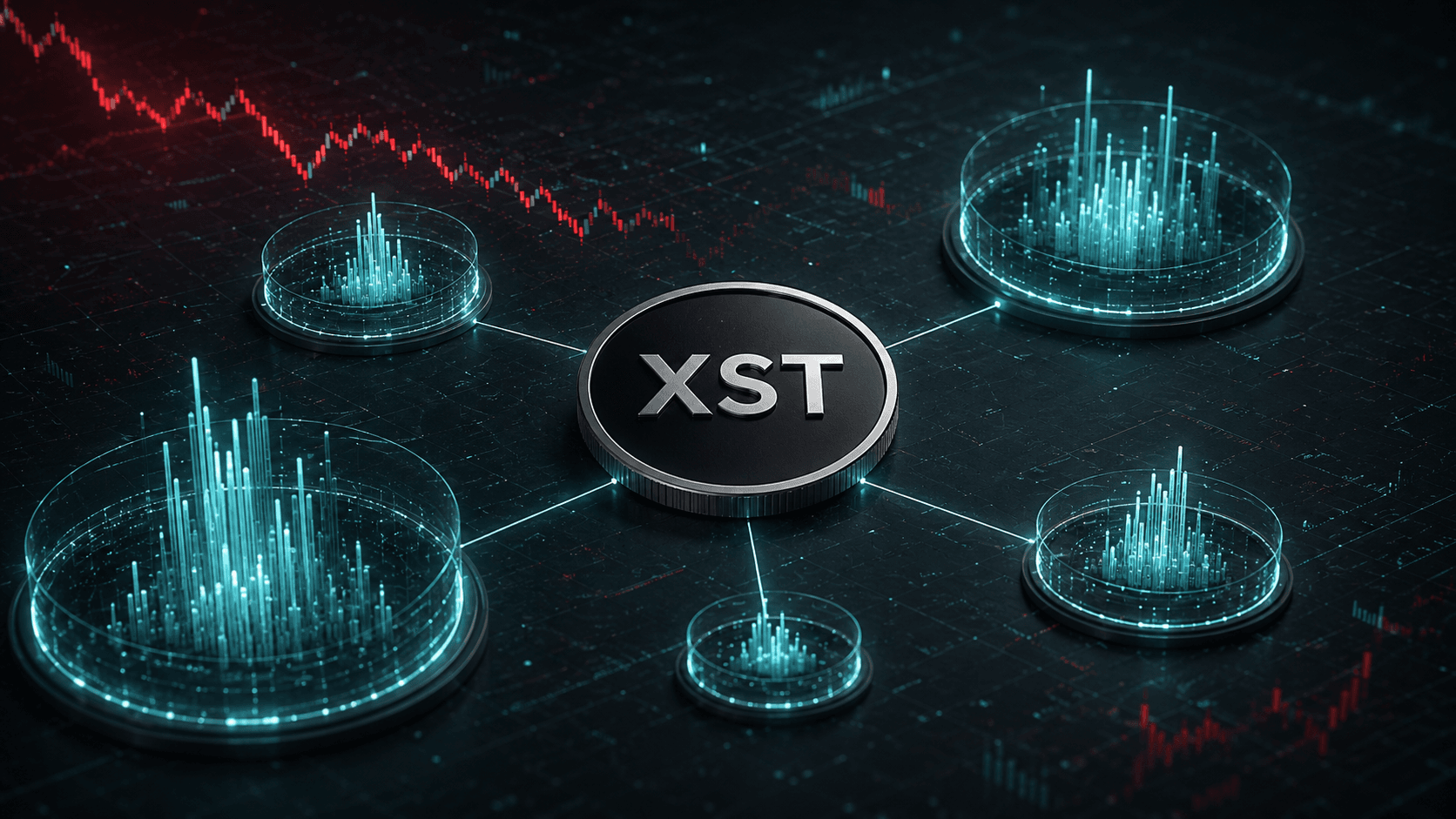
Why volume distribution matters more than price alone right now
A price chart shows where XST has been. Volume distribution shows whether anyone can actually get in or out of a position without moving that price significantly. For a token trading exclusively on decentralized exchanges rather than a centralized order book, this distinction carries more weight than it would for a more established asset, because DEX liquidity is typically thinner and more concentrated in a small number of pools than the aggregate volume figure suggests.
Knowing that XST has, say, a few million dollars in daily volume tells you almost nothing about whether a $50,000 trade can execute without significant slippage. That depends entirely on how much of that volume is concentrated in a single pool versus spread across several, and how deep the liquidity sits within that pool at any given moment.
Where XST actually trades and why that's notable
XST's most active market has consistently been the XST/USDC pair on Meteora DAMM V2, with CoinGecko data from earlier in the decline showing this single pair accounting for roughly a quarter of total 24 hour volume, with the remainder split across other Meteora pools and Orca. No centralized exchange listing has meaningfully entered this picture at any point in XST's trading history.
This matters for two reasons. First, it means every buyer and seller is routing through the same narrow set of liquidity pools, which concentrates risk rather than distributing it the way trading across multiple independent centralized order books would. Second, it means the token's price discovery has always happened in an environment more exposed to large single trades moving the price sharply, a dynamic that gets more pronounced, not less, as overall interest and volume decline.
What the dollar volume trend actually shows across the decline
Here's where the picture gets more specific. Trading volume figures captured at different points during XST's decline, roughly $1.5 to $1.68 million in early August, climbing to $2.8 million by late August according to a Benzinga report, and $3.2 million as of August 26 per Phantom's token page, show dollar volume holding in a broadly similar range even as the price collapsed by more than 90% over the same period.
That's a meaningful disconnect worth sitting with. If price fell by roughly 94% while dollar trading volume stayed roughly flat or even ticked up, it means the number of tokens actually changing hands each day increased substantially, since the same dollar amount now buys far more XST than it did at the highs. A stable or rising token volume against a collapsing price is generally a sign of continued active turnover rather than a market that's gone quiet, which contradicts the assumption that a 94% decline automatically means trading interest has dried up alongside it.
-- Price
Why stable volume against a collapsing price is not necessarily reassuring
It would be easy to read steady dollar volume as a sign of resilience, but the more accurate read cuts the other way. High token turnover at a collapsing price is consistent with exactly the kind of capitulation dynamic described in coverage of XST's broader decline: a shrinking pool of higher-cost-basis holders exiting, met by new participants entering at increasingly lower prices, rather than a stable base of long-term holders simply sitting still.
This is a different situation from a token where volume has genuinely dried up alongside the price, which would typically signal abandoned interest. XST's volume pattern instead suggests a market that remains active but increasingly speculative, with participants cycling through positions at a fast pace rather than a broad base of buyers treating the current price as a level worth holding.
What thin liquidity means for anyone trying to trade XST at scale
The practical implication for a trader is straightforward. A market this concentrated in a handful of DEX pools, without any centralized exchange depth to fall back on, means trade size matters enormously. A small trade executes close to the quoted price. A large trade can move that price meaningfully in either direction, and the gap between those two outcomes has likely widened, not narrowed, as the token's overall market capitalization has shrunk alongside its price.
Anyone evaluating XST's current tradability should treat the headline volume figure as a starting point rather than a complete picture, checking the depth within the specific pool they intend to trade through rather than assuming aggregate volume translates evenly into executable liquidity at any given size.
Conclusion
XST's trading activity has stayed concentrated on the same small set of Solana DEX pools throughout its entire price history, and that hasn't changed after a decline of roughly 94% from its all time high. What has changed is what that volume represents: dollar figures holding in a broadly similar range against a collapsing price point to a market with high token turnover rather than one that's gone quiet, a pattern more consistent with active capitulation than with abandoned interest. For anyone still trading XST, the concentration of that volume in a handful of pools, rather than the headline number itself, is what actually determines how tradable the token remains at any given size.
FAQ
1. Where does XST coin actually trade?
XST trades exclusively on Solana decentralized exchanges, primarily the XST/USDC pair on Meteora DAMM V2, with additional volume on other Meteora pools and Orca, according to CoinGecko. No major centralized exchange listing has been part of its trading history.
2. Has XST's trading volume collapsed along with its price?
Not proportionally. Dollar volume figures from early August through late August 2026 have stayed in a broadly similar range even as price fell over 90%, according to data from Benzinga and Phantom, which means token turnover has actually increased.
3. Does steady volume mean XST's price has stabilized?
Not necessarily. Steady or rising token turnover against a falling price is more consistent with active capitulation, holders exiting while new buyers enter at progressively lower levels, than with a market that's found a stable floor.
4. Why does DEX only trading matter for liquidity risk?
Because volume is concentrated in a small number of pools rather than spread across independent centralized order books, large trades can move the price significantly more than the same trade would on a deeper, centralized market.
5. Can I check XST's liquidity depth before trading?
Checking the specific pool's depth on the DEX where a trade will actually execute, such as Meteora or Orca, is more reliable than relying on an aggregate volume figure, since liquidity concentrated in a single pool determines actual slippage at any given trade size.
This content is provided for general informational purposes only and doesn't constitute financial, investment, legal, or tax advice. Any events, rewards, online promotions, or related information mentioned herein should not be considered a recommendation, solicitation, or invitation to purchase, sell, trade, or otherwise deal in any crypto assets. Crypto assets are highly volatile and may result in loss. The availability of WEEX services, products, and related events may vary by region. You are responsible for ensuring that your participation is in accordance with applicable local laws and regulations.
You may also like
XST Coin Liquidity Risk: What Low DEX Depth Actually Means for Buyers Who Want to Exit

XST Coin Price Prediction: What Happens to AI Narrative Tokens After the Initial Hype Fades
What Is ANSEM (The Black Bull)? The Pump Story, the 60 Percent Wallet and the Risks

What Is XST Coin and Should You Buy It? A No-Nonsense Guide for Crypto Investors

XST Coin vs Akash Network: How Two AI Infrastructure Tokens Compare

What Is XST Coin? A $54M Valuation on $760,000 of Liquidity
Salesforce Stock Price Targets Are Rising Fast: What Wall Street Actually Sees
MRVL Stock Price Target: Why Options Traders Bet on $300 Before Earnings
Marvell Stock (MRVL) Beat Earnings and Raised Guidance: Why Did It Fall Anyway?
What Is SUE Coin? Is a Dump Coming After Its 150% Pump?
What Is the WEEX Mini App? A Lightweight Way to Trade Inside Telegram
What Is CLAN? Is a Dump Coming After Its 100% Surge?
BISCOTTI Crypto: Robot Dog Token Behind Emblem Vault's Debut
How to Evaluate a Crypto Exchange in Pakistan: A Practical Checklist for Traders
CRMON After Salesforce's 23% Post-Earnings Surge: The Catch

How Safe Are the Crypto Exchanges Pakistani Traders Actually Use? A Security Comparison
Which Crypto Exchange Offers the Widest Range of Assets for Pakistani Traders?
XST Coin Price Crosses Into Deep Capitulation Territory: What a 90%+ Decline Actually Signals
A Breakup Became "我的女友景甜" Token in Hours: What That Says About Crypto's Attention Economy
How to Buy Crypto with PKR in Pakistan via WEEX Quick Buy
How to Buy Crypto with JazzCash or Easypaisa via WEEX OTC
NVDA Stock Jumps 7% After Earnings: Is $250 Next?

PONS After 200% Rally: Overvalued or Still a Growth Story?
What Happened to Raini Studios Token? RST After the Game Shutdown
Why Is Raini Studios Token (RST) Up Today Despite Low Trading Volume?
RST vs RAINI: Which Raini Studios Token Is Still Supported?
CyberLeek Is Trending—but Why Are People Searching for CYBERLINK?
CYBERLINK or CYBERLEEK? Check the Ticker and Chain Before Trading
Before You Buy CyberLeek: You Should Know CYBERLEEK Token Risks First
Is CyberLeek (CYBERLEEK) Safe? Price Crash and Key Token Risks Explained
XST Coin Liquidity Risk: What Low DEX Depth Actually Means for Buyers Who Want to Exit
XST Coin Price Prediction: What Happens to AI Narrative Tokens After the Initial Hype Fades
What Is ANSEM (The Black Bull)? The Pump Story, the 60 Percent Wallet and the Risks
What Is XST Coin and Should You Buy It? A No-Nonsense Guide for Crypto Investors
XST Coin vs Akash Network: How Two AI Infrastructure Tokens Compare
What Is XST Coin? A $54M Valuation on $760,000 of Liquidity
Contents
Popular coins
Latest articles


