
Crypto Trading Bot vs Manual Trading: Which Is Better?

 Prefer us on Google
As cryptocurrency markets operate 24/7, many traders face a common challenge: how to monitor markets and execute strategies consistently.
Some traders prefer manual trading, where they analyze market conditions and make decisions themselves. Others use crypto trading bots to automate repetitive tasks and execute predefined strategies.
But which approach is better?
The answer depends on the trader’s goals, experience, and strategy. Trading bots can improve execution speed and reduce emotional decisions, but they cannot replace strategy development or risk management. Manual trading provides more flexibility, but it requires more time and discipline.
What Is Manual Crypto Trading?
Manual crypto trading means a trader personally analyzes the market and places orders through a trading platform.
A manual trader may consider factors such as:
- Price movements;
- Technical indicators;
- Market news;
- Overall sentiment.
For example, a trader may analyze Bitcoin’s trend, decide that market conditions are favorable, and manually place a buy order.
The biggest advantage of manual trading is flexibility. Human traders can consider information that is difficult to convert into fixed rules, such as unexpected news events or sudden changes in market sentiment.
However, manual trading also has limitations. Cryptocurrency markets never close, which means traders cannot realistically monitor every price movement. In addition, emotions such as fear and greed can influence decisions.
Common mistakes include buying during market hype, selling during panic, or ignoring a predefined risk plan.
What Is a Crypto Trading Bot?
A crypto trading bot is a software program that automatically executes trades based on predefined rules.
Instead of manually watching charts, traders can create rules that tell the bot when to take action.
For example: A simple strategy may instruct a bot to buy when the price reaches a certain level and sell when a target price or stop-loss condition is triggered.
Most trading bots work through exchange APIs. The bot receives market data, analyzes conditions based on its strategy, and sends orders to the exchange.
However, a trading bot does not predict the market or guarantee profits. It only follows the instructions provided by the user.
If the strategy is poorly designed, the bot may continue making incorrect decisions faster than a human trader.
Crypto Trading Bot vs Manual Trading: Key Differences
| Category | Manual Trading | Trading Bot |
|---|---|---|
| Execution speed | Depends on human operation | Automated and faster |
| Emotional impact | More affected by emotions | Follows predefined rules |
| Market monitoring | Requires continuous attention | Can operate automatically |
| Strategy changes | Easy to adjust instantly | Requires code or configuration changes |
| Technical requirements | Lower | Requires setup and maintenance |
| Decision-making | Uses human judgment | Depends on programmed logic |
The main difference is that manual trading focuses on human judgment, while trading bots focus on consistent execution.
Advantages and Disadvantages of Crypto Trading Bots
One major advantage of trading bots is that they reduce emotional decision-making.
A well-designed strategy can continue operating according to predefined rules without being affected by short-term market fear or excitement. This can be useful for strategies such as grid trading, trend following, or other systematic approaches.
Trading bots can also save time. Instead of constantly checking charts, traders can allow software to monitor conditions and execute trades automatically.
However, automation also creates new risks.
The biggest risk is strategy failure. A bot cannot understand whether its trading logic is still suitable for current market conditions. A strategy that worked in the past may perform poorly when volatility, liquidity, or market trends change.
Bots also require maintenance. Developers need to monitor API connections, update strategies, and handle technical issues such as failed orders or network interruptions.
Automation improves execution, but it does not remove the need for research and risk management.
Advantages and Disadvantages of Manual Trading
Manual trading remains popular because it gives traders direct control over decisions.
A human trader can react to unexpected events, adjust positions quickly, and combine different types of information that may be difficult for a program to process.
For example, a trader may decide not to open a position before a major economic announcement because of uncertainty. A simple trading bot may not consider this factor unless it has been specifically programmed.
The downside is that manual trading requires more time and discipline.
Because crypto markets operate continuously, traders may miss opportunities or make rushed decisions. Emotional reactions can also affect performance, especially during periods of extreme volatility.
Can Trading Bots Replace Human Traders?
Trading bots are not designed to completely replace human traders.
Instead, they are tools that help traders execute strategies more efficiently.
Humans are generally better at:
- Creating trading ideas;
- Understanding broader market conditions;
- Adjusting strategies when situations change.
Bots are generally better at:
- Processing data quickly;
- Following rules consistently;
- Executing repetitive tasks.
For many quantitative traders, the most practical approach is a combination:
Human designs the strategy → Bot executes the rules → Human monitors performance.
This approach uses automation while keeping human oversight.
How Do Exchange APIs Support Trading Automation?
Trading bots need a connection to an exchange before they can execute orders. This is where APIs become important.
An exchange API allows software to communicate with a trading platform. Depending on available functions, a bot can use APIs to:
- Access market data;
- Check account information;
- Submit orders;
- Monitor order status.
For developers interested in building automated systems, exchange APIs provide the technical foundation for connecting trading programs with markets.
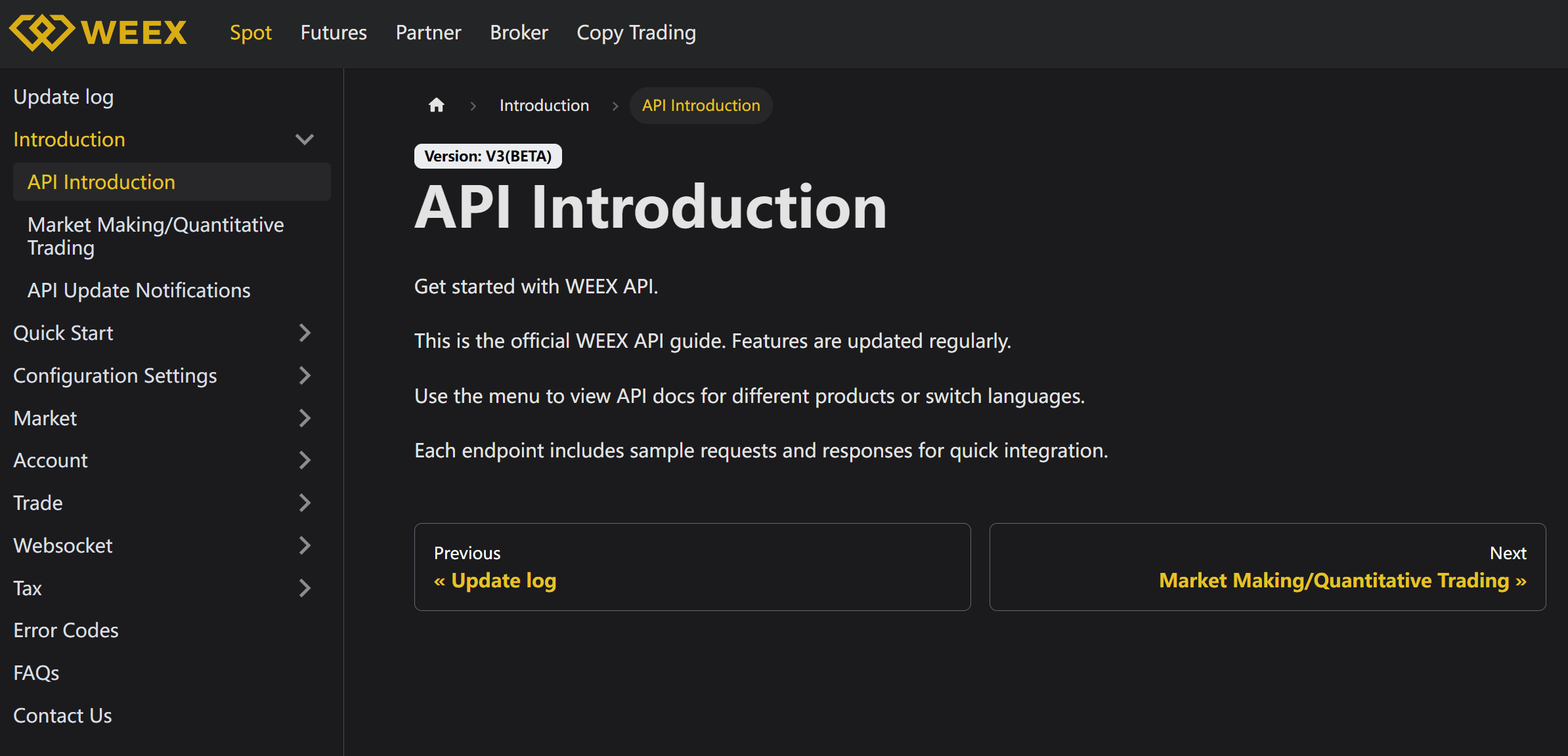
For example, developers can review the WEEX API resources to understand API-related functions and integration processes.
A typical workflow includes: Review API documentation → Create API Key → Connect market data → Test trading functions → Monitor system performance
WEEX API can support automated trading development, but it does not determine whether a strategy will succeed. Traders still need to design strategies, manage risk, and evaluate performance.
When using any exchange API, security is also important. Users should only enable necessary permissions, protect API credentials, and avoid sharing API Secret information.
Should Beginners Use Trading Bots or Manual Trading?
For beginners, manual trading is often a better starting point because it helps users understand how markets work.
Before using automation, traders should understand:
- How orders are executed;
- How strategies generate signals;
- How risk affects results.
Trading bots may be useful for users who already understand a strategy and want to automate execution.
A reasonable learning path is: Learn trading basics → Test a simple strategy → Understand risks → Try automation with limited funds
Using a trading bot without understanding the underlying strategy can create unnecessary risks.
Conclusion
Crypto trading bots and manual trading are not competitors. They are different approaches designed for different needs.
Manual trading provides flexibility and human judgment but requires time and emotional discipline. Trading bots provide automation and consistent execution but depend entirely on the quality of their strategies.
For quantitative traders, the most effective approach is often combining both methods: humans create and evaluate strategies, while bots handle repetitive execution.
Exchange APIs, such as WEEX API, provide the infrastructure needed for automated trading systems, but technology alone cannot guarantee results. Successful trading still depends on strategy quality, risk control, and continuous evaluation.
This content is provided for general informational purposes only and doesn't constitute financial, investment, legal, or tax advice. Any events, rewards, online promotions, or related information mentioned herein should not be considered a recommendation, solicitation, or invitation to purchase, sell, trade, or otherwise deal in any crypto assets. Crypto assets are highly volatile and may result in loss. The availability of WEEX services, products, and related events may vary by region. You are responsible for ensuring that your participation is in accordance with applicable local laws and regulations.
You may also like

Kioxia Stock and SK Hynix: What Rivals Sharing the Same Shareholder Actually Means

Is HIMS Stock a Buy After the Earnings Selloff? What the Full-Year Guidance Raise Actually Implies

ASTS Stock Falls After Missing Q2 Estimates: What the Revenue Miss and Japan Launch Actually Mean
Intel Stock Is Up Over 170% in 2026: What the AI Foundry Turnaround Actually Required
Intel Stock Sale Draws Over $100 Billion in Demand: What the 5x Oversubscription Actually Signals

RKLB Stock Price Targets Range From $64 to $150: What the Analyst Disagreement Actually Reveals

RKLB Stock Has Fallen Sharply Since SpaceX's IPO: What History Says Happens to Number Two Players
SPCX Stock Price Target Raised to $450 by Arete Research: What the Upgrade After the Cursor Deal Actually Means
SPCX Stock Closes Above Its $135 IPO Price for the First Time in Weeks: What the Recovery Actually Signals
XST Coin: Which Token Is It, and How Thin Is the Market?

HOOD Stock at $94: Record Revenue, Crypto Slump, 24/7 Access

XRP News: Which August 2026 Headlines Actually Move Price
CRWV Stock After Q2: Demand Is Fine, the Interest Bill Isn't
Best Crypto Trading Bot Strategies for Beginners
How High Can XST Reach? Buy, Hold, or Wait?
How to Backtest a Crypto Trading Strategy? A Beginner’s Guide
How to Build a Crypto Trading Bot With an Exchange API: A Beginner’s Guide
Is Cronos (CRO) Still Worth Buying in 2026? Ecosystem Growth, Staking Yields and Risk Factors
Google Stock and the $200 Billion Anthropic Financing Program: What the Largest AI Deal in History Means for GOOG

Why Is Cronos (CRO) Gaining Trader Attention? Key Drivers Behind the Recent Volume Surge

Is Bitcoin Preparing for a Bullish Breakout? Key Technical Indicators and On-Chain Data

How to Avoid Liquidation During Market Crashes? Futures Risk Management Strategies
Which AI Crypto Tokens Are Surging Today? Top Decentralized AI Projects to Watch
Is Cronos (CRO) Preparing for a Major Rally? Catalysts, Risks and the 2026 Outlook
Which Major Tokens Face Massive Unlocks Tomorrow? Market Impact and Price Predictions
HIMS Stock Falls After Raising Guidance: What the GLP-1 Regulatory Uncertainty Actually Changes
What Are the New Crypto Regulation Laws? Essential Compliance Guide for Traders
ASTS Stock Price Prediction 2026-2027: Can AST SpaceMobile Recover After the Launch Bottleneck
Is ASTS Stock a Buy After Falling 48% From Its All-Time High? What the $1.3 Billion Backlog Actually Implies
PLTR Stock Is Up 37% From Its Low: What Michael Burry's "Price Does Not Matter" Warning Actually Means
Kioxia Stock and SK Hynix: What Rivals Sharing the Same Shareholder Actually Means
Is HIMS Stock a Buy After the Earnings Selloff? What the Full-Year Guidance Raise Actually Implies
ASTS Stock Falls After Missing Q2 Estimates: What the Revenue Miss and Japan Launch Actually Mean
Intel Stock Is Up Over 170% in 2026: What the AI Foundry Turnaround Actually Required
Intel Stock Sale Draws Over $100 Billion in Demand: What the 5x Oversubscription Actually Signals
RKLB Stock Price Targets Range From $64 to $150: What the Analyst Disagreement Actually Reveals
Contents
Popular coins
Latest articles