
Why Stop at 126K? Michael Saylor Breaks Down BTC Stagnation and Retail Absence Truth

Original Video Title: Michael Saylor Responds to Bitcoin Critics
Video Source: Natalie Brunell
Original Text Translation: Deep Tide TechFlow
Key Points Summary
Michael Saylor returns, answering all questions from Natalie Brunell—including those most people are afraid to ask.
This episode's podcast topics include:
· Why Bitcoin failed to break $126K, what he believes really happened?
· Is price suppression a real thing?
· What is the biggest controversy surrounding Bitcoin?
· Bitcoin's mention in the Epstein files
· Does quantum computing pose an actual threat to the Bitcoin network?
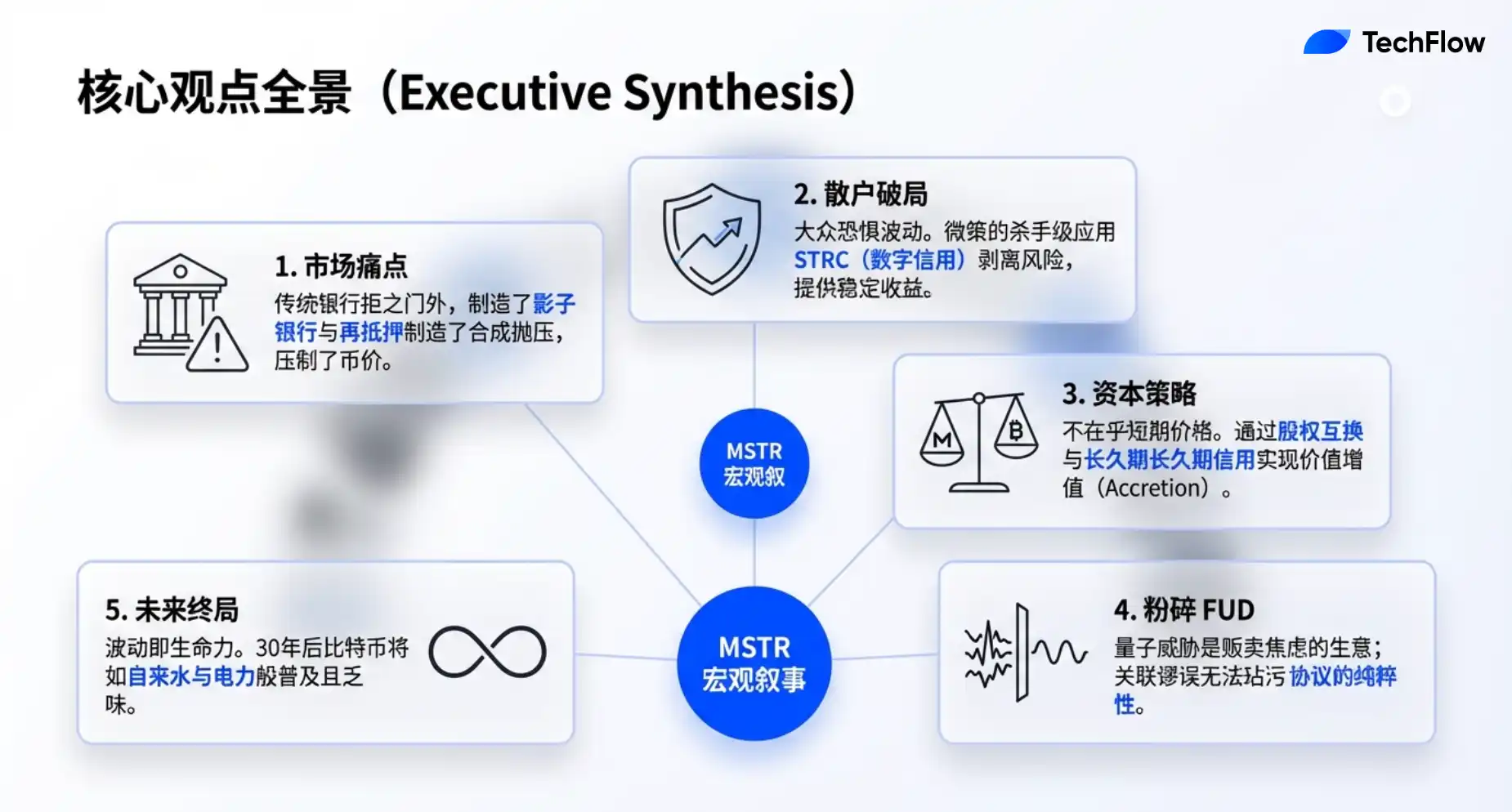
Highlights Summary
The Truth About Price Suppression: Shadow Banking and Rehypothecation
· Currently, roughly $1.8 trillion to $2 trillion worth of Bitcoin is held by retail or offshore investors who cannot access the traditional banking system, forcing them into shadow banking. Due to the lack of a robust, non-rehypothecated credit system, the price of these assets is suppressed.
· What is suppressing the asset prices? I think it's the absence of a complete, non-rehypothecated credit system. Your $10 million worth of Bitcoin might have changed hands and sold off three or four times, effectively creating thirty to forty million dollars in selling pressure because the shadow bank has sold off the asset you collateralized.
Why Retail Hasn't Onboarded: From "Roller Coaster" to "Digital Credit"
· The steadfast retail has long been onboarded, and the way to attract mainstream investors is by offering digitally credited products that strip away volatility and provide stable returns (such as STRC).
· The vast majority of retail wants something that's 2 to 4 times better than a bond fund, or like the S&P 500 but without the drawdown. STRC strips away 80% to 90% of Bitcoin's risk and volatility, giving investors a product with four to five times overcollateralization, double-digit returns, and tax-deferred characteristics. This is a killer app for digital capital.
Commercialization Process: One Thousand Hours vs 10 Seconds
· Bitcoin is transitioning from the "tech enthusiast" phase to the "mass market product" phase. At the core of commercialization is packaging complex technology into an incredibly simple product experience.
· Bitcoin is digital capital. I could spend a thousand hours explaining it to you, and you would eventually understand, but you would still have to endure a 45% crash; on the other hand, do you want a bank account that offers 11% interest and tax deferral? Choose STRC. The former explanation would take a thousand hours, while the latter only takes 10 seconds. The world doesn't need to read ten thousand pages of history; the world just needs a product, just like the iPhone.
Capital Swap Logic: Why Holding Cost Doesn't Matter?
· Micro-strategy investment uses equity and long-term credit, not short-term borrowing. As long as the swap is "accretive," short-term price fluctuations will not materially impact the company.
· Retail investors' only source of credit is "margin credit," which is one-minute credit; if they are wrong, they will be liquidated over the weekend. The credit we use allows us to be wrong for up to 30 years. When swapping equity for Bitcoin, the price is not important; what matters is the premium or relative valuation at the time of entry into the trade. Our average cost will not make any substantial difference.
Counterattack on the "Doomsday Narrative": 99% of the Narrative is Just Business
· Crisis narratives about Bitcoin (such as quantum threat, quantum FUD) are mostly commercial activities that use panic to gain influence. Investors should maintain constructive optimism.
· 99% of these narratives are just a kind of business. If you buy insurance for every minor possibility, your income will eventually be completely drained, leading you to bankruptcy. The reality is that ten years later, you may only need to click on "software update" on your iPhone to solve the problem. Don't panic (Don't Panic).
Saylor's Response to Bear Markets, Price Crashes, and Negative Sentiment
Natalie Brunell: Bitcoin's price is falling, market sentiment is negative, critics believe that Bitcoin's theory is collapsing. What do you think they are overlooking?
Michael Saylor:
First, we need to take a longer-term view of the market. It has only been 137 days, about four and a half months, since the last all-time high in history. During this time, the Bitcoin price has experienced a 45% retracement, which is not uncommon in the tech investing field.
Looking back at Apple's history, when it launched the iPhone in 2007, it was not well-received by the market. It wasn't until the release of the iPhone 3 in 2009 that the market gradually recognized its value. However, even so, Apple's stock still experienced a 45% plunge between 2012 and 2013, similar to Bitcoin's current drop. Apple's price-to-earnings ratio dropped from 30 to 10, and then it took a full seven years to recover from the 2013 low to a price-to-earnings ratio of 30. Similarly, Amazon was once thought to be unable to make a profit but eventually became the world's highest revenue company, surpassing even Walmart in influence.
So, what about Bitcoin? At what point can you determine that it has become global digital capital? Are the current signs not enough? The U.S. president is telling you, the Fed's Kevin Walsh is telling you, the Treasury's Scott Bessent is telling you, even the SEC, CFTC, and other cabinet members are telling you. BlackRock is telling you, and our company (MicroStrategy) having its enterprise value increase by 100 times is also telling you. In the history of the capital markets, when has a company ever purchased a $50 billion asset and loudly declared it to be digital capital, the new global currency? It has never happened before.
So the question is, is $1 billion enough? Is $5 billion enough? When will we have a deep enough understanding of this issue? Long before the world recognizes it, you already have enough information to know that Amazon is unstoppable, a decade ahead of global consensus. For Apple, you may have known it was unstoppable as early as 2009, seven years before world recognition, and perhaps even a decade ahead. Now, you already have enough information to know that Bitcoin is unstoppable.
Ultimately, the world will reach a consensus, and those like Warren Buffett and Carl Icahn will be the ones to create that consensus. They won't be the first, they will be the last. They won't make big profits, probably only doubling or tripling their investments. When they enter the market, the price-to-earnings ratio will go from 10 to 30. But if you can think independently and withstand the volatility, your investment can achieve returns of 10 times, 20 times, or even 30 times.
In fact, there is no successful tech investment that does not require a 45% drawdown and go through that "valley of despair." The current drawdown has already lasted 137 days, but you know, it may take two years, three years, or even four years. If it takes seven years to recover, then congratulations, this is like the Apple of yesteryears, one of the greatest success stories of this decade.
Why Bitcoin Has Not Reached the Predicted Price
Natalie Brunell: For those disappointed with this bull run, such as the price not exceeding $126,000, what do you think is the reason?
Michael Saylor:
I believe the market is evolving, the entire ecosystem is maturing. If you observe all the dynamics, you will see the derivative market is shifting from offshore to onshore, signaling its maturity. With the growth of US-regulated derivative markets, it has peeled off some of Bitcoin's volatility, while also dampening some of the upside, smoothing out both peaks and troughs, so what you're seeing is no longer
an 80% drawdown and an 80% volatility, but a 40% to 50% drawdown.
But the more critical situation is: the banking industry's adoption of Bitcoin, although progressing, is slower than those with short attention spans anticipated. Banks may need 4 to 6 years to truly adopt a brand-new asset class, but people expect to see Bitcoin accepted within 4 months. The reality is, if banks are not yet offering banking services, credit lines, custody, or trading, then what does that mean?
It means that at the market top, there is about $20 trillion in value, perhaps $18 trillion of Bitcoin held by retail or offshore investors, and they cannot enter the traditional banking system; they are in the shadow banking system. If you have over a trillion dollars in capital, and no one is willing to give you a loan, how do you unlock value? If I pledge $10 million worth of Apple stock to JPMorgan, I can get a $5 million loan with very low interest, but you cannot even pledge $10 million in Bitcoin to these mainstream banks for a loan.
So your only option is to seek the shadow banking system or offshore channels. The only "safe" way to liquidate is to sell it, but this suppresses price growth. Now there's a third option emerging, where you can convert Bitcoin to IBIT (spot ETF), some banks are starting to offer credit lines against it, which is broader and cheaper than direct Bitcoin lending, but we are still in the initial 12 months, and the lines are very limited.
There's a fourth way, you go to a crypto exchange or OTC desk, they may even offer you a loan at 1% or even 0% interest rate. But there's a catch: they require you to transfer the Bitcoin to them so they can rehypothecate it. This means your $10 million Bitcoin may be sold three or four times over, actually creating $30-40 million in selling pressure, as the shadow banks sell off the asset you pledged.
So, what is ultimately suppressing asset prices? I believe it is the lack of a complete, non-rehypothecated credit system. When you mortgage your house to the bank, the bank doesn't turn around and sell your house on your street ten times; if they did, the price of your house would go down. The rehypothecation present in the crypto economy has dampened price action, putting the market under leverage on both sides of the volatility.
We are in a phase where rehypothecation is suppressing prices, and we can only wait for this process to self-reverse.
Bitcoin Long-Term Returns: What's Ahead
Natalie Brunell: You often say "volatility is vitality," are you concerned that your 40% annualized return prediction for Bitcoin may change?
Michael Saylor:
In the next 21 years, I expect the average annual return rate (ARR) over this period to be around 29%. I have always believed we will experience rebounds and pullbacks, so I see it as a stair-step growth pattern, maintaining slightly below 30% in the long term but with surges and slumps in between.
If you listen to people, some may say, "There might be a problem in the Middle East this weekend, and if there is, Bitcoin is the only asset you can sell, so the price might collapse, and we are worried." And I would say, if something happens in the Middle East, indeed Bitcoin is the only asset you can sell, but it is also the only asset you can hold. This means a lot of people looking to trade over the weekend are moving funds into crypto trading platforms, making it the most interesting asset class in the world for a trader; but if you are a four-year holder, what does this weekend's buying and selling, flipping, or collapse matter?
In fact, the distinction here is that some "hot money" has flowed into this ecosystem, money that would not have been allocated here originally. For example, a trader with $20 billion can choose to put it in a bank to earn basic interest or invest it in the crypto trading platform system. When Bitcoin drops 5%, someone is selling, and someone is buying. Someone will wake up at 4 a.m. on a Sunday to buy at a 5% discount.
This money is not going to New York real estate, gold, traditional derivatives, or Nvidia stock. Why? Because in those markets, you can't have this kind of crazy panic selling, rage quitting, or FOMO buying frenzy. Bitcoin is most volatile because it is most useful.
In nature, there is no such thing as "fairness." If ten thousand ants gang up on a centipede, that's fine, just like when you want to trade Bitcoin with 50x leverage, or when you use a trash coin for cross-chain staking. No one can stop you. Is that smart? In 99% of cases, it's not smart, and you will lose everything. But the key is, those who do foolish things will be washed out of the market. If they don't make money, the free market will separate them from their capital.
Bitcoin represents the global capital market, where someone is always doing what you wouldn't or wouldn't want to do. It is this utility that creates volatility, but it is also this utility that creates attraction or a magnetic field, drawing all the financial energy, political energy, and digital energy in the world, and you have to come to terms with it. If you are worried about how Bitcoin will perform in the next four days, four weeks, or four months, then you are a trader, and you better have an excellent trading strategy. Otherwise, you are an investor, and you have a four-year time span, so these fluctuations don't matter at all. You just need to know that it is because of those crazy traders that such a massive amount of capital and attention floods into this space.
Why Haven't Retail Investors Participated in the Recent Bull Market?
Natalie Brunell: While Bitcoin is currently largely held by individuals, Lynn Alden mentioned that retail investors have not really participated in this recent bull market. What do you think is the reason for this?
Michael Saylor: I think that retail investors who are passionate and have a strong belief in digital capital and Bitcoin actually entered the scene in the past decade. If you are looking for a non-sovereign, digital store of value asset, you have already found it in the waves of the years 2010 to 2015 and bought into it as much as you could.
But if you want to attract the next wave of retail investors, they do not want an asset with 40% volatility and 40% annualized returns. What they want is something with around 10% volatility, around 10% returns, or even something with 0 volatility and 8% returns.
The way to attract mainstream investors is to offer them products similar to STRC. We would say: "This has an 11% return, tax-deferred, and we have stripped away its volatility." The one-year volatility of STRC is lower than the Nasdaq, S&P 500 Index, or even gold. I will give you an asset that has less volatility than traditional stores of value, but with a clear 10% or 11% monthly return.
You can conduct a test yourself: Walk down the street and ask 100 people, "Would you prefer a 30% annual return over the next 20 years but endure a 40% drawdown and three times the volatility of the S&P 500, or would you like an annual 10% return with the ability to withdraw at any time from a bank account?"
I dare say that 95% of the market would want that 10% bank account, with perhaps 5% of retail investors willing to hold Bitcoin and withstand twice the S&P's volatility to achieve a 30% return. This may be too optimistic, and the actual number may only be 1% to 2%.
The vast majority of retail investors want something 2 to 4 times better than a bond fund or a product like the S&P 500 but without the drawdowns. We can attract them only when we combine the benefits of Equity, Credit, and Crypto.
This means Equity's benefits of double-digit returns and tax deferral; Credit's benefits of price stability, principal protection, low volatility, and clear, consistent cash income; and Crypto (Bitcoin)'s benefits of digital innovation, transformative capabilities, and 3 to 4 times higher productivity than the traditional economy.
Currently, retail investors must choose between the "Bitcoin rollercoaster" and the "S&P 500 with 10% annualized return but accompanied by volatility risk," or they can settle for Apple corporate bonds with just around a 2% after-tax return.
This is why my enthusiasm over the past year has been focused on this: Can I, through engineering means, take an asset with a 45% volatility (Bitcoin), strip off 80% to 90% of its risk and volatility, and provide investors with a product offering four to five times excess collateral, double-digit returns, and tax deferral capabilities?
You receive cash dividends every month, and if you wish to compound, you reinvest the dividends. When you need to pay your child's tuition or taxes, you can simply cash out or sell. To achieve this, you cannot have the drawdowns like Bitcoin. You need a credit tool, an issuer willing to provide excess collateral, and actively manage it to create price stability. This is the significance of STRC or digital credit. Through this method, we can attract 10 to 100 times more retail investors than now. If in the first wave we only get 2% to 4% of retail investors, then through digital credit, we can reach 20% to 40%, making this a killer application of digital capital.
How Does STRC Perform?
Natalie Brunell: Among all the preferred stocks you have issued, you seem most interested in Stretch (STRC), and you have been using it to accumulate more Bitcoin. Is there a strategy behind this?
Michael Saylor: We are stripping out the volatility of Bitcoin, extracting yield, eliminating currency risk, and removing capital risk. Bitcoin has had a volatility of about 45% over the past year. Through Strike, we managed to reduce it to around 38%; through Stride and Strife, we reduced it to around 20%; and through Stretch, we brought it down to around 10%, even reaching single digits at one point. Then, all this volatility we stripped out flowed into MSTR's common stock, pushing its volatility to 80%.
What people really want is a stable 10% yield with no volatility. My personal pursuit is zero volatility, zero interest rate risk (zero duration), and returns multiple times the money market rate.
To achieve this goal, we have tried nearly 20 different fixed-income strategies. Currently, most similar products in the market, even with 10x or 20x over-collateralization, trade like triple junk bonds—highly unstable. The credit market has become distorted: even if a bond has $70 in assets backing every $1 of debt, its credit spread (risk pricing) makes it look like a fast-failing junk bond. This business now operates like 16 guys trading in a back alley, with spreads as wide as 300 basis points, lacking transparency and efficiency.
You might ask: Why not just list debt instruments? Because listing traditional term debt makes no sense. If you sell a 5-year bond and 4 years later it only has 12 months left, this "non-perpetual" nature causes its value to depreciate over time. Since it is destined to mature and disappear, why bother making it a public security? So, we must create a perpetual instrument to list, which is why we issued preferred stocks.
Initially, our approach was simple: direct 10% dividend or 8% dividend plus conversion rights. The two products, Strike and Strife, were very successful, outselling other preferred stocks by 10 times. But we quickly realized that people not only hate complexity but also hate interest rate volatility.
If you ask a retail investor, what is the value of a 10% yield perpetual preferred stock that they will hold forever? They can't figure it out at all. If you have to use bond math to calculate, its "duration" (i.e., price sensitivity to interest rates) is about 10 years, equivalent to a 15 to 18-year government bond. Natalie, can you keep up with this mathematical logic? It's very convoluted: if the sensitivity is 10, then when the market interest rate drops by 1%, the price theoretically rises by 10%; conversely, when the rate rises by 0.5%, the asset value drops by 5%.
This means that every time Fed Chair Powell speaks, the theoretical value of this instrument will fluctuate by 10%. How many retail investors want to see their "stable asset" shrink by 10% after a Fed press conference? So we created STRC. Although for professional Bitcoin credit investors, a long position can bring about significant capital appreciation potential (such as a rate decrease leading to a narrowing of spreads, doubling the purchased assets), explaining all this requires discussing the yield curve, rating agencies, and the future of Bitcoin, which is too complex.
Returning to the retail perspective, our conversation only needs 12 seconds: — "I want to deposit money in the bank, earn 10% interest per year, and the government doesn't tax me." "Deal.". No need to worry about interest rate fluctuations, corporate credit changes, or even whether Bitcoin has doubled or halved, none of that matters. The only important fact is: you receive a 11.25% return, and it is tax-free.
Of course, there are risks: If Bitcoin goes to zero, that's a survival crisis. The global credit market size is as high as $300 trillion, but everyone's current situation is terrible: to get that 5% return, you must endure junk bond risks, illiquidity, or wait for up to a century. What do retail investors want? They don't want any duration risk, currency risk, credit risk, or volatility, they just want to be able to withdraw their money at any time, earn a return several times higher than a money market fund, and not pay taxes.
The traditional bond model has run its course, that's for professional investors to play with, retired Air Force majors just want a stable monthly cash flow. Why monthly? Because the regular market does not support weekly or daily payments. If the Nasdaq supported hourly payments, we would do that too. So we created the most efficient, tax-efficient, and simplest fixed income stream. The company's five-year vision is: Bitcoin is digital capital, I will spend a thousand hours explaining it to you, you will eventually understand, but you still have to endure a 45% crash and worldwide ridicule; on the other hand, do you want a bank account that pays 11% and defers taxes? Choose STRC.
The previous explanation would take a thousand hours, while the latter only takes 10 seconds. The world doesn't need to read ten thousand pages of history; the world only needs answers, even just products, like the iPhone. You use air conditioning, tap water, light bulbs every day. Do you study their principles? No. You just need a pill, take it, and the problem is solved. If I could cast a spell to make you instantly happy and wealthy, you would definitely sign up immediately. STRC is that spell: you buy, it pays you a double-digit tax-free dividend, your descendants enjoy tax breaks, and you don't have to worry about anything else.
It's like Standard Oil back in the day. It was called 'Standard' because it ensured kerosene lamps wouldn't suddenly catch fire; it was safe. What consumers need is trust in the brand. Bitcoin is evolving from the 'amateur radio enthusiast' small circle to the mainstream. In the past, playing with radios required a knowledge of physics. Now, six-year-olds are using radio technology while scrolling TikTok, but they don't care about the principles at all. Bitcoin will be the same. Eventually, 8 billion people will manage digital capital on their phones, seamlessly switching between savings coins, stablecoins, and various securities. Just like that video where I held an iPhone and said 'everyone will want it,' STRC solves the ultimate pain point of the market: eliminating volatility, leaving behind cash.
Media Sentiment and Volatility Cycle
Natalie Brunell: We see that every time Bitcoin hits a new all-time high, the media shows extreme enthusiasm and praise; but when the price retreats, a gloomy mood follows, and people start overly predicting negative futures. Do you feel that some are hoping for your failure? How do you deal with such drastic emotional swings?
Michael Saylor: This struggle is real, but it is precisely volatility that drives engagement, interest, and speculation. When the price of Bitcoin falls, everyone is talking about us, while those non-volatile assets, like real estate in Manhattan's Upper East Side or lumber prices, no one talks about them. No news, no interest.
I have run a publicly traded company for many years, where conventional company information is released quarterly, and investors may only make a decision once a year. But after entering the Bitcoin field, we realized that our assets made our website update every 15 seconds, changing us from updating financial markets every 12 weeks to every 15 seconds.
For every $10,000 fluctuation in Bitcoin, our company makes or loses around $7-8 billion. Previously, our company would work hard all year to earn $70 million; now, every $100 fluctuation in Bitcoin is equivalent to our annual work level before. We have directly accessed an energy source, a volatility generator on the balance sheet, driving a constantly looping news cycle. Even on TV, skeptics think about shorting us, while optimists look for buying opportunities. Without this volatility, both short-term and long-term players wouldn't pay us so much attention.
The Wall Street Journal used to cover only public companies, as private company stories were irrelevant to the average reader's buying and selling. Now, we've made a company "interesting" by magnifying Bitcoin on its balance sheet and making it vibrate, making the company interesting 10,000 times over.
This toxicity and extreme evaluation actually come from a real interest in Bitcoin. The breakthrough of the crypto economy is in creating a globally operating, 24/7, extremely interesting financial asset. In contrast, I can tell you how to ruin a financial asset: ban people outside the U.S. from buying, limit trading hours from 9:30 to 4:00, require a three-month account-opening review, and add a $100 million threshold. If you keep adding these restrictions, the asset will become lifeless. Even giving it a hard-to-remember six-digit code will weaken its appeal.
However, the crypto industry has gone in another direction: anyone anywhere in the world can start trading within 60 seconds by downloading an app. During a bank holiday, you can still move $1 billion worth of Bitcoin in minutes, with a fee of just 44 cents. This is a digital revolution, where money wants to move at the speed of light around the clock. Waterfalls don't stop on bank holidays, neither does electricity, gravity, or the speed of light. Bitcoin wins because this million-vibrations-per-second digital capital, programmable by AI, will ruthlessly evolve to replace slow, clumsy traditional financial forms.
Is Quantum Computing a Threat to Bitcoin?
Natalie Brunell: We often say in the Bitcoin community, "Don't trust, verify," but many ordinary people lack the technical knowledge to verify. Is quantum computing really an existential threat? I saw that MicroStrategy recently issued a statement about ensuring Bitcoin's "quantum resistance." Can you explain why you don't believe this is a risk already reflected in the price?
Michael Saylor:
First, the broad consensus in the cybersecurity community is that quantum risk, if any, is at least 10 years away; it's not a near-term concern. Whether quantum threats exist remains an open issue, but what's certain is that there's no imminent threat right now. If quantum risk materializes, you'll see large-scale upgrades to software running the global banking industry, the internet, consumer devices, AI networks, and all crypto networks (including Bitcoin). We will adopt "post-quantum resistant cryptography," which is not a surprise event; we can all see it coming.
The software of Bitcoin has always been changing, and now we are discussing upgrading from version 29 to 30. Nodes, hardware, wallets, and exchanges will all upgrade accordingly, and in 10 years, a global consensus will naturally emerge on the best way to deal with Bitcoin. Why am I not worried now? Because all vested parties—Google, Microsoft, Apple, Coinbase, BlackRock, the U.S. government, the Chinese government, JPMorgan Chase—they all have to deal with the same issues.
In fact, the crypto community is currently the cutting edge of cybersecurity communities. If you look at the security protocols of mobile crypto assets (multi-factor authentication, hardware keys, etc.), they are orders of magnitude more robust than the protocols of bank transfers or stock trades. I believe the crypto community will be the first group to perceive and respond to threats. We have already announced the Bitcoin Security Plan, and even the money I donated to MIT earlier was for Bitcoin security research. The quantum narrative is not currently the biggest threat to Bitcoin.
The reason we are still discussing the threat of quantum computing is that other so-called risks have failed to materialize. Ten years ago, the Bitcoin community was embroiled in the "block size war," with some even asserting that Bitcoin would fail due to insufficient bandwidth. However, today, ten years later, the free market has already resolved this issue.
In fact, this "doomsday narrative" has always existed in human history. Whether it's the "alarmists," the "overly ambitious speculators," or the "idealistic intellectuals," they often fabricate various crises to gain influence, capital, or power. If I don't promote some kind of "doomsday narrative," how can I get rich? How can I be elected governor?
99% of these narratives are nothing more than a business. Just like someone selling "moving accident insurance" or "child autism from vaccines," the probability of these events may be as low as 0.01%, but if you buy insurance for every tiny possibility, eventually your income will be completely exhausted, leading you to bankruptcy. The reality is, ten years later, you may only need to tap "Software Update" on your iPhone to solve the problem.
The quantum computing threat is just the latest form of "quantum FUD," and when this narrative is ultimately proven to be baseless, someone will likely come out and claim that we need to implant nanobots in our brains while Bitcoin is not ready. This is not just Bitcoin's story; it is actually a microcosm of human history. Faced with these so-called crises, all you need to do is maintain a constructive, optimistic attitude. You can choose to believe that humanity is too foolish to adapt to technological changes and hand your money over to speculators who claim the world is ending, or you can believe that we will upgrade our software and use new technology to make life better.
Remember the phrase from the back cover of "The Hitchhiker's Guide to the Galaxy": "Don't Panic." Even in the face of a real cybersecurity threat, your bank, government, and business software will all be forced to upgrade to address it. Remember Y2K? The whole world was in a panic back then, but nothing ultimately happened. Throughout human history, we have overcome thousands of similar "non-events," and quantum threats will be one of them.
What Is the Strongest Criticism of Bitcoin?
Natalie Brunell: I have a very interesting question for you: What do you think is currently the strongest and most convincing argument against Bitcoin? And why do you reject it?
Michael Saylor:
The strongest and most convincing argument against Bitcoin at the moment is— it is too new. As a new thing, its existence has not been long enough, and perhaps before I trust it for the rest of my life, I would like to see it around longer.
It took humans 30 years to embrace electricity, while Bitcoin has only been around for 17 years. Some may say, "How many people flew on a jet plane 17 years after its invention?" The airplane was invented in 1903, and by 1920, it was still in its early stages, and the world was full of such profound innovations that were eventually embraced by all, but the process often took more than 17 years.
I believe the answer lies in "time." Early adopters are always a minority, just like after the invention of the automobile, it wasn't until the Ford Model T appeared that it began to be popular, and it took many more years to reach a point where everyone had a car.
This is essentially a natural process: to transform innovative technology into consumer or industrial devices and establish enough track record for people to be willing to stake their lives or reputations on it. I believe we are currently in the midst of this "commercialization" process.
Is MicroStrategy's Bitcoin Cost Basis Important?
Natalie Brunell: Just before your final thoughts, I'm curious, you seem completely unconcerned about the cost price. Many people are now trying to find the bottom, obviously many are watching the technical charts, but you seem unaffected, just buying at any price. Could you explain to those who think, "Since it could still go lower, why not accumulate at a lower cost price"?
Michael Saylor: You can think of us as practicing Dollar-Cost Averaging (DCA), but the key point is: we are using Equity, not debt. When we buy Bitcoin, if we sell equity and then buy Bitcoin, regardless of whether we buy at $100,000 or $200,000, we are simply engaging in a perpetual, risk-free swap. We are swapping equity for Bitcoin. When should you swap equity for Bitcoin? As long as it is accretive.
If Bitcoin goes up by 10%, but our equity goes up by 25%, then the swap is profitable. If Bitcoin then drops by 20%, would you regret it? Of course not, because if you didn't do it, you wouldn't have had that Bitcoin in the first place.
By that point, you have actually lowered the risk of your equity. Placing a stable asset under your equity actually reduces risk, especially when you do this swap at a premium. So the only real question is: is this swap good for the shareholder? At one level, swapping preferred stock for Bitcoin is a good deal; at another level, swapping common stock for Bitcoin is also a good deal.
Once you execute the transaction, the future price of Bitcoin is actually less relevant. If you swapped common stock for Bitcoin, it doesn't matter, because for the next few thousand years, you don't have a sustained liability.
Of course, theoretically, there is a scenario where swapping preferred stock might cause dilution. For example, if I pay a 10% preferred stock dividend, but Bitcoin only returns 5% over the next 100 years, then this swap would be dilutive to common stockholders. So, the calculus of swapping digital credit for Bitcoin is much more complex, but swapping common stock for Bitcoin is very simple.
If you are swapping debt, such as a 10-year, 5% cost debt to buy Bitcoin, then Bitcoin needs to appreciate by more than 5% over 10 years to avoid dilution.
If you are using margin debt to swap for Bitcoin, like borrowing at 10x leverage — let's say buying $1 billion Bitcoin with only $100 million collateral. If Bitcoin drops by 10%, you will face a margin call and lose the entire $100 million. Why is this dangerous? Because the period you borrowed the money for is only "one minute."
So, the real core issue is: What is the duration of the swap? Are you doing a "one-minute flash loan"? If so, the entry price relative to the current price is crucial. Did you borrow money for ten years? Its importance will be apparent in ten years. If you borrowed perpetual funding that never needs to be repaid, then the importance of the entry price becomes very blurry.
Financial math is not the same. The simplest way to think about it is: If you are using equity to buy Bitcoin, the price is not important. What's important is the premium or relative valuation at the time of your entry into the trade. If you are using preferred stock to buy Bitcoin, Bitcoin's performance over 30 years will have some impact, but even if Bitcoin grows at less than 10% per year, and we pay a 10% dividend, in certain scenarios, this is still advantageous for common stock.
In fact, when we are selling digital credit to buy Bitcoin, we have 20 to 30 years to prove ourselves right. If you are selling corporate bonds or convertible bonds, the duration of those instruments is much shorter, maybe three to four years, so you have to prove yourself right faster.
What most retail investors don't understand is that their only source of credit is "margin credit," which is one-minute credit. If they are wrong, they will be liquidated over the weekend, whereas the credit we use allows us to be wrong for up to 30 years.
I can paint you all kinds of scenarios: we pay 10%, Bitcoin only returns 8%, we are wrong for 30 years, but this is still a good idea for common stock. To explain this clearly would take hours; that's a completely different podcast. We would need to delve into the first, second, and third-order financial dynamics of the monetary network and "harmonics."
But the fact is: If it is common stock, and we have a time span of 10 to 30 years to prove ourselves, it doesn't matter how Bitcoin performs in the next 100 years. We do not engage in other types of short-term debt, so (short-term prices) really don't matter. That's why our average price will not make any substantial difference.
What really matters is the nature of the security swaps we are conducting. Selling $1 billion of monthly variable rate STRC, selling $1 billion of perpetual 10% dividend STRF, or selling $1 billion of common stock have completely different dynamics, and the math behind this is much more complex than what can be explained in a tweet. I assure you, any critic comparing this has never thought about the second-order consequences of these operations, let alone the third, fourth, and fifth-order harmonics we are dealing with.
Bitcoin Mentioned in the Epstein Files
Natalie Brunell: Some people are very concerned about Bitcoin and core developers appearing in Epstein's files. People are very angry about the Epstein documents. Is this a concern for you?
Michael Saylor: That's simply not an issue. I think they may be tired of the "quantum threat" and have decided to concoct an "Epstein FUD" instead. In the mainstream media, they say that Epstein was trying to influence Bitcoin. Apparently, Epstein may have also used an iPhone, bought something from Amazon, may have used Linux at some point, may have supported the Democratic Party or the Republican Party. If Epstein has any connection to the Democratic Party, Republican Party, Apple, or Google, or if he used Google Search, so what? Should I sell my Google stock because of this? If you're a Democrat, you're still a Democrat; if you're a Republican, you're still one. This so-called "guilt by association" is just a gimmick to increase engagement.
Bitcoin is Bitcoin. It's auditable, you can audit the code. Just as you don't need to know who Prometheus is to decide not to set yourself on fire, do you? Who Prometheus is doesn't matter. Fire is fire, it's a chemical reaction. You can study chemistry, study thermodynamics to understand it.
Bitcoin is a natural force that anyone can use. Ultimately, it's a protocol. Just as scammers use Arabic numerals, criminals speak English. Every movie has a car chase scene, sometimes you want the person to get away, sometimes you want them to be caught, but you still drive, right? So I think this is just a distraction. We shouldn't get caught up in these things; we should focus on the bigger picture like a laser beam.
Bitcoin is digital capital; it's a revolution in the capital markets. It's a profound innovation in human history, allowing us to tightly couple economic energy to individuals, companies, or any entity.
The ability to tightly couple economic energy to individuals is as profound as the discovery of fire, the use of electricity, or even the evolution of mammals to store fat — it is a fundamental building block of life. With this foundational capital of Bitcoin, we can build digital credit (such as STRC), and even further, create true "digital currency." Imagine an 8% annualized return bank account with no volatility, who has it now? No one. Who wants it? Everyone.
By conservative estimates, this is a massive $300 trillion opportunity. The existing traditional credit markets are filled with low returns, heavy taxes, and various credit, duration, and currency risks. The outdated financial assets and protocols of the 20th century can no longer serve today's world, and we are entering a new era driven by digital assets, digital capital, digital credit, and digital currency.
Can this solve all problems? Obviously not, as there are still many challenges in the world that digital currency cannot reach. But if you walk down the street and ask 100 people if they want more money, everyone will give a positive answer. Therefore, this is undoubtedly an opportunity with pragmatic significance.
Money itself will not self-heal. Bitcoin is only the foundation of capital; we must build credit on top of it, and then establish currency on the basis of credit. We need to go to the market, seek approval from regulatory agencies, and package it into ETFs, cryptocurrencies, private funds, or public funds.
You have to get approval from the Japanese, the Emiratis, the Americans, the Europeans. You have to argue with regulatory agencies in China, Australia, and Canada. Then people will look at it and say, "This looks too good to be true, I don't trust it." So you have to explain why it is trustworthy, and then they will oppose you, and you have to come back to explain over and over again because that's how the world works.
Thirty years after the end of this podcast, everyone will take digital currency for granted, just as we now view electricity, cars, fire, antibiotics, or airplanes, but in history, these great inventions have all gone through stages of infamy, causing severe panic and questioning.
This is just the latest technological revolution. As William Gibson said: "The future is already here — it's just not evenly distributed." In 30 years, all of this will be a social consensus. But by then, you and I will both be facing unemployment because when something becomes as commonplace as tap water, it is no longer interesting, nor does it offer excess opportunity. No one interviews a company that installs plumbing at headquarters, right?
So I believe we are very fortunate to live in this moment of great opportunity amidst uncertainty, let us continue to move forward and never stop.
You may also like

WEEX P2P now supports BDT & LKR—Merchant Recruitment Now Open
Morning News | SK Hynix officially launches the marketing promotion process for its U.S. stock listing; the Central Cyberspace Administration announces the results of the first phase of rectifying AI application chaos, with over 14,000 non-compliant pr...
Can Open USD support Stripe's ambitions?
Blockchain Capital Partner: AI is rewriting the fundamental unit of labor
The cryptocurrency industry has become a traditional industry
Chip frenzy cooling down? Morgan Stanley's Wilson: Funds are shifting towards AI supercomputing giants like Microsoft and Amazon
Morning Report | Vitalik outlines Ethereum's long-term roadmap, Lean Ethereum will become the third major iteration; SK Hynix seeks to attract more AI investors by listing in the U.S
Trump, the best stock trader among U.S. presidents
From ByteDance to Financial Freedom: How did "Byte Brother" Leto develop his investment judgment skills to achieve a turnaround of 30 million?
Selling coins despite a loss of 55 million dollars, the faith in Strategy has reached the interest payment date
OUSD False Cooperation Controversy? The Credit Game of Stablecoins and Endorsements by Giants
Q-Day Countdown: Will Quantum Computing End Cryptocurrency?
The ten years of Cloud on the Air: From corner coffee to global financial infrastructure
$10,000 in TRUMP Token vs. $10,000 in Nasdaq: The "Trump Trade" That Actually Worked in 2026
The impact of OUSD on Circle, Tether, and Paxos: not a single negative factor, but a more complex reshaping of competition
Li Feifei's latest long article: When video generation, robots, and NVIDIA all claim to be world models, we need a taxonomy
Blaming the desolation of the cryptocurrency world on the rise of AI is a form of intellectual laziness
Strategy Founder: The Next 10 Years of Bitcoin
WEEX P2P now supports BDT & LKR—Merchant Recruitment Now Open
Morning News | SK Hynix officially launches the marketing promotion process for its U.S. stock listing; the Central Cyberspace Administration announces the results of the first phase of rectifying AI application chaos, with over 14,000 non-compliant pr...
Can Open USD support Stripe's ambitions?
Blockchain Capital Partner: AI is rewriting the fundamental unit of labor
The cryptocurrency industry has become a traditional industry
Chip frenzy cooling down? Morgan Stanley's Wilson: Funds are shifting towards AI supercomputing giants like Microsoft and Amazon