
Wall Street Bears Target Ethereum: Vitalik In the Know Takes Flight, Tom Lee Remains Bullish


Original Source: Culper Research
Original Translation: Azuma, Odaily Planet Daily
Editor's Note: On March 6, the Wall Street short-selling firm Culper Research suddenly published an article announcing that they were shorting ETH and BMNR-related securities. Culper Research's logic is that developers like Vitalik miscalculated Ethereum's demand elasticity before the Fusaka upgrade, leading to the upgrade breaking ETH's tokenomics. Culper Research also mentioned that Vitalik is well aware of this and is taking practical action to front-run it, while the stubborn Tom Lee is heading towards a dead end.
In response to this large-scale short by the institution, Vitalik himself and Tom Lee have not yet responded, but Vitalik's father Dmitry Buterin (dima.eth) responded by saying, "When you see the phrase 'Vitalik knows this and is selling,' you don't need to read further. They are clowns eager for attention, not researchers."
Below is the original content from Culper Research, translated by Odaily Planet Daily. Translating this article does not imply our endorsement of Culper Research's views, but is merely to present part of the Wall Street institutional perspective on ETH and market manipulation.

It has been disclosed that we are shorting ETH and ETH-related stocks, including Bitmine (BMNR).
We believe that after the Fusaka upgrade in December 2025, Ethereum's tokenomics has been disrupted. Vitalik is well aware and is selling off; meanwhile, ETH's staunchest bull Tom Lee continues to add to futile investments. ETH will continue to decline.
Tom Lee's Bitmine has been defending ETH, claiming that "due to increasing utility, ETH is not in a death spiral." He cited the surge in Ethereum's active addresses and transaction volume after the Fusaka upgrade as evidence of "fundamental improvement" and institutional adoption, but he is completely mistaken.
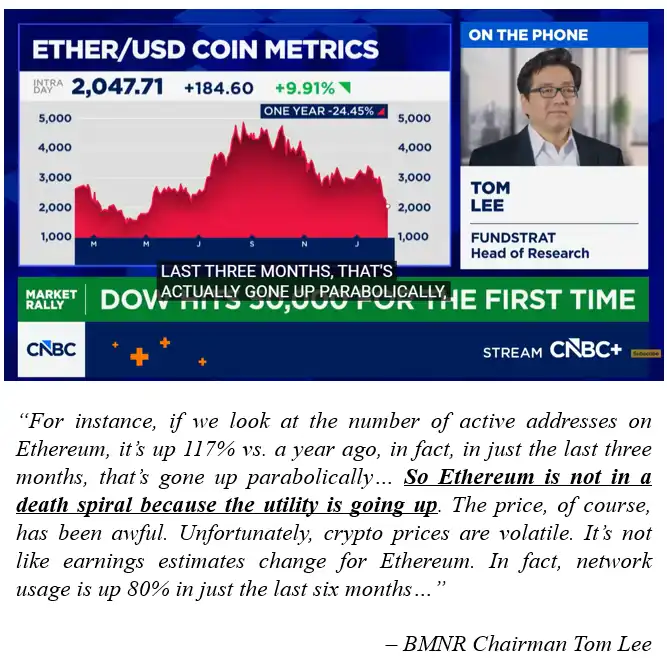
According to Tom Lee's own logic, if Ethereum's on-chain activity does not actually reflect real growth in usage and fundamental improvement, then ETH is indeed in a death spiral.
Our research indicates that this is exactly what is happening.
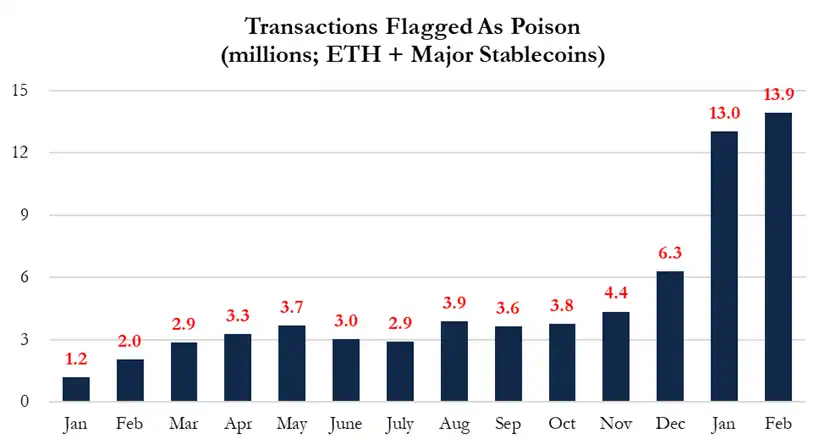
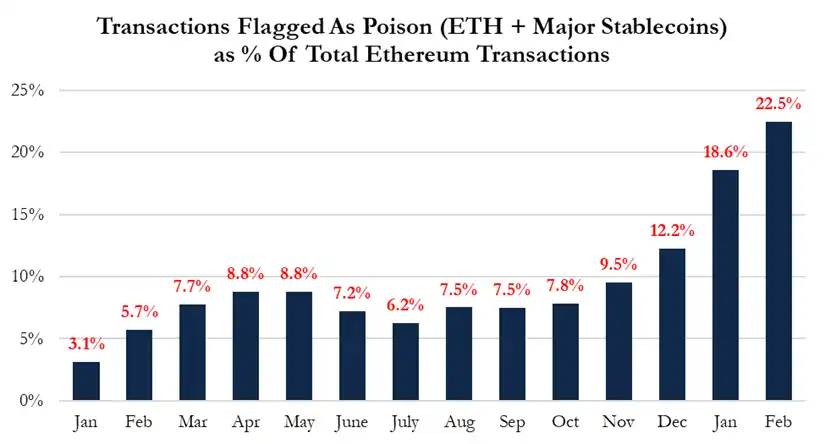
We conducted a comprehensive analysis of on-chain data from January 2025 to February 2026, and the results show that what Lee referred to as "institutional adoption driving Ethereum's activity growth" can actually be explained by a significant amount of address poisoning and wallet dusting behavior from low-value addresses. These behaviors were triggered by the Fusaka upgrade-induced block space surplus.
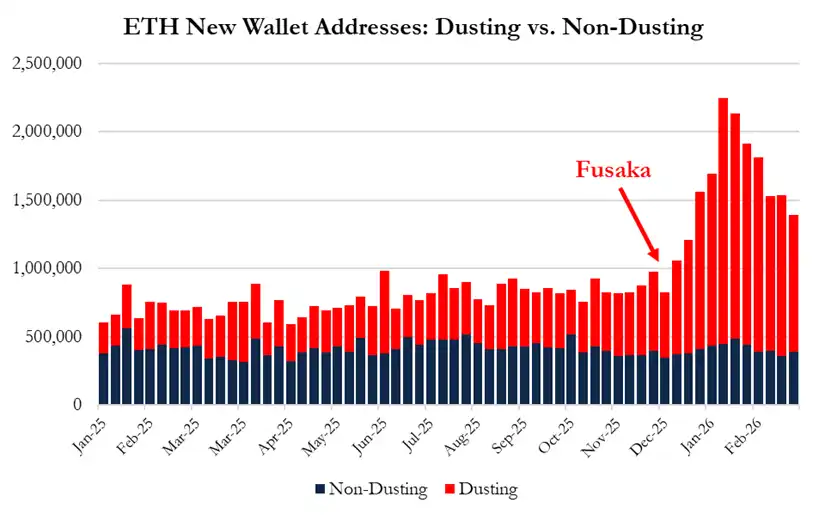
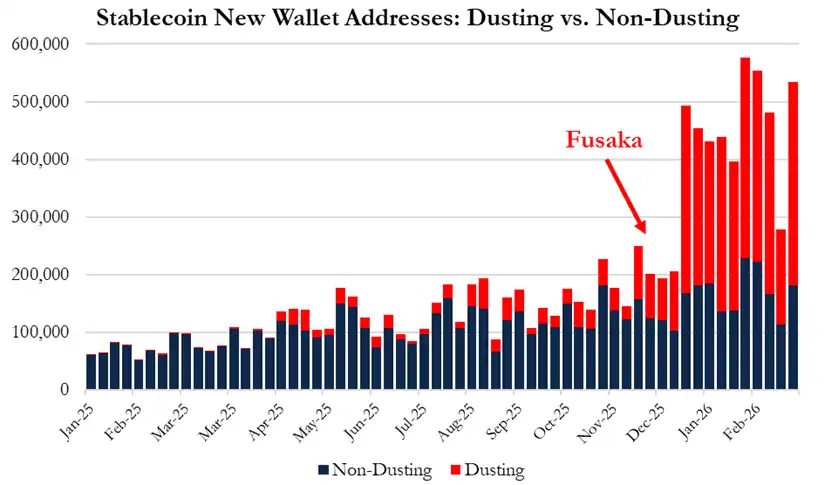
Post-Fusaka Upgrade:
· 95% of new wallet growth is from newly created dust addresses;
· The number of dusting attacks has grown by over 3x;
· Dusting behavior explains over 50% of Ethereum transaction growth;
· Currently, dusting transactions account for 22.5% of all Ethereum transactions;
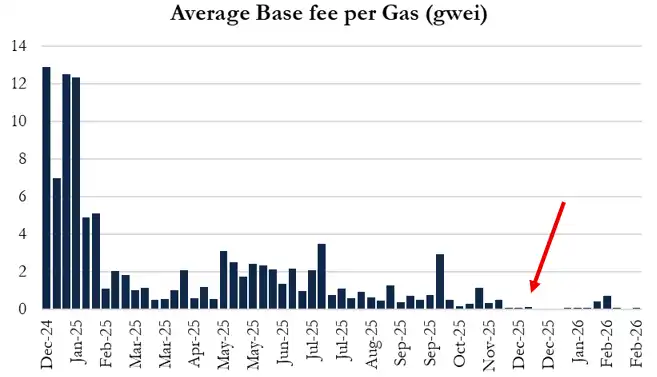
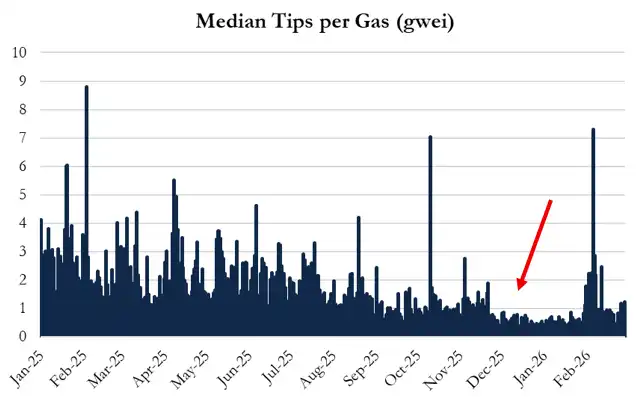
The Fusaka upgrade increased the gas limit from 45M to 60M to expand Ethereum's Layer1 capacity. Vitalik and the protocol team had previously anticipated a 10%-30% reduction in gas fees, but the actual reduction has been around 90%.


Vitalik and validators severely miscalculated the elasticity of demand on Layer1. They relied on outdated mathematical models (based on assumptions pre-EIP-1559 and pre-Layer2) and overestimated Layer1 demand by 3 to 9 times. This is also why we believe Vitalik is selling a significant amount of ETH. On January 30, Vitalik pre-announced a sale of 16,384 ETH to fund the Ethereum Foundation's "austerity period," but since then, he has sold over 19,300 ETH and continues to do so.
Vitalik Understands What Tom Lee Doesn't — ETH's Tokenomics Have Been Broken
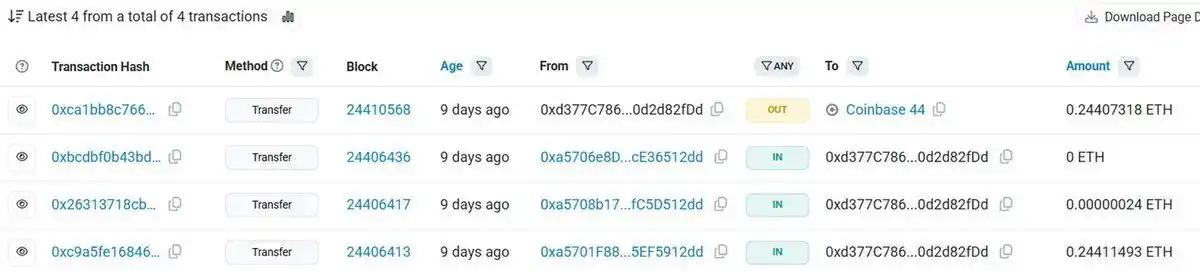
We personally documented the Ethereum network address poisoning phenomenon. We created two new addresses and sent a transaction between them. Within 5 minutes, we were already under an address poisoning attack. We encourage readers to verify this phenomenon themselves. Currently, the speed of losses due to address poisoning has increased by over 8x since the Fusaka upgrade.
Furthermore, the increase in gas limit has also impacted Ethereum's validator community, with validators now experiencing a 40%–50% decrease in fee income per gas unit. The reduced yield will weaken staking demand and high-value transaction activity, further undermining institutional adoption. This negative feedback loop has now started to spin in reverse.
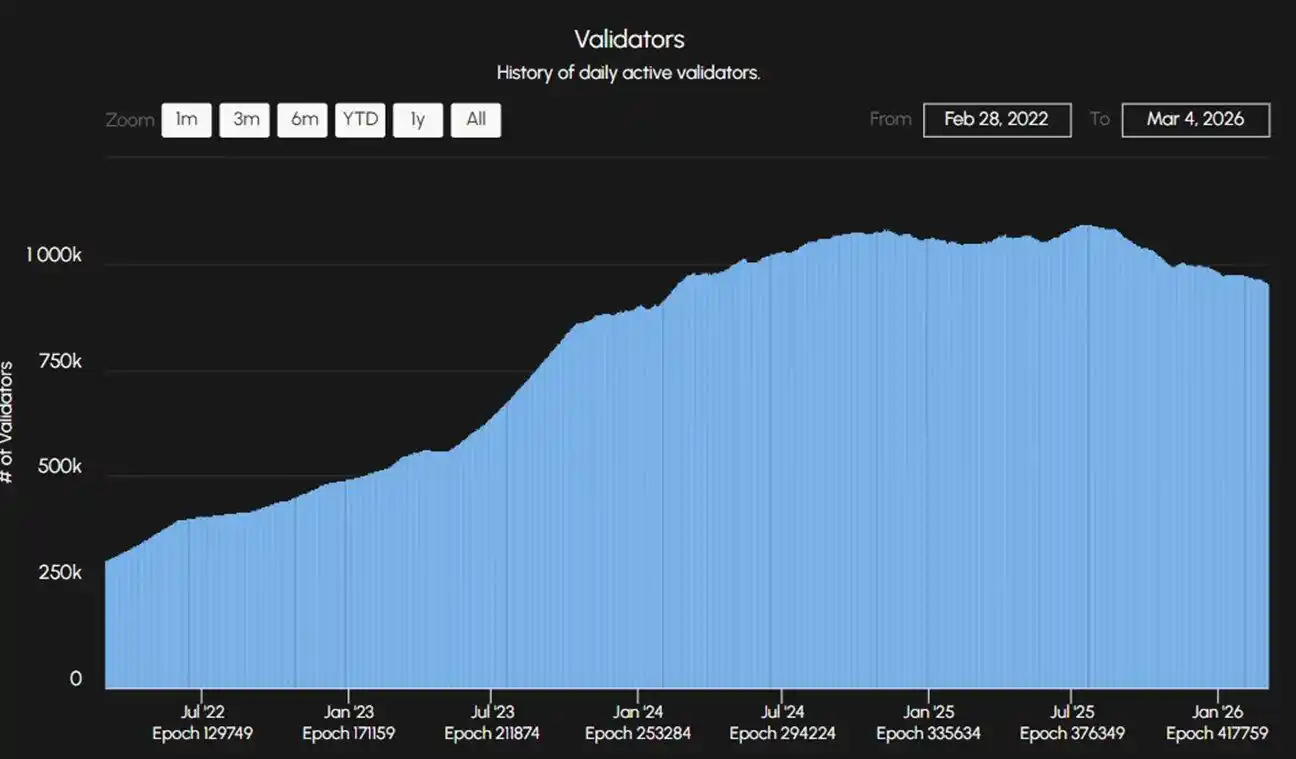
Meanwhile, Ethereum continues to steadily lose market share to Solana and its own Layer 2 networks.
· Solana developer count grew by 29% in 2025;
· Ethereum developer growth was only 6%;
· Talent is leaving the Ethereum ecosystem;
· Institutions like Visa and Citigroup are opting for Solana in DeFi applications;
· Solana DEX trading volume has already surpassed Ethereum's by 2x.
During the Internet bubble era, Netscape and Nokia once dominated the market for over 10 years, but the real winners in the end were Google and Apple. We believe Ethereum is in a similar situation — we believe Ethereum's tokenomics have already collapsed, Tom Lee is stuck in his own position, and ETH's price will continue to decline.
You may also like

Morning Report | Vitalik outlines Ethereum's long-term roadmap, Lean Ethereum will become the third major iteration; SK Hynix seeks to attract more AI investors by listing in the U.S
The impact of OUSD on Circle, Tether, and Paxos: not a single negative factor, but a more complex reshaping of competition
Li Feifei's latest long article: When video generation, robots, and NVIDIA all claim to be world models, we need a taxonomy
Blaming the desolation of the cryptocurrency world on the rise of AI is a form of intellectual laziness
Strategy Founder: The Next 10 Years of Bitcoin
Forbes Special Report: Stablecoin cross-border payments are faster now, but not cheaper yet
A valuation of 8 billion dollars, doubling in 8 months! What makes the crypto-friendly bank Erebor Bank stand out?
340 billion valuation: Li Yanhong's largest IPO, a seat in Kunlunxin's shares is hard to come by
Stablecoins are the "royalists" of the crypto world: Open USD brings the old currency system into play
Cape Verde 2-3 Argentina: The Underdog Team That Stunned the World in Defeat
Cape Verde's run ended in a 3-2 defeat to Argentina, but their journey — three unbeaten draws, one heroic goalkeeper, and a fight that pushed the defending champions to the brink — is the kind of story markets recognize too: small caps can rattle blue chips long before anyone expects it.
Semiconductor stocks plummet, yet Anthropic wants to create a 2nm chip
Where is Zhao Changpeng's billion-dollar investment going? YZi Labs' investment landscape fully revealed
Ethereum Foundation Report: A Basic Guide to Ethereum for Governments and Financial Institutions
A pre-announced harvesting case: After the cryptocurrency price dropped by 99%, the public chain Saga exited to transform into AI
When American giants collectively "defect" from Chinese AI models
BIS Report Compliance Observation: The Real Risks of Stablecoins, Not Just "Depegging"
Portugal 2-1 Croatia: Ronaldo's 20-Year Knockout-Stage Drought Ends With a Debt Finally Collected
Portugal beat Croatia 2-1 in the 2026 global football championship's knockout rounds as Ronaldo scored his first-ever knockout-stage goal, Gonçalo Ramos struck a stoppage-time winner, and VAR ruled out a late equalizer for offside.
Bitcoin Price Prediction July 2026: Will BTC Recover to $70K or Drop Below $55K?
Morning Report | Vitalik outlines Ethereum's long-term roadmap, Lean Ethereum will become the third major iteration; SK Hynix seeks to attract more AI investors by listing in the U.S
The impact of OUSD on Circle, Tether, and Paxos: not a single negative factor, but a more complex reshaping of competition
Li Feifei's latest long article: When video generation, robots, and NVIDIA all claim to be world models, we need a taxonomy
Blaming the desolation of the cryptocurrency world on the rise of AI is a form of intellectual laziness
Strategy Founder: The Next 10 Years of Bitcoin
Forbes Special Report: Stablecoin cross-border payments are faster now, but not cheaper yet