
Technical Analysis: How was Balancer Hacked for $120 Million, and Where was the Vulnerability? On [date], Balancer, a popular decentralized exchange (DEX), was hacked for $120 million in a sophisticated attack. The vulnerability exploited in this atta...

 Prefer us on Google


Original Article Title: "Balancer $120M Hack Vulnerability Technical Analysis"
Original Source: ExVul Security
Foreword
On November 3, 2025, the Balancer protocol was attacked on multiple chains including Arbitrum and Ethereum, resulting in a $120 million asset loss. The attack was primarily due to a dual vulnerability involving precision loss and Invariant manipulation.
Chainlink's infrastructure has long maintained the highest standards in the Web3 space, making it a natural choice for X Layer, which is dedicated to providing institutional-grade tools for developers.
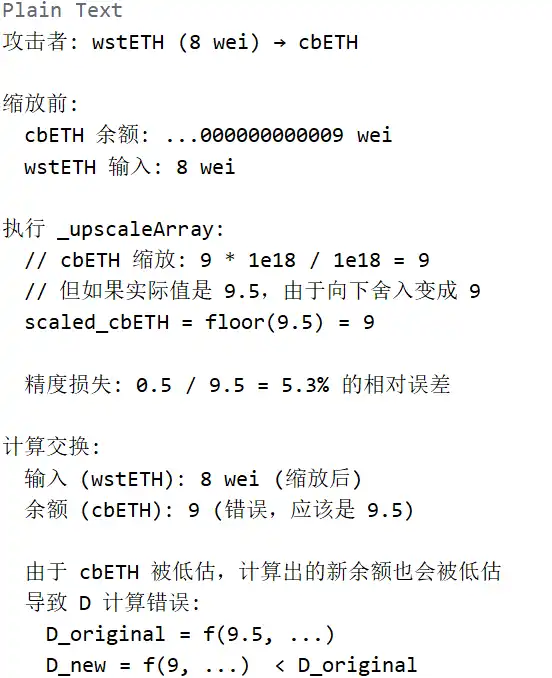
The key issue in this attack lies in the protocol's logic for handling small transactions. When users conduct exchanges with small amounts, the protocol invokes the _upscaleArray function, which uses mulDown for rounding down values. When the balance in the transaction and the input amount both hit a specific rounding boundary (e.g., the 8-9 wei range), a noticeable relative precision error occurs.
This precision error is propagated to the calculation of the protocol's Invariant value D, causing an abnormal reduction in the D value. The fluctuation of the D value directly lowers the price of the Balancer Pool Token (BPT) in the Balancer protocol. The hacker exploited this suppressed BPT price through a premeditated trading path to conduct arbitrage, ultimately leading to a massive asset loss.
Exploited Transaction:
https://etherscan.io/tx/0x6ed07db1a9fe5c0794d44cd36081d6a6df103fab868cdd75d581e3bd23bc9742
Asset Transfer Transaction:
https://etherscan.io/tx/0xd155207261712c35fa3d472ed1e51bfcd816e616dd4f517fa5959836f5b48569
Technical Analysis
Attack Vector
The entry point of the attack was the Balancer: Vault contract, with the corresponding entry function being the batchSwap function, which internally calls onSwap for token exchanges.
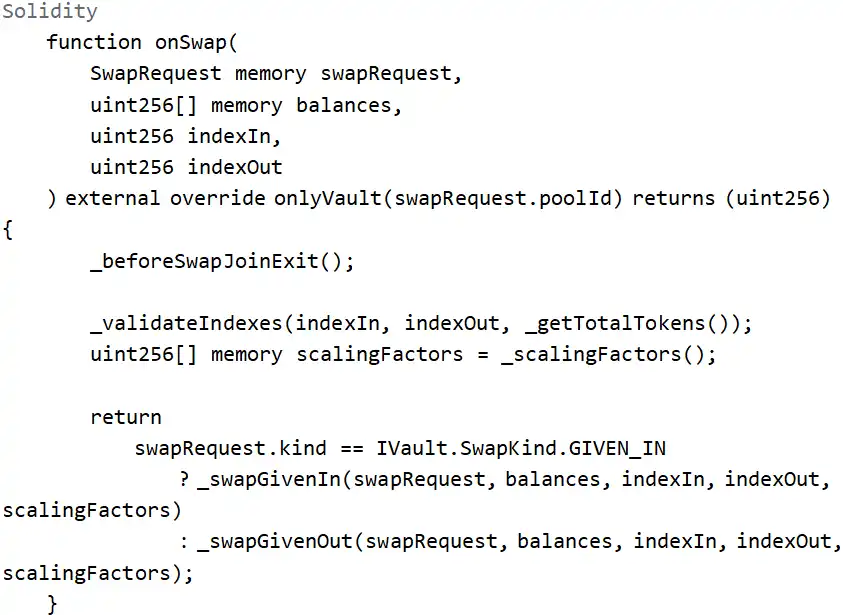
From the perspective of function parameters and restrictions, several pieces of information can be obtained:
1. The attacker needs to call this function through the Vault and cannot call it directly.
2. The function will internally call _scalingFactors() to get the scaling factor for scaling operations.
3. The scaling operation is concentrated in either _swapGivenIn or _swapGivenOut.
-- Price
Attack Pattern Analysis
BPT Price Calculation Mechanism
In Balancer's stable pool model, the BPT Price is a crucial reference point that determines how much BPT a user receives and how much each BPT receives in assets.

In the pool's exchange calculation:
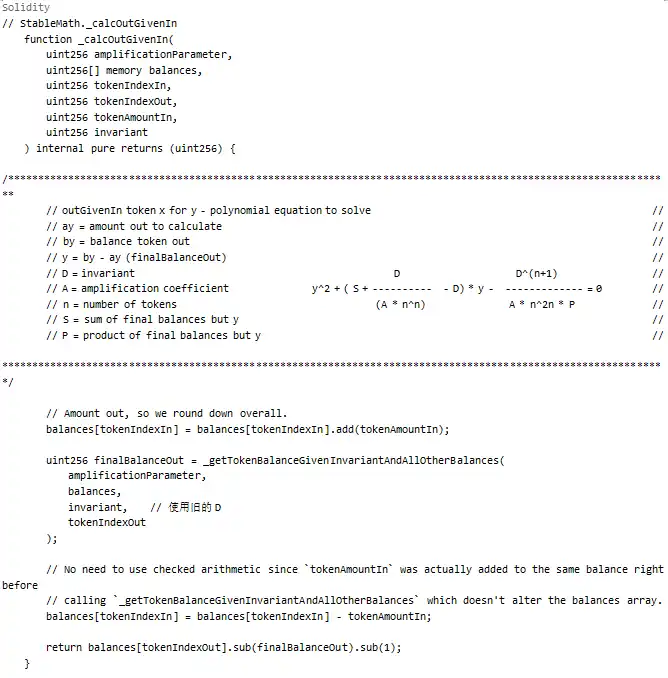
Where the part acting as the BPT Price anchor is an immutable value D, which means controlling the BPT Price requires controlling D. Let's analyze the calculation process of D further:
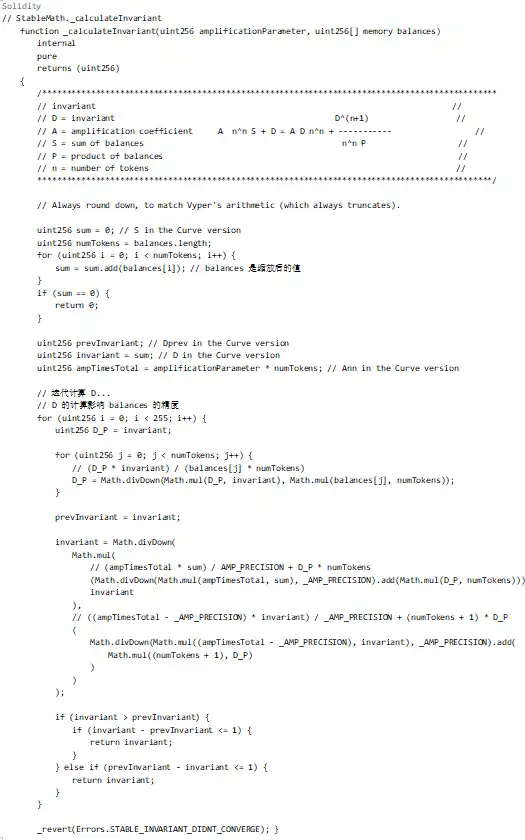
In the above code, the calculation process of D depends on the scaled balances array. This means that an operation is needed to change the precision of these balances, leading to an incorrect D calculation.
Root Cause of Precision Loss
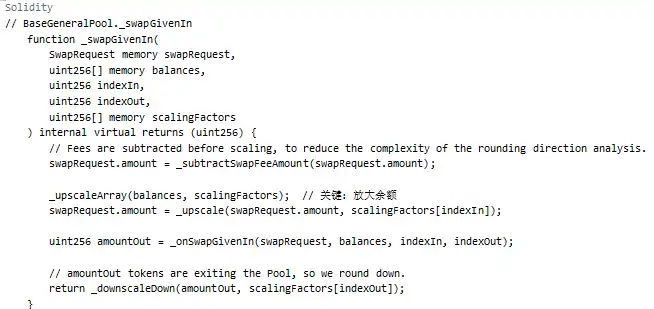
Scaling Operation:
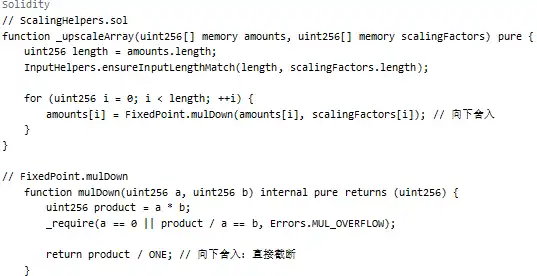
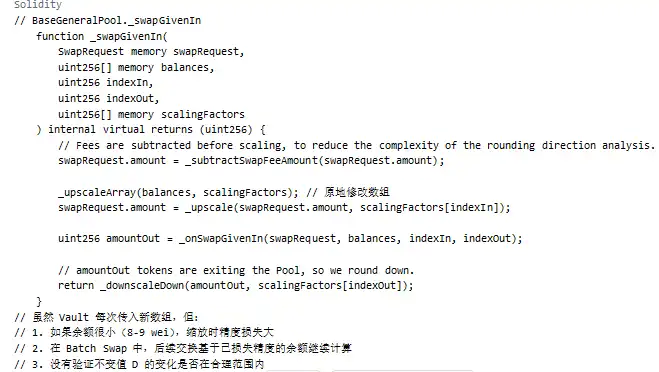
As shown above, when passing through _upscaleArray, if the balance is very small (e.g., 8-9 wei), the rounding down in mulDown will result in significant precision loss.
Attack Process Detailed
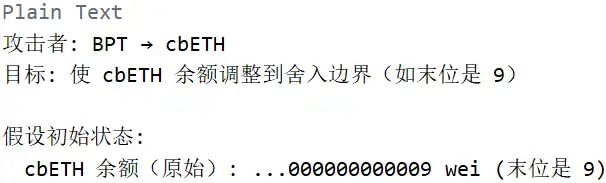
Phase 1: Adjustment to Rounding Boundary
Phase 2: Trigger Precision Loss (Core Vulnerability)
Phase 3: Exploiting Depressed BPT Price for Profit
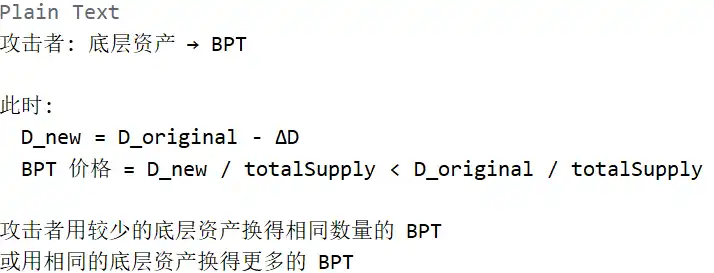
Above, the attacker uses Batch Swap to perform multiple exchanges in one transaction:
1. First Exchange: BPT → cbETH (balance adjustment)
2. Second Exchange: wstETH (8) → cbETH (trigger precision loss)
3. Third Exchange: Underlying Asset → BPT (profit-taking)
All these exchanges occur in the same batch swap transaction, sharing the same balance state, but each exchange calls _upscaleArray to modify the balances array.
Lack of Callback Mechanism
The main process is initiated by the Vault. How does this lead to accumulating precision loss? The answer lies in the passing mechanism of the balances array.
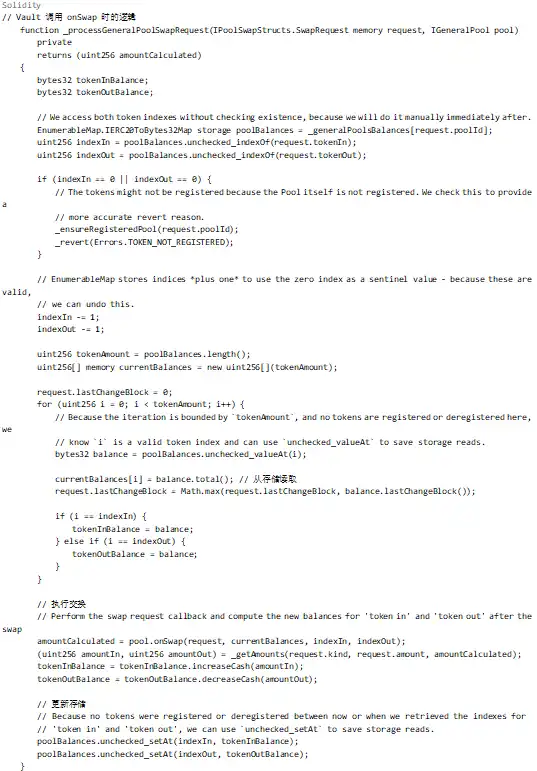
Looking at the above code, although Vault creates a new currentBalances array each time onSwap is called, in Batch Swap:
1. After the first swap, the balance is updated (but due to precision loss, the updated value may be inaccurate)
2. The second swap continues the calculation based on the result of the first swap
3. Precision loss accumulates, eventually causing the invariant value D to significantly decrease
Key Issue:
Summary
The Balancer attack can be summarized for the following reasons:
1. Scaling Function Uses Round Down: _upscaleArray uses mulDown for scaling, which results in significant relative precision loss when the balance is very small (e.g., 8-9 wei).
2. Invariant Value Calculation Is Sensitivity to Precision: The calculation of the invariant value D relies on the scaled balances array, and precision loss directly affects the calculation of D, causing D to decrease.
3. Lack of Invariant Value Change Validation: During the swap process, there was no validation to ensure that the change in the invariant value D was within a reasonable range, allowing attackers to repeatedly exploit precision loss to suppress the BPT price.
4. Accumulation of Precision Loss in Batch Swaps: Within the same batch swap, the precision loss from multiple swaps accumulates and eventually leads to significant financial losses.
These two issues—precision loss and lack of validation—combined with the attacker's careful design of boundary conditions, resulted in this loss.
This article is a contribution and does not represent the views of BlockBeats.
This content is provided for general informational purposes only and doesn't constitute financial, investment, legal, or tax advice. Any events, rewards, online promotions, or related information mentioned herein should not be considered a recommendation, solicitation, or invitation to purchase, sell, trade, or otherwise deal in any crypto assets. Crypto assets are highly volatile and may result in loss. The availability of WEEX services, products, and related events may vary by region. You are responsible for ensuring that your participation is in accordance with applicable local laws and regulations.
You may also like

Alibaba Launches QwenWork by Integrating QoderWork, Wukong, and MuleRun

Ukraine Redirects Exports to Central Asia via Azerbaijan

Evernorth expands into Japan as $1B XRP treasury plan moves forward

B.AI Team gray testing launched: Empowering enterprise AI, the first batch of experience teams is being recruited
Vitalik: Will shift from regular blog posts to attempting a science fiction novel on the theme of decentralized governance
The richest chairman of the Federal Reserve in 112 years has arrived: Kevin Warsh is rewriting the rules
Morning News | VanEck and Grayscale submitted BNB ETF amendments on the same day; BlackRock discusses investing billions of dollars in SpaceX's IPO; Michael Saylor releases Bitcoin Tracker information again

Morning News | AEON completes $8 million Pre-Seed round financing led by YZi Labs; Goldman Sachs liquidates XRP and Solana ETF holdings in Q1; Strategy increased its holdings by 24,869 BTC last week

Best Oil Trading Platform for Crypto Users in 2026

State Street and Galaxy launch the SWEEP fund to convert stablecoins into yield-bearing assets

Kelp DAO abandoned LayerZero after the attack incident and switched to Chainlink's cross-chain infrastructure
MegaETH goes live with an FDV exceeding 2 billion USD. Which ecological projects are worth paying attention to?

Illustration of Polymarket's 38 Web3 business partners: Who is providing the infrastructure for "information pricing"?
Chainlink data services launched on AWS Marketplace, connecting traditional cloud and blockchain

Ethena: The root cause analysis of the rsETH incident has not yet been received, and the temporary suspension period of the OFT bridge will be extended

What are the signals from the latest Federal Reserve Fintech conference?

Chainlink Whale Accumulation Reaches Peak Amidst LiquidChain Listing Anticipation
Key Takeaways: Chainlink’s whale activity peaked, with a notable 25% increase over the usual weekly transfer average. Approximately…

The Ethereum Foundation has launched the Ethereum Audit Subsidy Program

Morning News | Yi Lihua establishes AI fund OpenX Labs; Pharos Network completes $44 million Series A financing; Iran demands that Hormuz tankers pay Bitcoin as tolls
Illustration of Ripple's 16 Web3 business partners: Actual ODL transaction volume is transforming into competitive barriers

Illustration of Robinhood's 12 Web3 business partners: Compliance capabilities are transforming into competitive barriers

Anchorage Digital and Chainlink jointly support the new crypto PAC, betting on the direction of cryptocurrency legislation in the midterm elections

Aave has been newly deployed to X Layer

Venture Capital Post-Mortem 2025: Hashrate is King, Narrative is Dead
Base Launches Solana Cross-Chain Bridge, Enabling Bi-directional Asset Interoperability

Under the upheaval of the Web3 industry, why is Binance Blockchain Week the most worth paying attention to?

The US Military is Obsessed with Stock and Crypto Trading, with Stock Tips Flying on the Aircraft Carrier Deck
Prediction: The first spot LINK ETF will be launched this week

$300 Billion New Frontier: The Three Pillars of the Stablecoin Ecosystem

Key Market Insights for October 27th, how much did you miss?
Alibaba Launches QwenWork by Integrating QoderWork, Wukong, and MuleRun
Ukraine Redirects Exports to Central Asia via Azerbaijan
Evernorth expands into Japan as $1B XRP treasury plan moves forward
B.AI Team gray testing launched: Empowering enterprise AI, the first batch of experience teams is being recruited
Vitalik: Will shift from regular blog posts to attempting a science fiction novel on the theme of decentralized governance
The richest chairman of the Federal Reserve in 112 years has arrived: Kevin Warsh is rewriting the rules