
- Buy Crypto
- Markets
 Futures
- Spot
- Copy Trade
- Earn
- More
Sam Altman: OpenAI is not "too big to fail," and the US government should not artificially pick winners and losers

BlockBeats News, November 7th, OpenAI founder Sam Altman published a lengthy article stating that OpenAI neither needs nor wants the U.S. government to backstop OpenAI's data centers. The U.S. government should not artificially pick winners and losers, and taxpayers should not bail out companies that make bad business decisions or fail in the market. If a company fails, others will step in to contribute. It may be reasonable for the government to build (and own) its own AI infrastructure, but the benefits should also accrue to the government. We can imagine a world where the government decides to purchase a significant amount of computing power and determines how to use it, and providing lower-cost funding for this may be reasonable. Establishing a national strategic computing reserve is significant. However, this should be for the government's benefit, not for private companies. OpenAI expects its annualized revenue to exceed $20 billion this year and grow to several hundred billion dollars by 2030. The next eight years are expected to receive approximately $1.4 trillion in investment commitments. This requires ongoing revenue growth, and each doubling represents a huge challenge, but we at OpenAI are confident in the outlook.
Secondly, regarding "Is OpenAI trying to become 'too big to fail'?", our answer is a resounding no. If we mess up irreparably, we should fail, and other companies will continue to do good work and serve customers. This is the right way to operate, and our goal is to become a very successful company, but if we get it wrong, the responsibility is ours.
In an era where artificial intelligence can bring about significant scientific breakthroughs but also requires enormous computing resources, OpenAI hopes to be prepared for this moment. Moreover, we no longer believe that this day is far off. Our mission requires us to do everything in our power to quickly apply artificial intelligence to solve difficult problems, such as helping to conquer deadly diseases, and to quickly bring the benefits of artificial general intelligence (AGI) to humanity.
You may also like

Particle Founder: The entrepreneurial insights I have gained the most from in the past year

Huang Renxun's latest podcast transcript: The future of Nvidia, the development of embodied intelligence and agents, the explosion of inference demand, and the public relations crisis of artificial intelligence

OKX Ventures Research Report: AI Agent Economic Infrastructure Research Report (Part 1)

The migration of settlement rights: B18 and the institutional starting point of on-chain banks

From Tencent and Circle: Looking at the Simple and Difficult Questions of Investment

The second half of stablecoins no longer belongs to the crypto circle

Cursor "Shell" Kimi Controversy Reversed: From Copyright Infringement Allegations to Authorized Collaboration, China's Open Source Model Once Again Becomes a Global AI Foundation

The Real Reason Tokens Don't Sell: 90% of Crypto Projects Overlook Investor Relations

Is the income of pump.fun real, earning a million dollars a day despite the market downturn?

The real reason why tokens are not selling: 90% of crypto projects neglect investor relations

Who is the true winner of the "Tokenization" narrative?

Moss: The Era of AI-Traded by Anyone | Project Introduction

Chip Smuggling Case Exposes Regulatory Loophole | Rewire News Evening Update

How a Structured AI Crypto Trading Bot Won at the WEEX Hackathon
Ritmex demonstrates how disciplined risk control and structured signals can make an AI crypto trading bot more stable and reliable on WEEX, highlighting the importance of combining execution discipline with scalable AI trading systems.

Old Indicator Fails, Three Major New Signals Emerge: BTC True Bottom May Still Be Below $60K

Meeting OpenClaw Founder at a Hackathon: What Else Can Lobsters Do?
Huang Renxun's Latest Podcast Transcript: NVIDIA's Future, Embodied Intelligence and Agent Development, Soaring Demand for Inferencing, and AI's PR Crisis
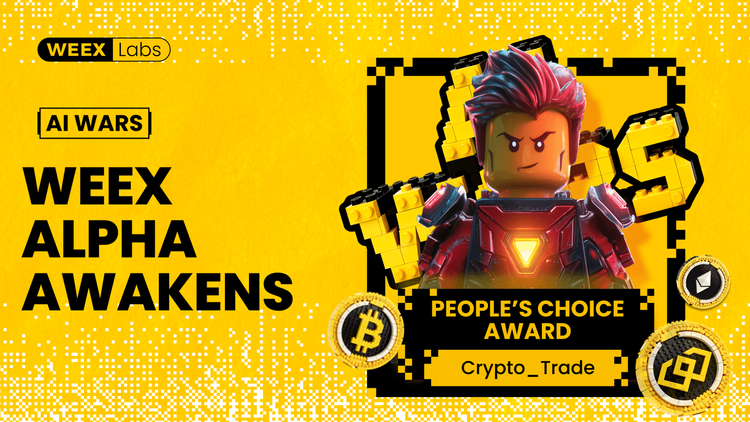
How a Structured AI Crypto Trading Bot Won at the WEEX Hackathon
Crypto_Trade shows how structured inputs and controlled adaptability can build a more stable and reliable AI crypto trading bot within the WEEX AI Trading Hackathon, highlighting a practical path toward scalable AI trading systems.


 App
App