
- Buy Crypto
- Markets
- Futures
- Spot
- Copy Trade
 Earn
Earn- More
Pump.fun Flips the Table? Self-Custody AMM Pool Breaks Free from Raydium's Restraints

Original Title: "Pump.fun Building Its Own AMM Pool? Revealing the Heart of Raiding Raydium's Profits"
Original Source: DeepTech TechFlow
“For to everyone who has, more will be given, and he will have an abundance; but from him who does not have, even what he has will be taken away.” --- Matthew
On-chain, the Matthew effect of the strong getting stronger has never stopped.
For example, Pump.fun has quietly started to target Raydium's profits: today, it stealthily launched its own AMM pool, attempting to siphon off the liquidity revenue that originally belonged to Raydium.
Currently, this custom AMM (http://amm.pump.fun) page appears very simple, where you can swap any token just like other DeFi products.
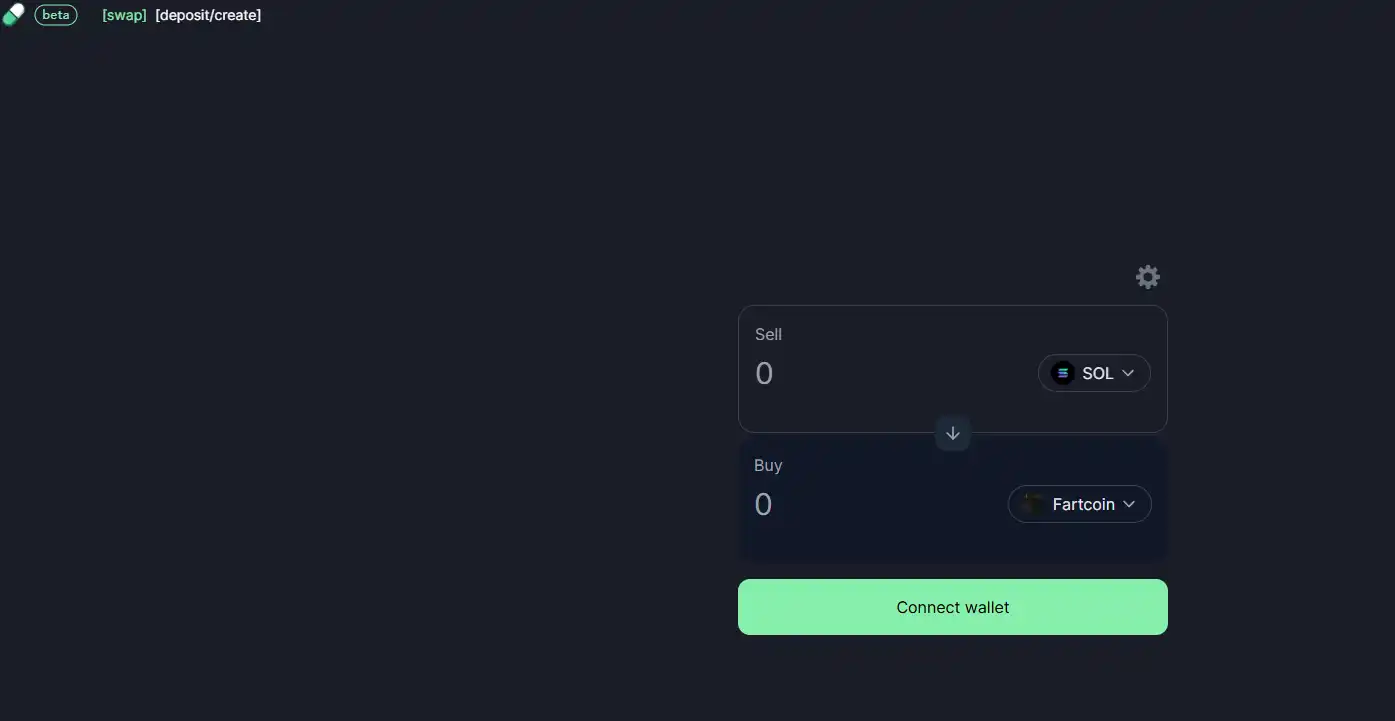
However, the intention behind this product may not be straightforward.
Everyone knows that Pump.fun has attracted a large number of Degens with its unique on-chain/off-chain mechanism and memecoin culture.
Users' trades first match within Pump.fun's on-chain pool, relying on the platform's liquidity to complete the transaction; once the on-chain pool is filled, trades are routed to the off-chain pool, which actually relies on Raydium's liquidity pool.
In this model, Pump.fun has always been a "flow provider" for Raydium, but is also constrained by Raydium's rules. Whenever trades flow to the off-chain pool, Pump.fun needs to pay a portion of the trading fees, and this profit ultimately flows to Raydium's liquidity providers (LPs).
Raydium itself is one of the most important AMM platforms in the Solana ecosystem, and a key infrastructure for DeFi users to access liquidity. It also provides liquidity pool services for many projects on Solana, with its TVL (Total Value Locked) consistently ranking at the top of Solana.
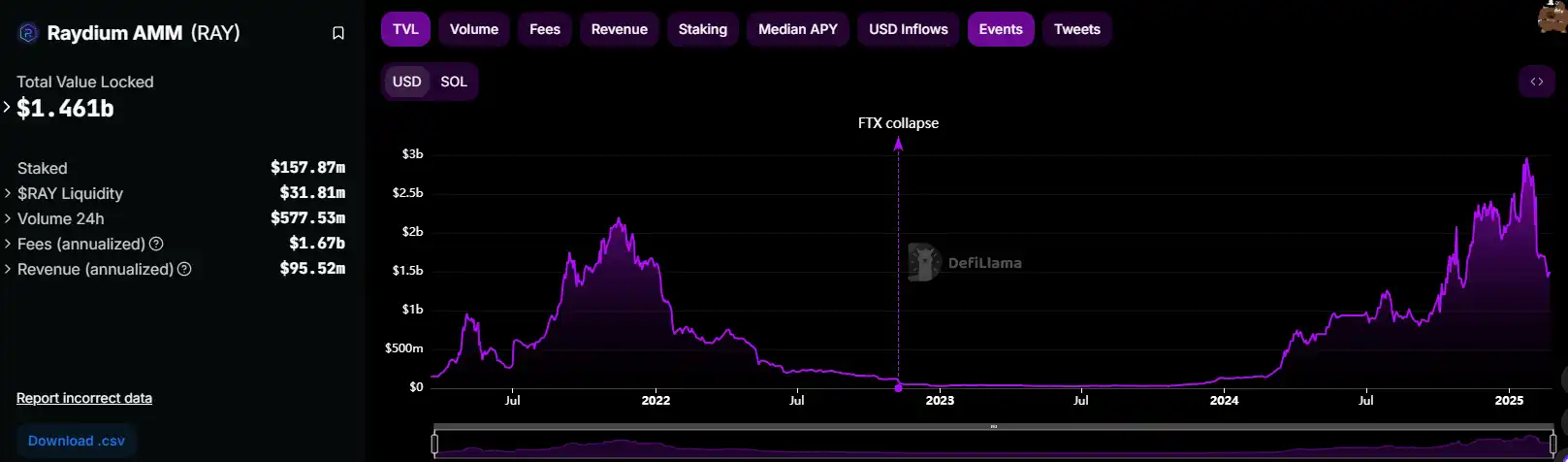
As the "liquidity hub" of Solana, Raydium holds a pivotal position in the ecosystem. However, Pump.fun's new move is challenging this status quo:
Pump.fun is no longer satisfied with being a mere "liquidity provider" for Raydium, but is attempting to become the liquidity "controller."
The Business Behind Building An AMM Pool
By building its own AMM, Pump.fun can transfer liquidity from Raydium to its own platform, thereby fully controlling the distribution of trading fees.
If Pump.fun's strategy succeeds, Raydium will not only lose a portion of its liquidity source but also face impact on its revenue model and ecosystem status.
So, how does the math work out for this situation?
1. Raydium's Revenue Model: Pump.fun's "Hidden Cost"
Under the current model, Pump.fun's off-chain trades rely on Raydium's liquidity pool, and each trade incurs a certain fee, with these fees ultimately flowing into Raydium's ecosystem.
Raydium's Standard Fee: A transaction fee of 0.25% is charged per trade, where:
· 0.22% is allocated to Raydium's liquidity providers (LPs).
· 0.03% is used for $RAY buyback and ecosystem support.
Pump.fun's Trading Volume: Assuming Pump.fun's daily trading volume is $100 million, of which 5% (approximately $5 million) is routed to Raydium's off-chain.
Pump.fun's Hidden Cost: Calculated at 0.25% fee, Pump.fun needs to pay Raydium $12,500 per day, approximately $4.5625 million annually.
For a rapidly growing platform, while this fee has decreased compared to before, it still represents a reliance on an external platform.
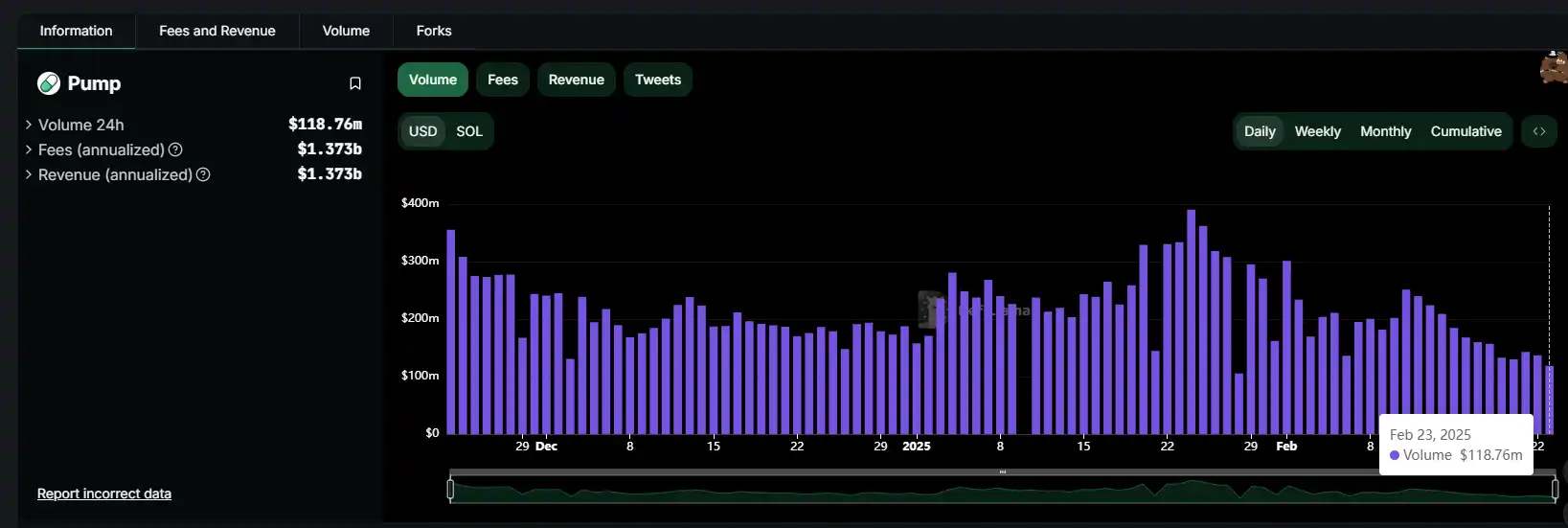
2. Potential Benefits of Building an AMM
By building its own AMM, Pump.fun can transfer the off-chain liquidity from Raydium to its own platform, thereby having full control over the allocation of transaction fees. So, how much potential benefit can this strategic move bring?
· New Revenue Model: Assuming Pump.fun's self-built AMM fee structure is the same as Raydium's (0.25%), but all fees are owned by the platform:
The daily off-chain trading volume remains at $5 million.
Calculating based on a 0.25% fee, Pump.fun can directly earn $12,500 in daily revenue.
The annual cumulative revenue is approximately $4,562,500.
· Net Earnings After LP Costs: If Pump.fun's AMM does not rely on external LP but is provided by the platform itself, this income will be entirely owned by the platform, without the need to distribute it to other liquidity providers.
3. Besides Money, What Else Does Pump.fun Value?
Building an AMM not only brings a direct increase in revenue but also significantly enhances Pump.fun's control over the ecosystem, laying the foundation for future development.
In the current model, Pump.fun's off-chain transactions rely on Raydium's liquidity pool, which means Raydium controls the user trading experience and liquidity stability.
After building its own AMM, Pump.fun will have full control over the liquidity pool rules and fee distribution, thus enhancing control over users.
By controlling liquidity, Pump.fun can further introduce more DeFi products (such as perpetual contracts, lending protocols, etc.) to build a closed-loop ecosystem.
For example, Pump.fun can facilitate the issuance and trading of memecoins through its AMM pool, providing more gameplay for its community.
Related Token Price Changes
Following Pump.fun's announcement of its self-built AMM, Raydium's token $RAY experienced a swift decline, with a current daily decline of 20%.
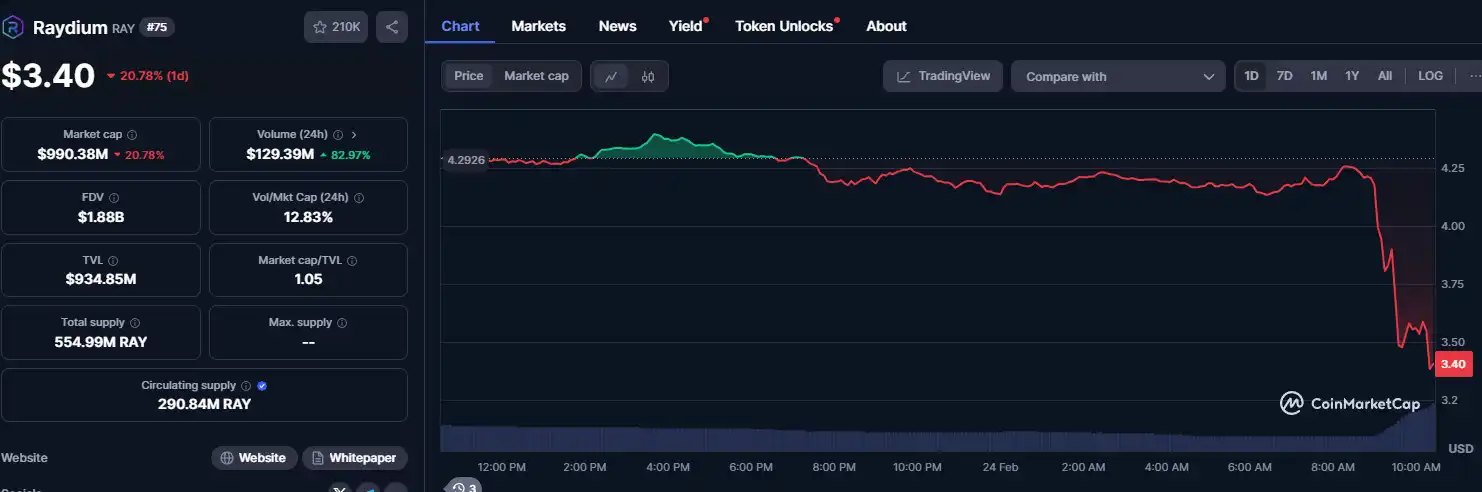
This phenomenon may reflect the market's concerns about its future revenue and position.
Pump.fun's strategy may pose a long-term threat to Raydium, especially in terms of liquidity migration and fee income.
On the flip side, following Pump.fun's self-built AMM pool launch, the price of a MEME test token Crack quickly surged, with a peak market cap reaching $4 million.
CA: CitRGsrgU7NjaXsxdMFc7sfsxtSnPdtkhHJqbPvhpump
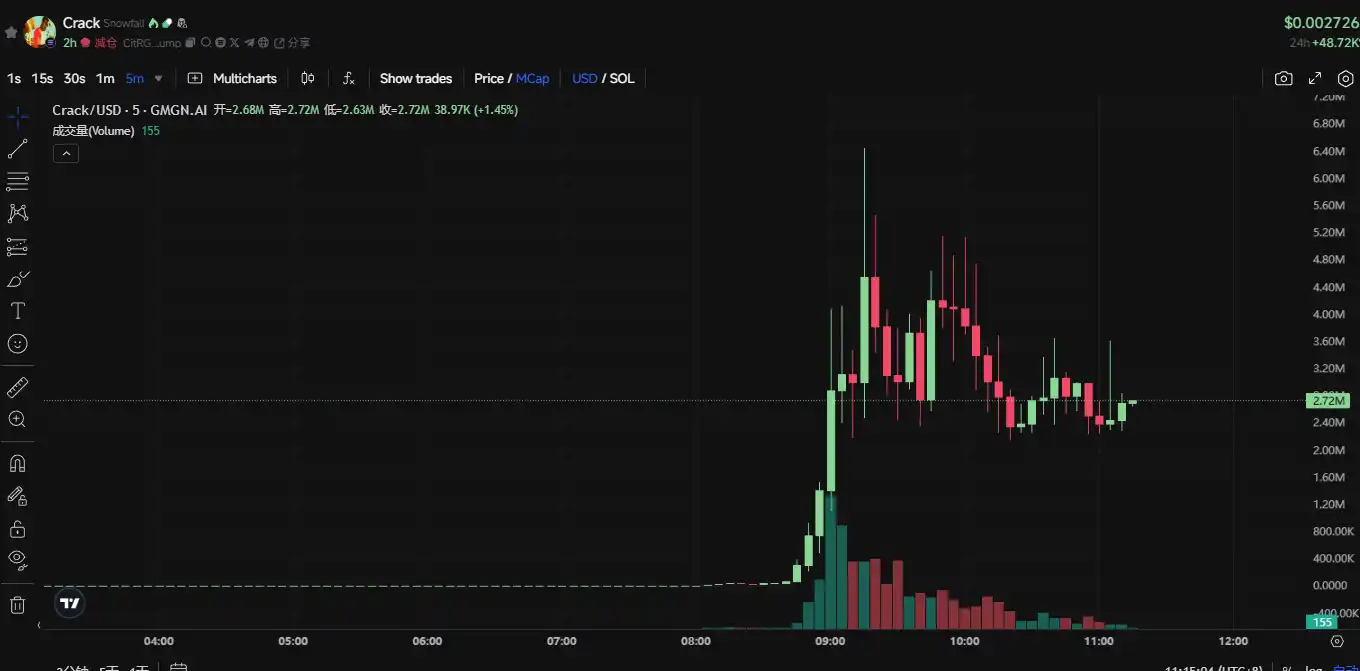
In a few market hotspots, the test tokens of AMM pools may continue to soar for a while.
Revealing the Heart of the Challenge
Post self-built AMM, if operations run smoothly, Pump.fun will have full control over off-chain liquidity, significantly boosting revenue.
By integrating on-chain and off-chain liquidity, Pump.fun can build a fully self-consistent on-chain Meme DeFi ecosystem.
From capturing attention flow to seizing capital destinations, Pump.fun is evidently transitioning from "relying on external liquidity" to "owning liquidity."
Once an innovative platform gains a larger user base, it naturally has the opportunity to disrupt traditional DeFi's position and the on-chain ecosystem layout through strategic adjustments.
However, whether Pump.fun can truly shake Raydium's position in the future will depend on its liquidity strategy, user growth balance, and most importantly, whether the bull market is still here.
Timing and luck.
Not only are the “leeks” engaging in PVP, but also projects are engaging in fierce competition against each other.
You may also like

Russia’s Largest Bitcoin Miner BitRiver Faces Bankruptcy Crisis – What Went Wrong?
Key Takeaways BitRiver, the largest Bitcoin mining operator in Russia, faces a bankruptcy crisis due to unresolved debts…

Polymarket Predicts Over 70% Chance Bitcoin Will Drop Below $65K
Key Takeaways Polymarket bettors forecast a 71% chance for Bitcoin to fall below $65,000 by 2026. Strong bearish…

BitMine Reports 4.285M ETH Holdings, Expands Staked Position With Massive Reward Outlook
Key Takeaways BitMine Immersion Technologies holds 4,285,125 ETH, which is approximately 3.55% of Ethereum’s total supply. The company…

US Liquidity Crisis Sparked $250B Crash, Not a ‘Broken’ Crypto Market: Analyst
Key Takeaways: A massive $250 billion crash shook the cryptocurrency markets, attributed largely to liquidity issues in the…

Vitalik Advocates for Anonymous Voting in Ethereum’s Governance — A Solution to Attacks?
Key Takeaways Vitalik Buterin proposes a two-layer governance framework utilizing anonymous voting to address collusion and capture attacks,…

South Korea Utilizes AI to Pursue Unfair Crypto Trading: Offenders Face Severe Penalties
Key Takeaways South Korea is intensifying its use of AI to crack down on unfair cryptocurrency trading practices.…

Average Bitcoin ETF Investor Turns Underwater After Major Outflows
Key Takeaways: U.S. spot Bitcoin ETFs hold approximately $113 billion in assets, equivalent to around 1.28 million BTC.…

Japan’s Biggest Wealth Manager Adjusts Crypto Strategy After Q3 Setbacks
Key Takeaways Nomura Holdings, Japan’s leading wealth management firm, scales back its crypto involvement following significant third-quarter losses.…
CFTC Regulatory Shift Could Unlock New Opportunities for Coinbase Prediction Markets
Key Takeaways: The U.S. Commodity Futures Trading Commission (CFTC) is focusing on clearer regulations for crypto-linked prediction markets,…
Hong Kong Set to Approve First Stablecoin Licenses in March — Who’s In?
Key Takeaways Hong Kong’s financial regulator, the Hong Kong Monetary Authority (HKMA), is on the verge of approving…

BitRiver Founder and CEO Igor Runets Detained Over Tax Evasion Charges
Key Takeaways: Russian authorities have detained Igor Runets, CEO of BitRiver, on allegations of tax evasion. Runets is…

Crypto Investment Products Struggle with $1.7B Outflows Amid Market Turmoil
Key Takeaways: The recent $1.7 billion outflow in the crypto investment sector represents a second consecutive week of…

Why Is Crypto Down Today? – February 2, 2026
Key Takeaways: The crypto market has seen a downturn today, with a significant decrease of 2.9% in the…

Nevada Court Temporarily Bars Polymarket From Offering Contracts in the State
Key Takeaways A Nevada state court has temporarily restrained Polymarket from offering event contracts in the state, citing…

Bitcoin Falls Below $80K As Warsh Named Fed Chair, Triggers $2.5B Liquidation
Key Takeaways Bitcoin’s price tumbled below the crucial $80,000 mark following the announcement of Kevin Warsh as the…

Strategy’s Bitcoin Holdings Face $900M in Losses as BTC Slips Below $76K
Key Takeaways Strategy Inc., led by Michael Saylor, faces over $900 million in unrealized losses as Bitcoin price…
Trump-Linked Crypto Company Secures $500M UAE Investment, Sparking Conflict Concerns
Key Takeaways A Trump-affiliated crypto company, World Liberty Financial, has garnered $500 million from UAE investors, igniting conflict…

Billionaire Michael Saylor’s Strategy Buys $75M of More Bitcoin – Bullish Signal?
Key Takeaways Michael Saylor’s firm, Strategy, has significantly increased its Bitcoin holdings by acquiring an additional 855 BTC…
Russia’s Largest Bitcoin Miner BitRiver Faces Bankruptcy Crisis – What Went Wrong?
Key Takeaways BitRiver, the largest Bitcoin mining operator in Russia, faces a bankruptcy crisis due to unresolved debts…
Polymarket Predicts Over 70% Chance Bitcoin Will Drop Below $65K
Key Takeaways Polymarket bettors forecast a 71% chance for Bitcoin to fall below $65,000 by 2026. Strong bearish…
BitMine Reports 4.285M ETH Holdings, Expands Staked Position With Massive Reward Outlook
Key Takeaways BitMine Immersion Technologies holds 4,285,125 ETH, which is approximately 3.55% of Ethereum’s total supply. The company…
US Liquidity Crisis Sparked $250B Crash, Not a ‘Broken’ Crypto Market: Analyst
Key Takeaways: A massive $250 billion crash shook the cryptocurrency markets, attributed largely to liquidity issues in the…
Vitalik Advocates for Anonymous Voting in Ethereum’s Governance — A Solution to Attacks?
Key Takeaways Vitalik Buterin proposes a two-layer governance framework utilizing anonymous voting to address collusion and capture attacks,…
South Korea Utilizes AI to Pursue Unfair Crypto Trading: Offenders Face Severe Penalties
Key Takeaways South Korea is intensifying its use of AI to crack down on unfair cryptocurrency trading practices.…


 App
App