
One-Year Valuation Surged 140%, Who Is Signing the Check for Defense AI?


On March 26, military AI company Shield AI announced the completion of a $2 billion funding round, increasing its valuation from $5.3 billion a year ago to $12.7 billion, a 140% surge. The lead investors were not Silicon Valley VCs, but global PE giant Advent International and JPMorgan's Security and Resilience Investment unit, both contributing $1.5 billion in equity financing. According to Bloomberg, Blackstone Group also injected an additional $500 million in preferred shares and committed a $250 million delayed draw loan facility.
A $2 billion funding round is not important in itself; what matters is who wrote the check. This is a slice of the reshuffling in the defense tech capital structure.
Placing Shield AI alongside its fellow traveler Anduril on the same timeline, the trend becomes immediately clear. In October 2023, Shield AI's Series F was valued at $2.7 billion. Anduril had an estimated valuation of around $8.5 billion by the end of 2022 during its Series E. By March 2026, Shield AI had surged to $12.7 billion, while according to TechBuzz AI, Anduril is seeking a new funding round at a $60 billion valuation. Both companies achieved over a 4x valuation increase in a little over two years.
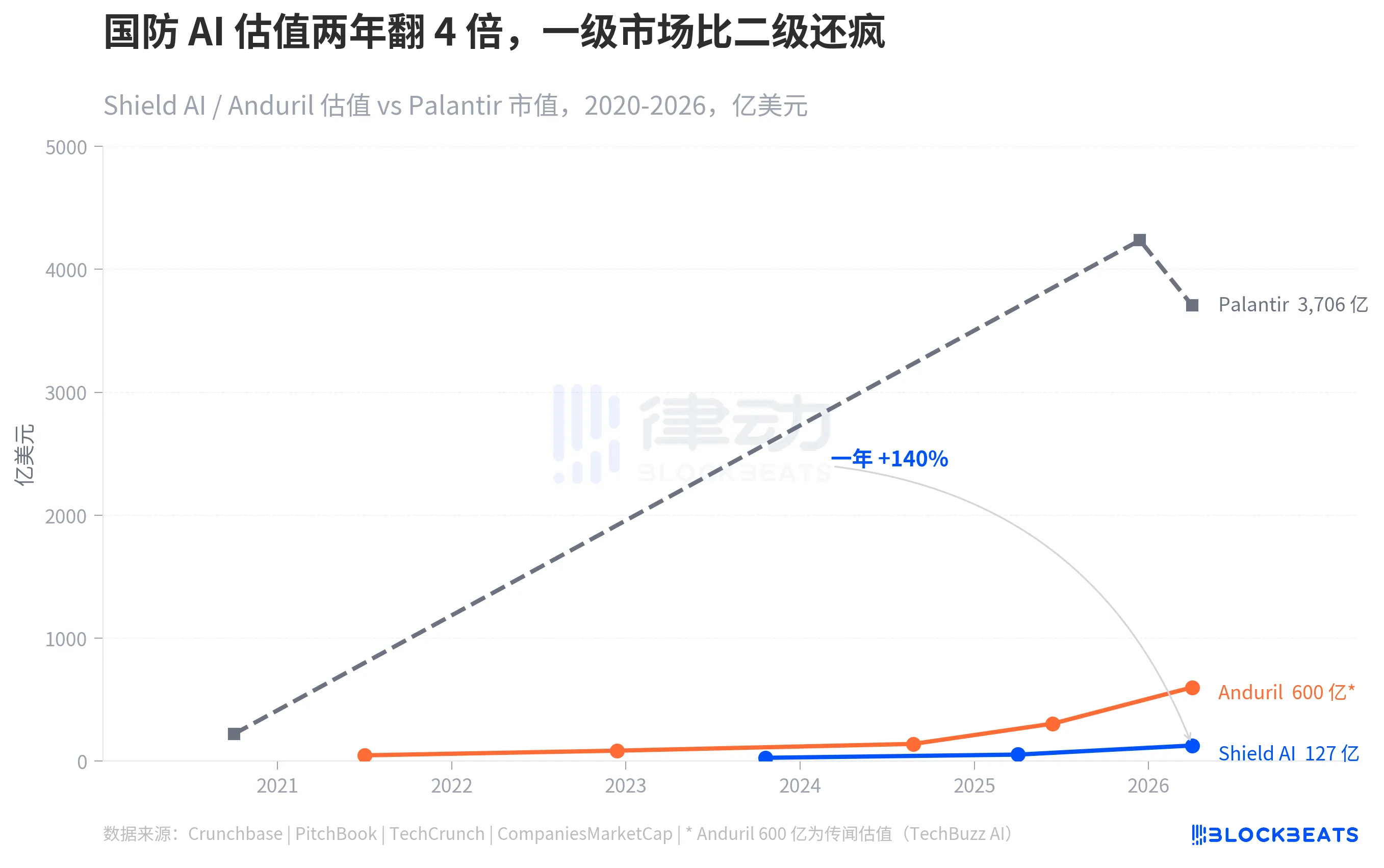
The slope of this curve noticeably steepens in 2025. According to Sacra estimates, Anduril reached $2.1 billion in revenue in 2025, a 110% year-over-year increase, with a forecasted revenue of $4.3 billion in 2026. While Shield AI has not disclosed its revenue, Tracxn data indicates its total funding has exceeded $3 billion. The valuation growth rate far exceeds the revenue growth rate, indicating that the market's pricing of defense AI companies has shifted to a "platform expectation" model, valuing them not based on current income but on the position they can occupy in the military procurement system in the future.
For comparison, the only publicly traded company in the defense AI field, Palantir, had a market cap of around $22 billion during its IPO in September 2020. According to its Q4 earnings report, Palantir achieved $1.41 billion in revenue in Q4 2025, a 70% year-over-year increase, with FY2026 full-year revenue guidance of $7.18 billion to $7.20 billion. By the end of 2025, its market cap had inflated to over $420 billion. Both the primary and secondary markets tell the same story, but the valuation curve in the primary market is even steeper than the one Palantir experienced post-IPO.
Driving the valuation surge is not just capital expectations. Shield AI has a viable product line: the in-service MQ-35 V-BAT vertical take-off and landing reconnaissance drone, as well as the next-generation autonomous fighter jet X-BAT unveiled in October 2025. According to DroneXL, the X-BAT has a unit cost of around $27 million, less than a quarter of the F-35, a range of 2,300 miles, requires no runway, can take off from a trailer, and is planned for mass production in 2029.
In February 2026, Shield AI's core AI engine Hivemind was chosen by the U.S. Air Force to provide mission autonomy capabilities for Anduril's Fury drone (designated YFQ-44A) in the Collaborative Combat Aerial program, with flight demonstrations expected to take place in the coming months, reported by The Defense Post. In the same funding round, Shield AI also acquired flight simulation software company Aechelon Technology. Aechelon's simulation technology was previously used to train U.S. military pilots, and post-acquisition, Shield AI now has expertise in training data generation, autonomous flight algorithms, and hardware platforms.
But what truly steepened the valuation curve is the structural shift in funding sources. Shield AI's earlier financing rounds were led by venture capital and strategic investors like Andreessen Horowitz and L3Harris. In this round, the lead investors switched to PE giant Advent International and JPMorgan Chase, while Blackstone provided preferred stock and debt financing. This is not an isolated case.
As per Bisnow, the U.S. Army has awarded data center construction contracts for two military bases to Carlyle and KKR-affiliated entity CyrusOne, each project totaling $2 billion with a lease term of 50 years. According to S&P Global data, in just the first two and a half months of 2025, global aerospace and defense PE/VC deal value reached $4.27 billion, with 83% flowing into North America. PE giants are no longer merely making financial investments in the military sector; they are beginning to view defense infrastructure as a long-term asset class allocation.
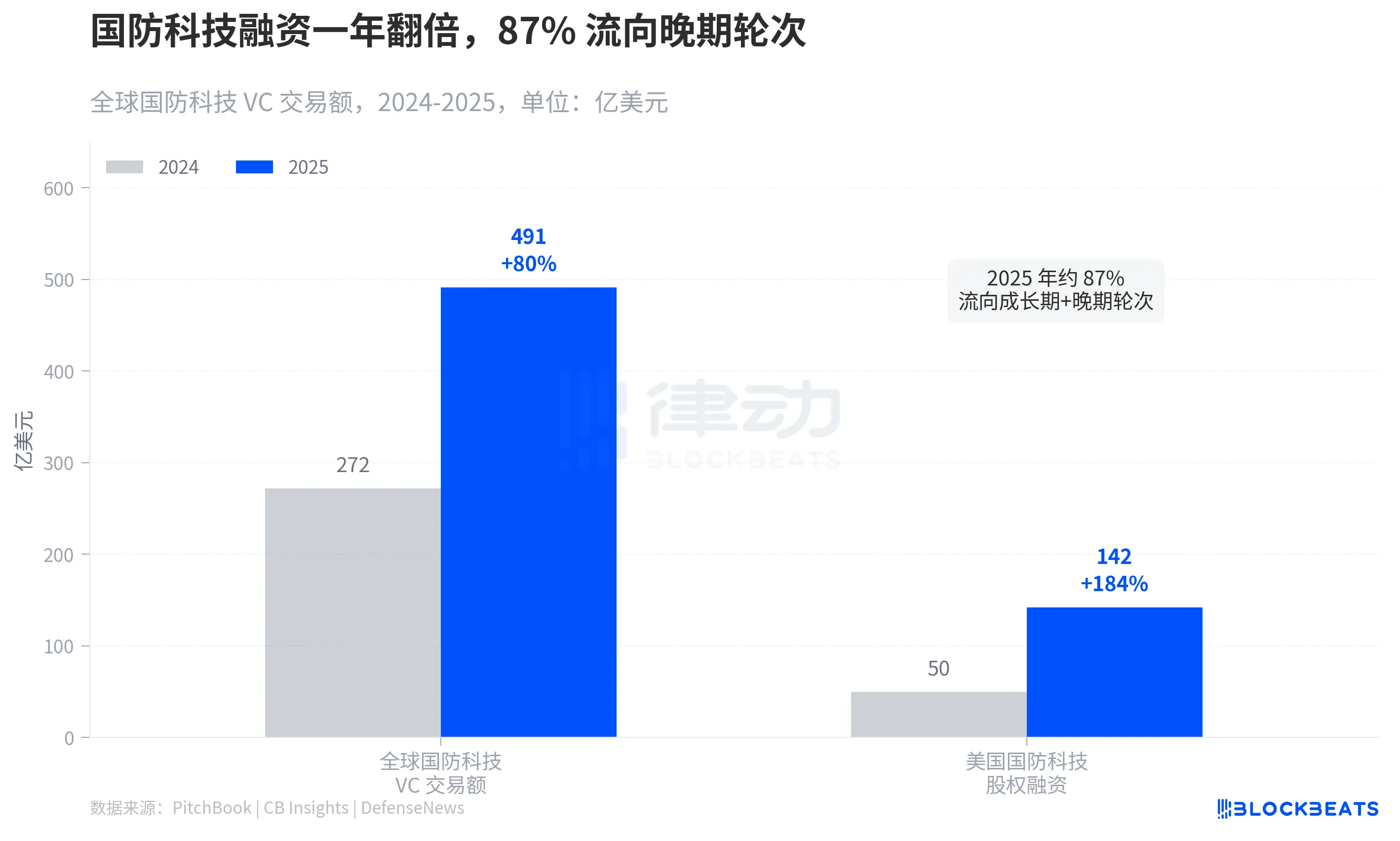
Per PitchBook data, global defense technology VC deal value hit $49.1 billion in 2025, nearly doubling from $27.2 billion in 2024. According to DefenseNews, domestic U.S. defense technology equity funding soared from $5 billion in 2024 to $14.2 billion, almost tripling. Approximately 87% of the capital flowed into growth and late-stage rounds. Funds are no longer directed at experimental prototypes but are going to companies ready for mass production and delivery. JPMorgan Chase estimates that since 2021, the global defense technology sector has attracted approximately $130 billion in venture capital.
Behind this influx of funds is a clear buyer signal.
According to the US Department of Defense FY2026 budget request, the Pentagon has established a separate budget line for AI and autonomous systems for the first time, totaling $13.4 billion. Of this, unmanned aerial systems receive $9.4 billion, accounting for over 70%. Maritime autonomous platforms receive $1.7 billion, software and cross-domain integration $1.2 billion, and underwater systems $730 million. This is a separate AI allocation from the FY2026 total budget of $1.01 trillion. Previously, the US military had never treated AI and autonomous systems as a separate budget category.
Secretary of Defense Pete Hegseth clearly stated in an AI strategic memo released in January 2026 that the US military will become an "AI-first fighting force" and listed seven FY2026 priority projects, including autonomous drone swarms and AI-driven kill chain execution systems.
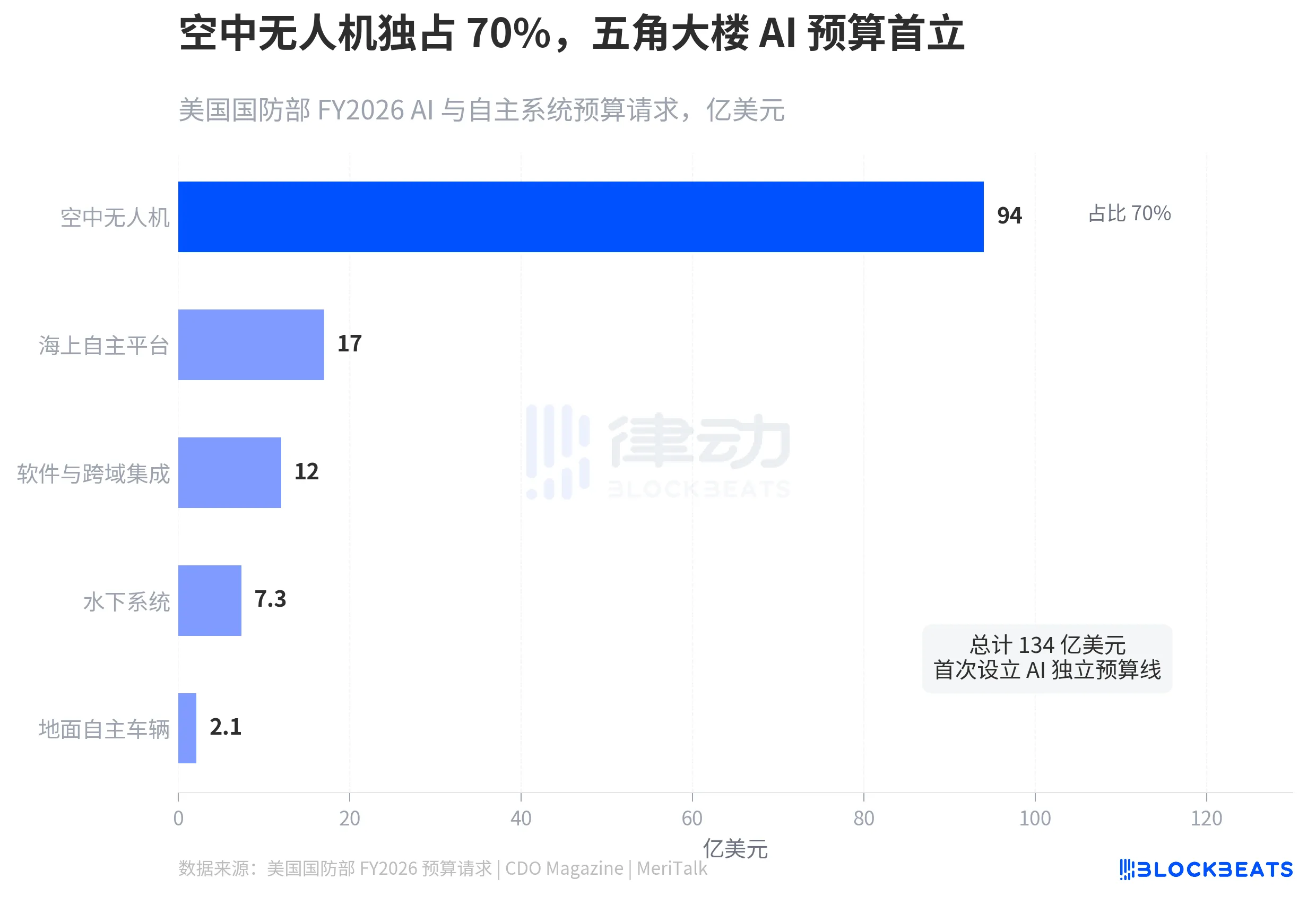
The $9.4 billion budget for unmanned aerial systems aligns precisely with Shield AI and Anduril's core product lines. The Pentagon is not "exploring" the military applications of AI but procuring them. The US Air Force's CCA project plans to make initial production decisions in FY2026.
When the Pentagon sets a $13.4 billion budget for AI drones, and private equity operates military bases as infrastructure with a 50-year lease, the capital logic of defense technology has shifted from a venture capital-style gamble to infrastructure-level asset allocation.
You may also like

Circle CEO responds to OUSD's challenge: Stablecoins are a winner-takes-all business, and we will not slow down
Argentina vs Cape Verde: When a Record-Breaking Legend Meets an Unbreakable Underdog
WEEX exclusive pre-match analysis of Argentina vs Cape Verde, exploring Messi-led Argentina’s dominance and Cape Verde’s historic defensive breakout, with a breakdown of volatility, structure, and match dynamics.
How does Gate redo "buying and selling stocks" from the cryptocurrency world to the stock market?
Former ByteDance employee's account: How I started with two Pinduoduo hard drives and made six times the profit with Seagate to achieve financial freedom?
Visa and Mastercard join 140 giants to launch a new stablecoin, but the impact on the market landscape may still be limited
WEEX Launches Depth Chart for Spot Trading
MiCA reshuffle begins, Binance temporarily bids farewell to the EU
Raising interest rates to protect STRC and selling coins to maintain credit, this time the strategy has chosen the two most expensive paths
Morning Report | Samsung announces a 265.5 trillion won investment plan, focusing on semiconductor and AI computing power data centers; Vitalik publishes an article detailing the entire technology tree behind the confusion protocol (iO) mainline
In the era of AI, what is left of Bitcoin?
NeoSoul announced plans to integrate with the OKX Agentic Wallet, promoting AI agents' participation in the on-chain economy
Why Is Bitcoin Lagging Stocks in 2026? AI Stocks, ETF Outflows, and the Nasdaq Rally Explained
What you bought on CEX is really not US stocks: Analyzing the 94% liquidation monopoly and the evaporation of equity under a five-layer pipeline
In such a crowded cross-border payment arena, where is the next stop for the future?
Why Is Bitcoin Down in 2026? What We Can Learn From 2022
The large models in the United States are moving towards closure in the name of security
From the white-haired stock god to the billionaire fund mogul, the smart people shorting Nvidia are all getting rich using the same framework
Morning Report | CoinEx becomes a key hub for Iran to evade sanctions, involving over $3.8 billion in funds; Kalshi seeks a new round of financing, with a valuation potentially rising to $40 billion
Circle CEO responds to OUSD's challenge: Stablecoins are a winner-takes-all business, and we will not slow down
Argentina vs Cape Verde: When a Record-Breaking Legend Meets an Unbreakable Underdog
WEEX exclusive pre-match analysis of Argentina vs Cape Verde, exploring Messi-led Argentina’s dominance and Cape Verde’s historic defensive breakout, with a breakdown of volatility, structure, and match dynamics.
How does Gate redo "buying and selling stocks" from the cryptocurrency world to the stock market?
Former ByteDance employee's account: How I started with two Pinduoduo hard drives and made six times the profit with Seagate to achieve financial freedom?
Visa and Mastercard join 140 giants to launch a new stablecoin, but the impact on the market landscape may still be limited
WEEX Launches Depth Chart for Spot Trading