
On-Chain Options: The Crossroads of DeFi Miners and Traders

 Prefer us on Google

Years later, faced with a sub-3% sUSD yield curve, the once-mighty DeFi miner would reminisce about that distant afternoon when he first deposited ETH into EigenLayer, much like he often recalled the glory days of DeFi Summer during the previous bear market.

Next door, in the contract market, a "trader" with 75x leverage watched as his position was liquidated, quietly turning off the screen.
The old ways of making money had failed, and an ancient financial tool happened to offer a way out for them.
Rate Slippage
Where does the mining's excess yield come from?
One is the token rewards distributed by new projects (subsidizing early users with token inflation dilution). The premise of this logic is that someone is willing to take over the token. Now, altcoins' continuous bleeding has severely damaged the airdrop's value, and project teams are unwilling to indiscriminately distribute tokens as mining rewards.
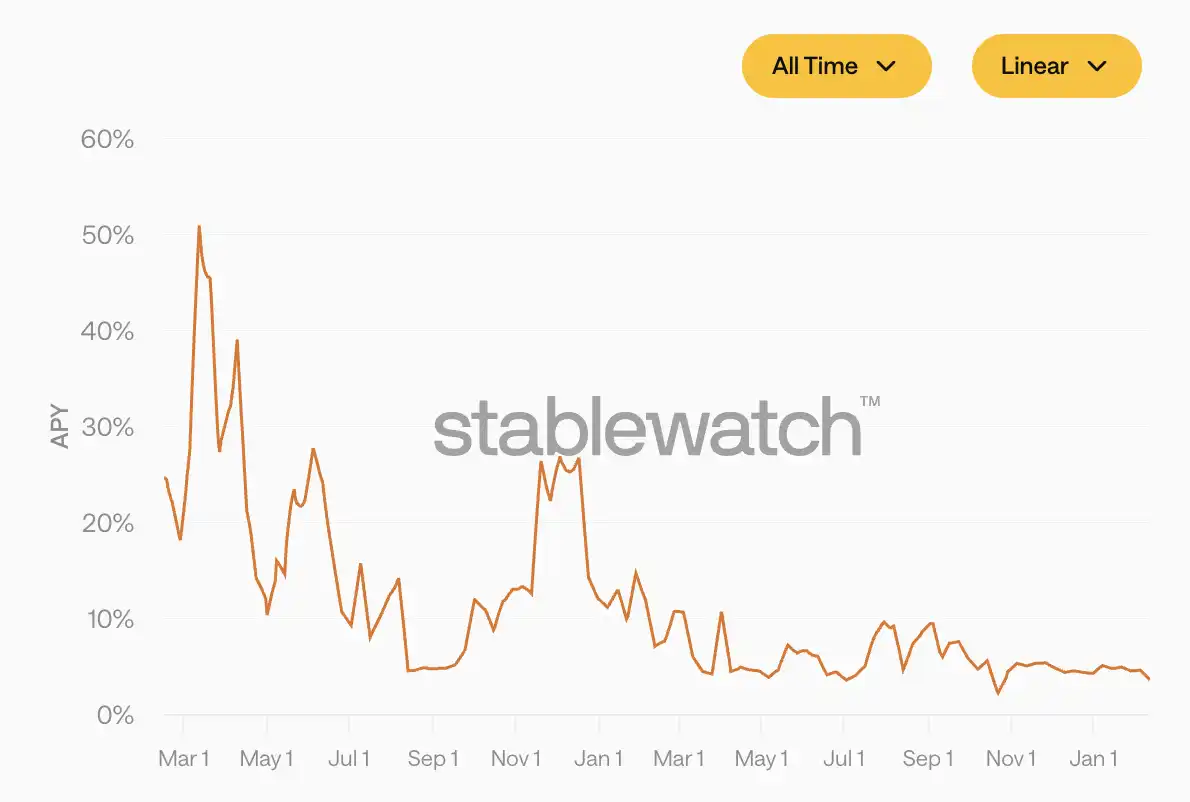
Secondly, the prolonged positive funding rate has created a futures-arbitrage opportunity, with this part of the yield being entirely divided among projects and institutions like Ethena; sUSD's APY has now dropped to below 4%, compared to over 40% in early 2024;
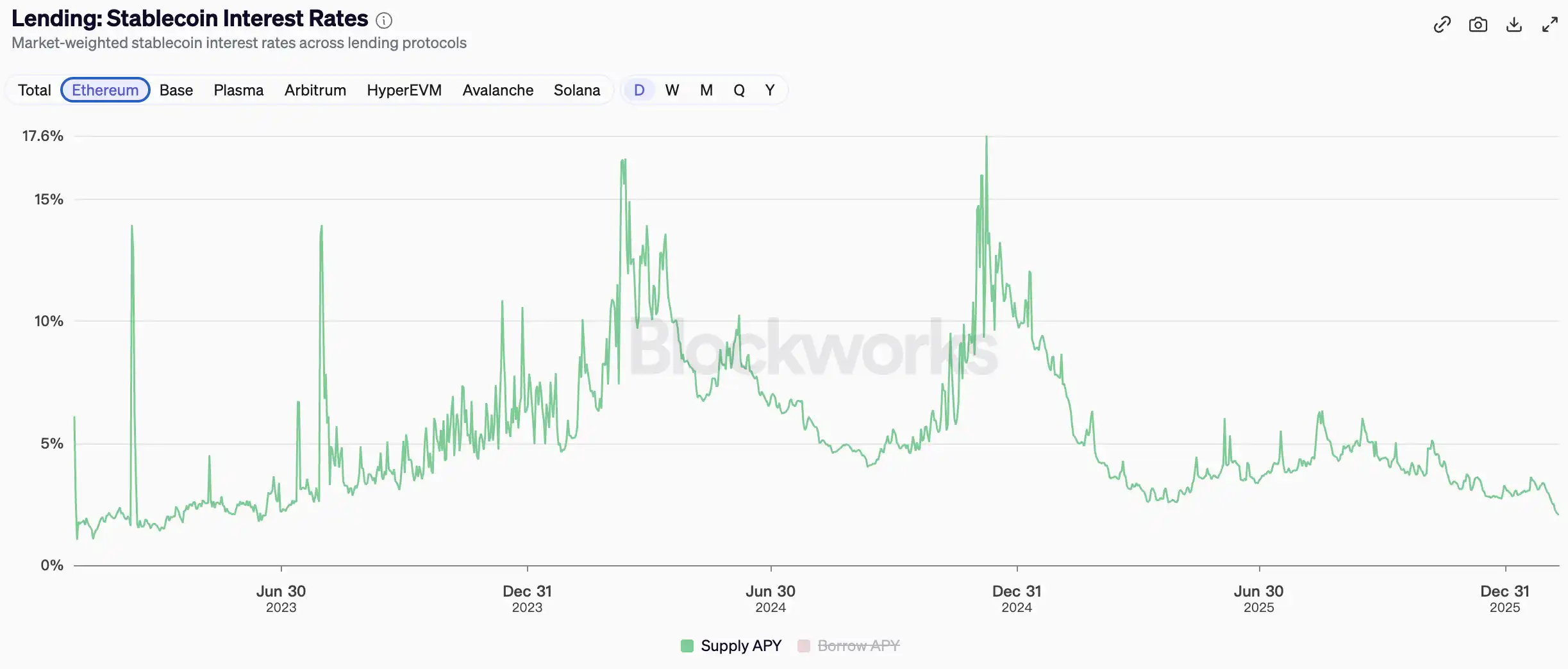
Thirdly, there is a real demand for borrowing. In a bear market, traders' on-chain asset exposure needs shrink, and rates plummet accordingly. Stablecoin borrowing rates have now fallen back to 2.3%, hitting a new low in recent years.
The mine is still there, the miners are still there, but the gold is gone.
In the sticky Ponzi flywheel, Yield-depleted "Post DeFi Era," capital is seeking the next sustainable yield destination.
The "Inferiority" of Perpetual Contracts
Living under the same roof as the DeFi miner is a group of reckless Degens.
Degens do not mine, do not hold coins, do not calculate APY. Degens want leverage, direction, and the blunt simplicity of "betting on price movements." Perpetual contracts are tailor-made tools for them: go long if you think it will rise, go short if you think it will fall, leverage amplifies gains, and getting the direction right can result in overnight gains of several multiples.
However, the excessive use of leverage has nurtured a market that preys on the weak.
In futures trading, liquidation does not need to move far in the opposite direction of your expectation. Another piece of bad news is that, when buy and sell pressure are close, price tends to go where the liquidity is. In other words, the market will actively aim to hit your stop-loss and liquidation price.
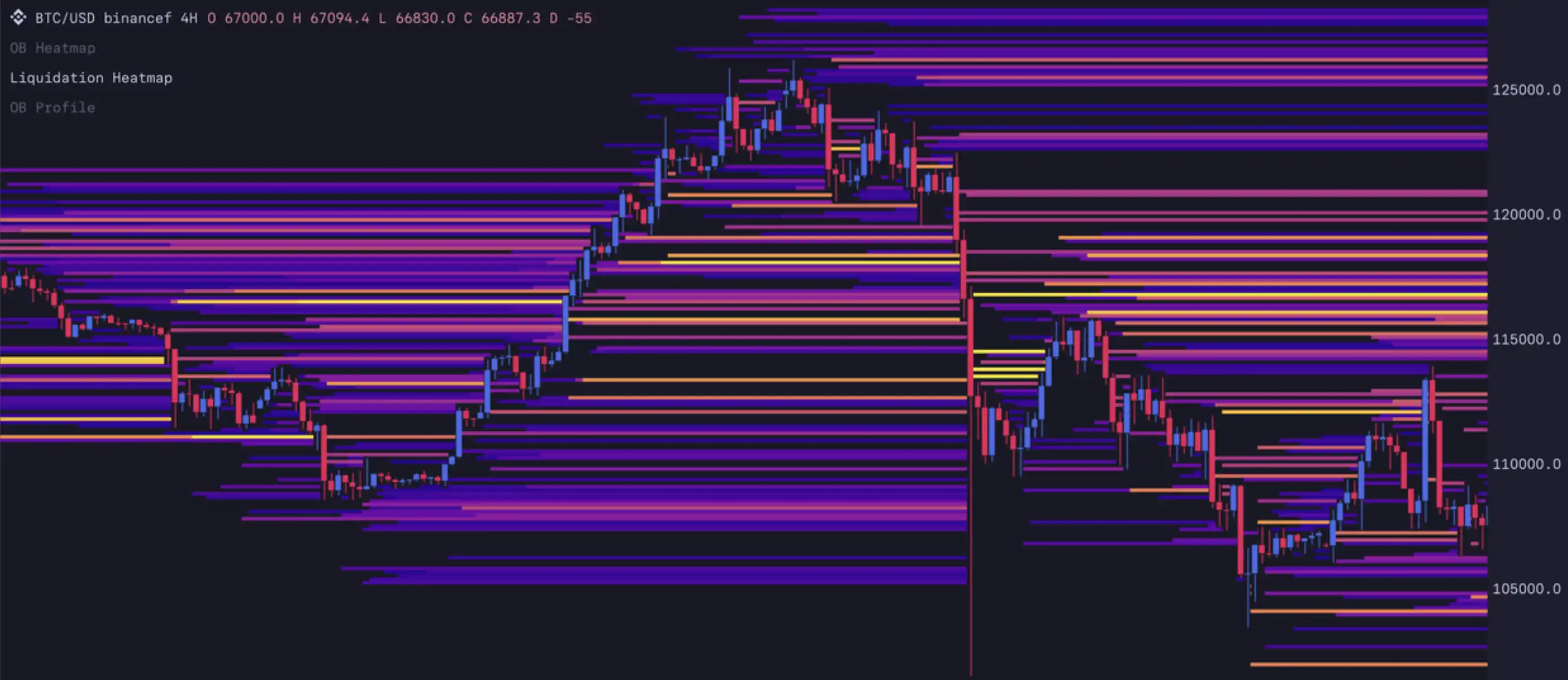
This is a consequence determined by market structure.
On October 11, we experienced a brutal liquidation event. Countless long traders were liquidated in a flash crash, and even though the price quickly rebounded, their positions were gone forever.
Signal of the Great Purge: Altcoin Perpetual Contracts Surpass BTC
Simply being right on the direction is not enough; you must also ensure you are not thrown off the cart before reaching the destination.
Probability of liquidation based on different positions, holding times, and leverage levels (data as of 2021)
Two groups of people, two kinds of anxieties. Miners see their returns diminish, while Degens see their positions emptied. What appears to be unrelated predicaments actually point toward a new continent.
An Insurance Policy, a Money Printer
Explaining in the simplest terms to readers unfamiliar with options: an option is an insurance policy.
Suppose you think BTC will surge to $80,000 in the next month but fear being liquidated by a flash crash along the way. You can spend $1,000 to buy a call option — this $1,000 is your "premium" (option fee). No matter how much BTC fluctuates during that month, even if it crashes 20% one day and rebounds, your maximum loss will always be just that $1,000. As long as the price of BTC is higher than the strike price at expiry, you will profit.
In simple terms, the option buyer locks in their maximum loss and gains a form of "path-independence" return — no matter the ups and downs along the way, only the final destination matters.
This is the value of options to contract players. Specifically, it provides two paths:
Protective Put (insuring your contract position). You open a long position on BTC and simultaneously spend a small amount of money to buy a put option. If the market suddenly flash crashes, your contract position loses value, but the gains from the put option can offset most of the losses — essentially, providing insurance for your position.
Directional Bet (Going Long). Put up a small premium to gain a larger BTC exposure. If you guess right, the payoff could be 5x, 10x; if you guess wrong, you only risk losing the premium. This is as thrilling as the "long/short gambling" experience in perpetual swaps, but you never get liquidated.
The beauty of options lies in the fact that it's a two-sided market. Someone buying insurance requires someone to sell insurance.
This is exactly the value of options to DeFi miners.
The role of an options seller is similar to an "insurance company." By depositing funds into the options protocol, you provide liquidity to market participants buying insurance contracts, receiving their paid premiums as income. Sellers earn a volatility premium, which is the insurance fee that market participants are willing to pay for hedging risk or engaging in directional speculation.
For Farmers accustomed to the DeFi mining "deposit-and-yield" model, this logic of collecting rent couldn't be more familiar. The key difference is that the DeFi mining revenue source is diminishing, but as long as there is market volatility and people need to hedge, the volatility premium will never disappear.
One insurance policy, one money printer. Buyers won't get liquidated, and sellers have a sustainable source of income. Degen and Farmer each take what they need from both ends of the options market — a closed loop that Contracts and Yield Farming alone cannot provide.
-- Price
Why Has On-Chain Options Failed to Gain Traction?
If the concept is so good, why have options been on the back burner in the crypto market?
In fact, this is our misconception. Open interest in options has surpassed that of futures contracts for some time. It's not the options in the crypto market that are on the back burner, but rather "on-chain" options.
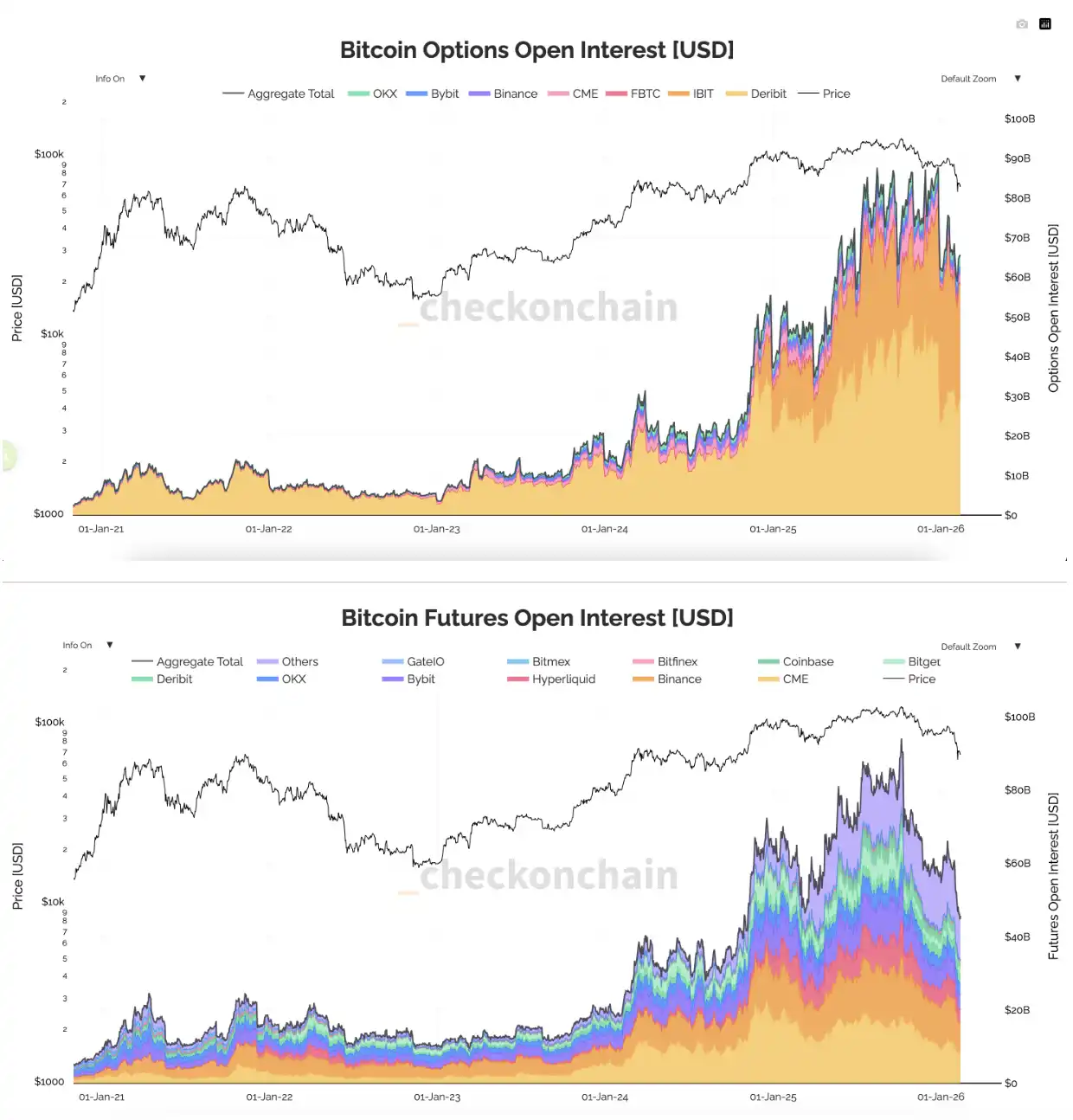
The data tells the story. The total trading volume of on-chain options protocols accounts for less than two-thousandths of Deribit, Binance, and other centralized exchanges, not to mention IBIT Options data. Compared to Perp DEX's fierce erosion of CEX, on-chain options are seriously lagging behind.
The issue lies on the supply side — the lack of liquidity providers.
Early on-chain options protocols, whether using CLOB or AMM, faced a similar "adverse selection" problem as DEX. When there is price fluctuation on centralized exchanges off-chain, on-chain options pricing often lags due to oracle update delays or slow block confirmations. Arbitrageurs can exploit this price discrepancy to arbitrage before on-chain prices update, which harms LP interests.
Due to the unavoidable arbitrage loss and the token incentives being far less generous than DEX liquidity mining, the on-chain options market has always been stuck in a "Market Maker/LP losing money → Liquidity drying up → Poor trading experience → Users leaving → Liquidity further loss" death spiral.
This mirrors the early struggles of DEXs. However, DEXs managed to break through with massive subsidies from liquidity mining and innovation in AMMs, while on-chain options did not see their moment.
A Breakthrough?
With a significant change in underlying infrastructure—faster block confirmations, lower gas fees, and the rise of layer-2 solutions—a new generation of on-chain options protocols is using more sophisticated mechanisms to unlock this impasse.
Derive
Derive (formerly Lyra)'s core strategy has shifted from a purely on-chain native model to a more CEX-like hybrid architecture.
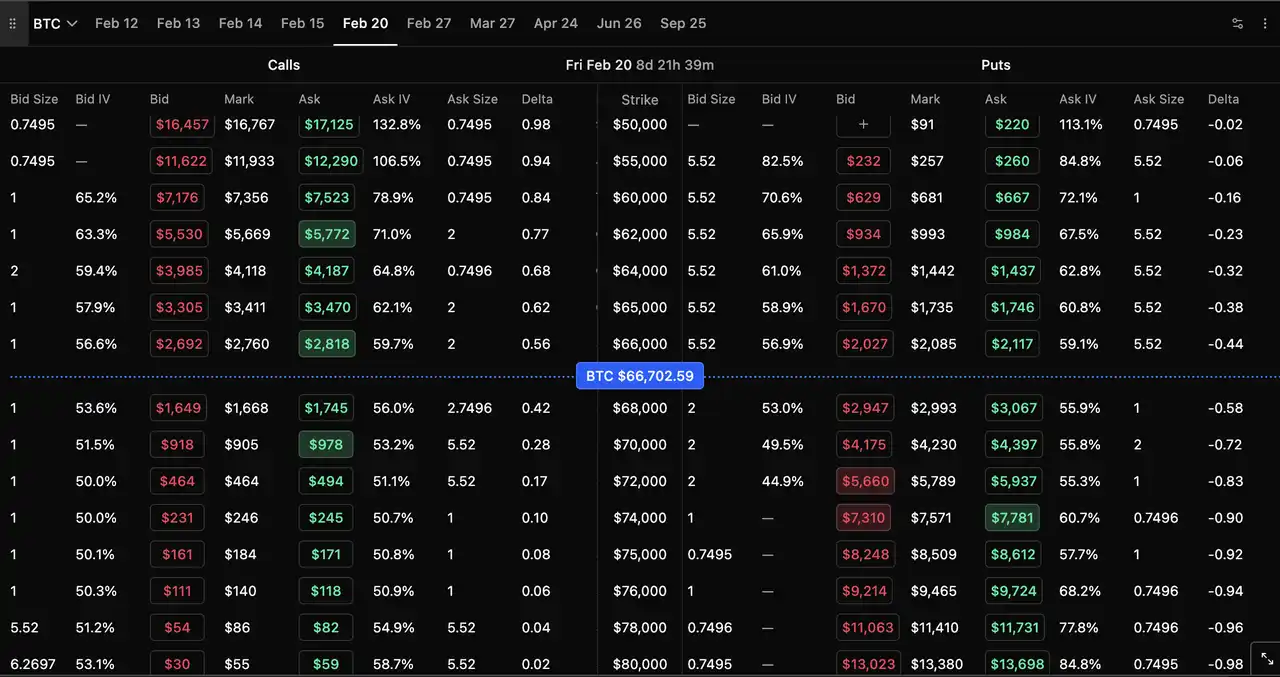
It has introduced an RFQ (Request for Quote) mechanism—when a trader wants to buy or sell an option, the system sends an RFQ to professional market makers. The market makers calculate the latest risk exposure and market price off-chain and then submit the quoted price on-chain. Market makers have the right to "refuse trades." If they believe the market is experiencing significant volatility, they can choose not to quote a price. This effectively blocks arbitrageurs from exploiting price delays to front-run market makers, thus attracting professional institutions like FalconX to provide liquidity.
In parallel with RFQ, Derive runs an order book model on its self-built L2 application chain, allowing small traders to place orders directly like on a CEX. RFQ services cater to custom large trades, while the order book services retail.
Hyperliquid HIP-4
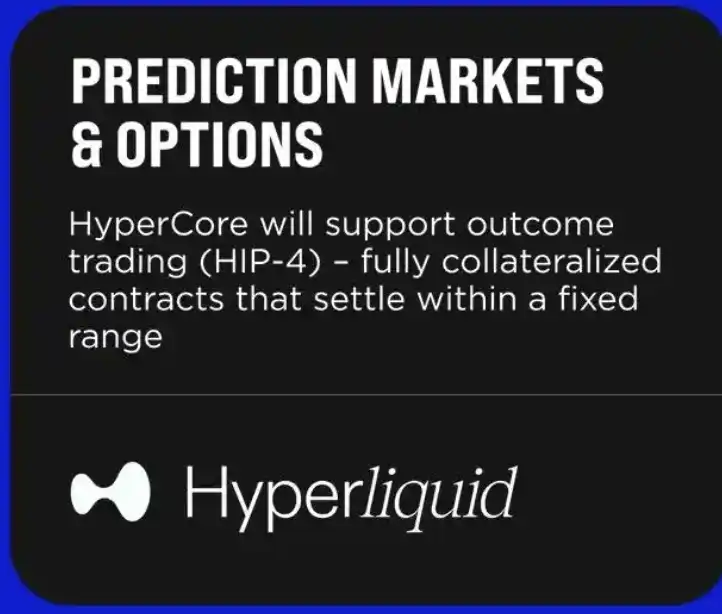
Hyperliquid's HIP-4 directly integrates "Outcome Trading" (including binary options and prediction markets) into its core trading engine, HyperCore.
The greatest value of HIP-4 is "Unified Margin." In the current market, if you want to trade both perpetual contracts and options, you need to have funds on different platforms. With HIP-4, users can use the same margin in the same account to simultaneously trade options and perpetual contracts. Market makers and traders can manage cross-market risk exposure in one place—for example, buying protective puts while longing a perpetual contract. This significantly improves capital efficiency and reduces market-making costs.
Also a "Dopamine" Game
"Retail investors hate options because they are too complex."
Look at the rebuttal provided by the US stock market: In 2024, over 50% of the trading volume of S&P 500 index options comes from "Same-Day Expiry Options" (0DTE, meaning options expiring on the same day). The majority of buyers of these options are retail investors. They do not perform complex Greek letter calculations; they simply use a small amount of capital to bet on whether the price will rise or fall today. If they guess correctly, they may earn 5 to 10 times their investment; if they guess wrong, they lose a limited premium.
Users do not hate options; the barrier lies in obscure terms and a complex interface.
A new generation of on-chain options projects is sprinting in this direction. Euphoria has created a "Click Trading" interactive mode: Users see a grid on a price chart, where each cell represents a price range. Simply click on the cell you think the price will touch, and if the price does reach that level, you receive a corresponding reward. No need to understand what a strike price is, no need to calculate Delta, no need to choose an expiration date. Instant payout, pure dopamine. The project is scheduled to launch on the MegaETH mainnet on February 16.
Euphoria Operation Interface
On the distribution side, on-chain options protocols can follow a "Front Shop Back Factory" model validated by Perp DEX. Derive recently opened up their Builder Codes, allowing developers to leverage Derive's infrastructure to build custom frontend applications and earn fees directly from the trading flow. It can be foreseen that more and more frontend applications will incorporate options modules into their stack in the future.
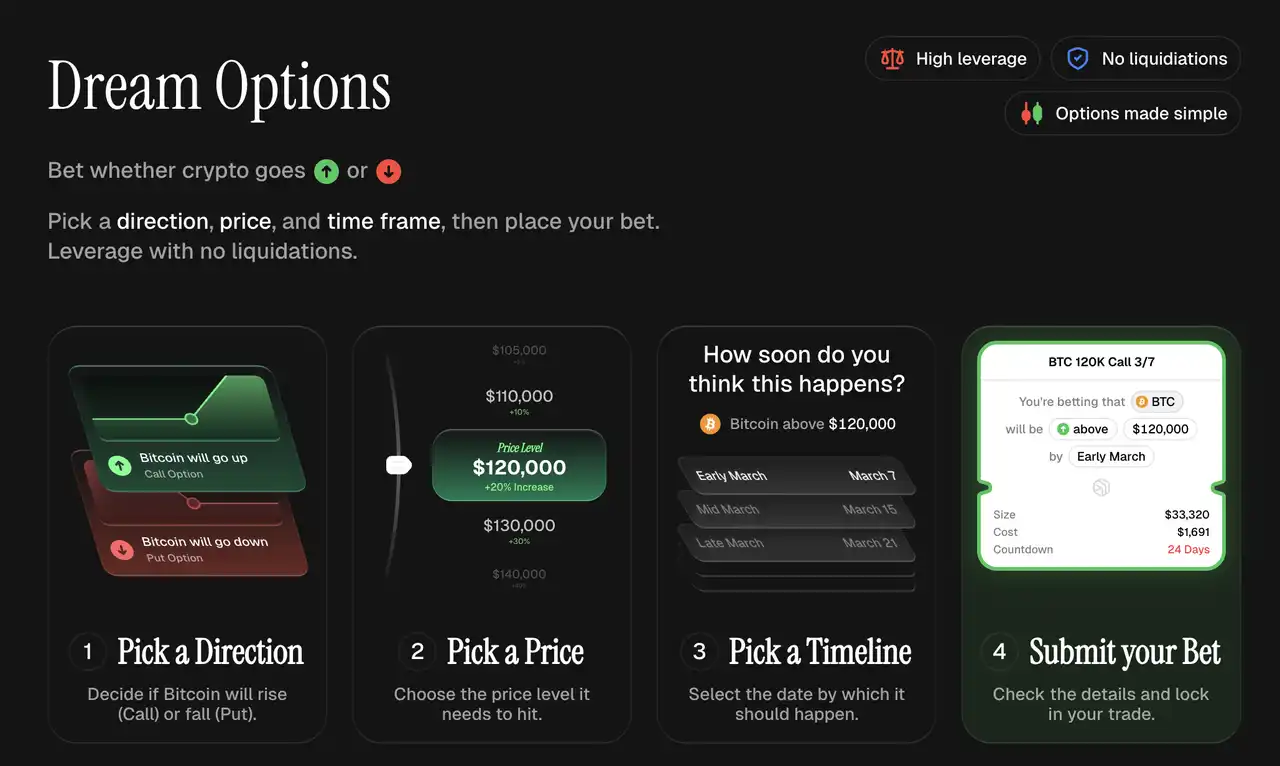
Option Trading APP Dreaming Based on Derive Builder Code
Conclusion
Current on-chain options volume, compared to Perp DEX, is still just a drop in the ocean. There are still many obstacles to overcome before a true breakthrough, such as insufficient liquidity depth, lack of retail investor education, and vague regulatory frameworks.
But the direction is clear.
On-Chain Options Trading Volume Hit a New High a Few Days Ago
In a world no longer offering free lunch, returns will converge to the essence of "risk premia."
With changing market dynamics, improved infrastructure, and a surge in retail demand, options are on the cusp of becoming a core piece of the on-chain financial system.
This content is provided for general informational purposes only and doesn't constitute financial, investment, legal, or tax advice. Any events, rewards, online promotions, or related information mentioned herein should not be considered a recommendation, solicitation, or invitation to purchase, sell, trade, or otherwise deal in any crypto assets. Crypto assets are highly volatile and may result in loss. The availability of WEEX services, products, and related events may vary by region. You are responsible for ensuring that your participation is in accordance with applicable local laws and regulations.
You may also like

ENA, SUI, and EIGEN Unlock Over $20 Million in Tokens This Week

ether.fi Removes Restaking From weETH, Nearing A Full EigenLayer Exit

Cryptocurrency venture capital firm Ethereal Ventures has disclosed for the first time that the total size of its two funds is approximately $150 million

Morning Report | Visa includes Polygon in its global stablecoin settlement program; MoonPay invests $100 million to acquire security company Sodot; Digital wallet platform Belo completes $14 million Series A financing
An Obscure Open Source AI Tool Alerted on Kelp DAO's $292 million Bug 12 Days Ago

46 minutes, $292 million stolen, DeFi faces development dilemma again

One Balance to Rule Them All: Gravitas' On-Chain Prime Broker Ambition

When Openclaw Founder Advises Young People to Stay Away from Crypto

Sentient Reveals Tokenomics, How Will the Market Price It?
Eigen Foundation Proposes Adjusting EIGEN Token Incentives to Provide Higher Rewards for Active Users
a16z crypto Promotes Guy Wuollet to General Partner
SharpLink is planning to deploy $200 million worth of ETH on the Linea network
Ripple and SBI Team Up for RLUSD Stablecoin Launch in Japan by Early 2026
Latest Crypto Market Snapshot as of August 22, 2025 BTC Soars to $115,250.00 ETH Hits $4,450.75 XRP Climbs…
aPriori Coin Airdrop: How to Claim $500+ Free Tokens by August 2025
I’ve been diving into cryptocurrency airdrops for years, and I can tell you from personal experience that the…

ChainOpera AI has officially partnered with EigenLayer to jointly build a trustable on-chain AI Agent network, with a daily transaction volume exceeding 600,000 times.

UK Intensifies Crackdown on Cryptocurrency Networks Linked to Russia

US PMI Falls in August: What This Means for Interest Rates and Investments
Microsoft 365 outage enters its second day with Outlook still unstable
Ethereum ETFs See Positive Inflows As September Trading Opens
Strategy Resumes Bitcoin Purchases with $369.7 Million Acquisition
Russia's Largest Bank Accepts Bitcoin as Collateral Starting Today

BitMine Adds 53,501 ETH In $131M Corporate Treasury Move

Wholesale Dollar Rises at the Start of September, Surpassing $1,510 Again

White House Faces Staff Exodus Ahead of U.S. Midterm Elections as Several Key Trump Aides Depart

US Manufacturing PMI Hits 55.6% in July, Fastest Expansion in Four Years

Crypto Scam in Saint-Tropez: Villa Sale Ends in a Trap Worth Over 1 Million Euros
Where in Ukraine is the Most Demand for Rental Housing: OLX Names Popular Formats

Michael Barr, Fed Governor, Says Rates Must Be Raised Firmly If Inflation Doesn't Stabilize
Where Should Global Crypto Platforms Report CARF? An Analysis of Reporting Nexus Rules

Ireland: The new tax-free investment account closes its doors to crypto
ENA, SUI, and EIGEN Unlock Over $20 Million in Tokens This Week
ether.fi Removes Restaking From weETH, Nearing A Full EigenLayer Exit
Cryptocurrency venture capital firm Ethereal Ventures has disclosed for the first time that the total size of its two funds is approximately $150 million
Morning Report | Visa includes Polygon in its global stablecoin settlement program; MoonPay invests $100 million to acquire security company Sodot; Digital wallet platform Belo completes $14 million Series A financing
An Obscure Open Source AI Tool Alerted on Kelp DAO's $292 million Bug 12 Days Ago
46 minutes, $292 million stolen, DeFi faces development dilemma again