
- Buy Crypto
- Markets
- Futures
- Spot
- Copy Trade
 Earn
Earn- More
Ethereum Hodler's Lament

Vitalik is feeling very bad.
When he heard people on Crypto Twitter and VC firms telling him that a PVP KOL gambler's casino, where over 99% of users lose money, is the best market fit the crypto industry can achieve, and wanting something better is seen as "condescending and elitist," Vitalik felt very bad.
When those who have no clue about the Ethereum Foundation's internal operations told him who should be kicked out of the organization, who should be let in, and expected him to make all these adjustments within two weeks, Vitalik felt very bad.
For all Ethereum teams and communities, 2024 was a tough year. The community's discontent got stuck in a cyclical rage mode, erupting from time to time, and the community's meme jokes mocking ETH's price kept coming in waves.
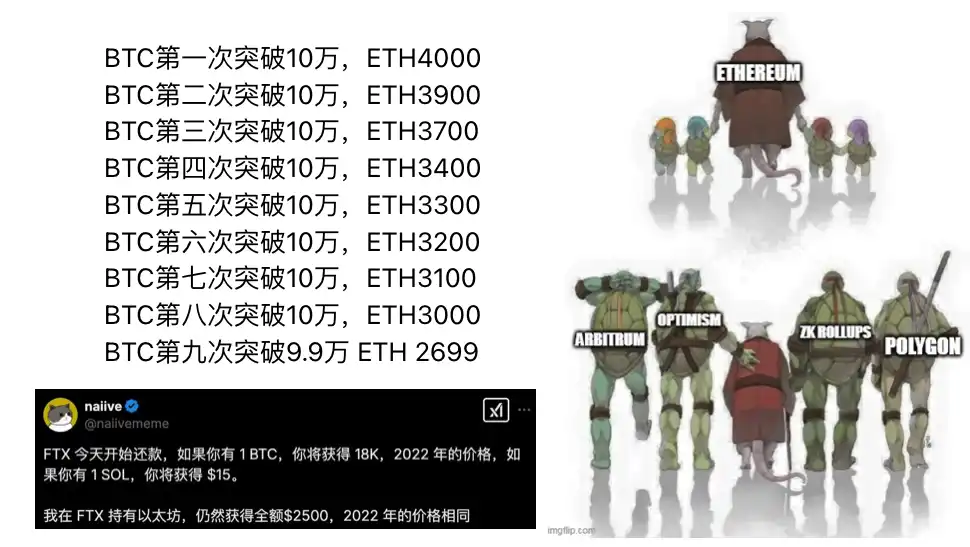
Apart from Vitalik, there is one more person feeling very bad.
That person is Aya Miyaguchi, the former Executive Director of the Ethereum Foundation. A year ago, Aya proposed to Vitalik the idea of moving from Executive Director to Foundation Chair, which materialized today, as Vitalik announced Aya's official promotion to Ethereum Foundation Chair. This has left the Ethereum community very dissatisfied.
Controversial New Chair of the Ethereum Foundation
In fact, over the past year, Aya has faced a lot of criticism from the Ethereum community and has been a controversial figure in both the Chinese and English Ethereum communities.
Over the past year, Ethereum's biggest competitor, Solana, has made a remarkable comeback. In addition to founder Toly's efforts in various "Solana gambling culture memes," Solana Foundation Chair Lily Liu's work has been widely recognized by the community. For example, proposing the PayFi concept of "earning interest on-chain to pay for real-world transactions," organizing many high-quality hackathon competitions, and investing in many high-quality projects in the Solana ecosystem.
However, in the eyes of many Ethereum community members, during Aya's 7 years as the Ethereum Foundation's Executive Director, there have been almost no "achievements."
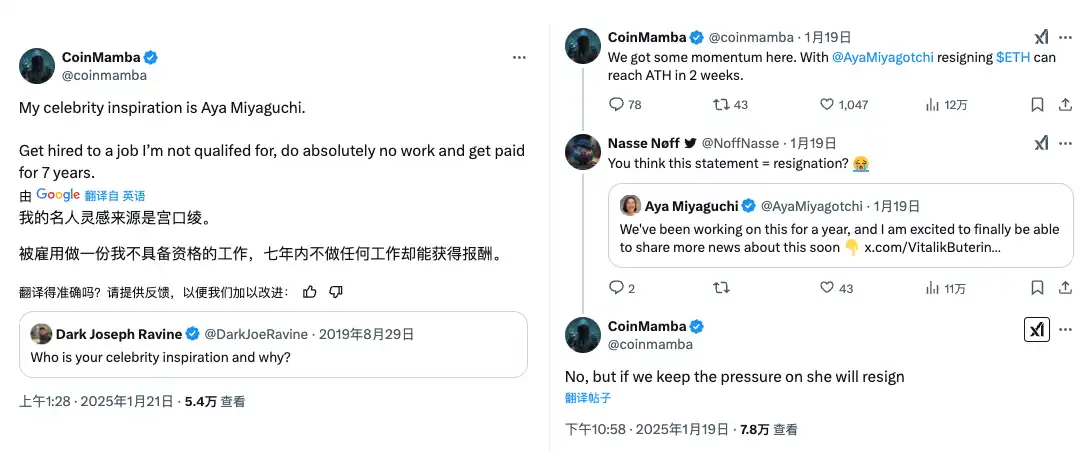
「Worked an unqualified job for 7 years, getting paid without doing any work」, CoinMamba-led traders and KOLs in the English-speaking community hold the deepest grudge against her.
They even attempted to pressure Aya into leaving through public opinion: posting statements like "The day Aya leaves will be Ethereum's Liberation Day", "ETH will hit a new high within two weeks of Aya's departure", "If we continue to pressure her, she will resign", and even some individuals issuing irrational insults and death threats towards her.
If everyone remembers the period around Chinese New Year when Vitalik made various breakthrough tweets, such as using abstract language while mentioning Milady, or even expressing thoughts of leaving Ethereum, stating "in good spirits", it was precisely during that time that Vitalik faced significant public pressure from the community.
Faced with the momentum from people like CoinMamba calling for "Aya's dismissal", Vitalik seemed somewhat overwhelmed, even tweeting seven or eight times in a row, stating, "The only person who can decide the Ethereum Foundation's leadership team is me, Milady!", "I hope everyone can speak kindly, Milady!", "Anyone who makes insulting remarks is a demon, Milady!", "Milady!"
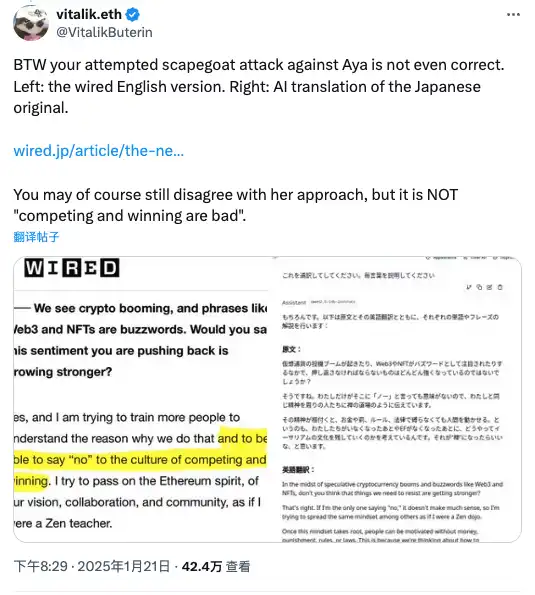
Aya's 7 Years of Doing Nothing?
This year marks the 10th anniversary of the Ethereum ICO, and Aya has been with the Ethereum Foundation for 7 years.
Prior to Aya, the Ethereum Foundation's Executive Director was also of Asian descent, named Ming Chan, who had many years of experience in IT and management consulting. Between 2015 and 2018, in these three years, she handled the foundation's day-to-day operations, ensured its standardized management, and ensured that technical development and community operations proceeded smoothly within legal and regulatory frameworks.
Since 2018, after Aya took over from Ming Chan as the new Executive Director of the Ethereum Foundation, she redefined the Foundation's responsibilities.
"To say that Aya has done nothing during her years in office may be a bit biased," said Lida, an Ethereum ecosystem protocol researcher, in an interview with BlockBeats. "The most prominent work that can be cited are the annual ETH Devcon or Devconnect conferences, which have been held every year and have been inseparable from Aya's efforts. Moreover, it is visible that ETH's activities have spread worldwide over these years, providing unconditional funding to community events around the world."
In addition, the Foundation's responsibilities include maintaining an execution client like Geth, hosting various conference calls (such as All Core Devs (ACD) hosted by Tim Beiko, All Devs Consensus (ACDC) hosted by Alex Stokes, etc.), conducting various Ethereum technical research, roadmap planning, and more.
"However, with the adjustments in recent years, Ethereum's research team is basically an independent department within the Foundation, setting roadmaps, having dozens of tasks developed concurrently by different teams, conducting Reddit AMAs twice a year, and more," Lida said.
In the latest reshuffle of Ethereum Foundation members, you can also see a significant restructuring of the research team. Apart from splitting this section into 5 categories of research groups, Stokes and Barnabe jointly serve as co-leads of the Ethereum Foundation Research Team.
Realizing the significant impact of her work in the education sector on children's futures, Aya developed a sense of "imposter syndrome."
"In order to convey the content that we as humans need to communicate, rather than simply teaching the content of a subject according to a manual, don't we need to learn ourselves first? Therefore, I was in a dilemma for a long time. So, I decided to resign." This is Aya explaining why she left the education sector in an interview.
After leaving the education sector, Aya enrolled in a graduate business school in the United States, focusing on the microfinance sector. However, she was not interested in making money itself. "I needed a job to stay in the U.S. for the long term, and it would have been difficult to find a job without going to graduate school."
It was during this time that Aya entered the crypto industry.
"It was probably around that time that I had the opportunity to talk to Jesse Powell, the founder of the cryptocurrency exchange Kraken, and felt that blockchain could be linked to financial inclusion and microfinance that I was studying. The founder asked me if I would be willing to help, so I joined Kraken," Aya recalled in the interview. Initially, she was in charge of Kraken's operations in Japan and later became the General Manager of Kraken Japan.
It was 2013, Vitalik was still a writer for Bitcoin Magazine, and during interviews with various individuals, he would take the opportunity to discuss his own ideas, such as areas where Bitcoin needed improvement, which ultimately laid the groundwork for Ethereum.
"It is said that a founding member of Kraken wanted to support such new technology and talent, greatly appreciated Vitalik, so when Vitalik was writing the Ethereum white paper, he spent some time at the Kraken office, and even Kraken's founder let Vitalik stay in a spare room in his own house."
It was also here that Vitalik met Aya, who was working at Kraken at the time.
Ethereum Was First and Foremost a Cultural Group
Recently, during a conversation with a friend, he brought up a point: "All team members are, in fact, an extension of the founder's values, even if the power distribution in web3 is decentralized, this will not change."
He makes a valid point. Stokes, who was just appointed as one of the co-leads of the Ethereum Foundation research team, pinned a tweet on his profile with a statement he wrote in 2022: "Ethereum was first and foremost a cultural project, we just happen to leverage software to amplify it."
And even under heavy community pressure not only was Aya not removed by Vitalik, but was instead given an even greater title, becoming a staunch guardian of Ethereum's culture. She likened Ethereum's positioning plan to an "infinite garden": "Ethereum's mission is not to rapidly acquire short-term gains, but to drive the popularization and development of decentralized ideals in the long term."
All of this is an extension of Vitalik's values.
So when the community turned hostile towards Aya, Vitalik felt personally attacked because it wasn't just Aya being insulted, but also Vitalik himself.
In the early Ethereum prequel stories, back when Vitalik had nothing but an idea, he welcomed the first 10 developers who responded and wanted to join, selecting 5 of them as the core team, the 5 founders of Ethereum. Following the 5 founders, in 2014, three more developers became co-founders.
At that time, there was no Ethereum Foundation, only the 8 core leaders. It wasn't until the internal relations within Ethereum became tense in 2014, with debates arising about whether to take venture capital money or crowdfund from the public; whether to pursue a for-profit path and become the Google of the crypto world, or remain a purely non-profit organization, that the future direction of the Ethereum Foundation became a recurring topic of debate, giving rise to factions.
When reminiscing about this memory, Vitalik said, "I was once convinced to lean towards taking Ethereum down a more enterprise-focused path. But that never made me feel more comfortable, it even made me feel somewhat dirty."
After the final co-founder meeting, Vitalik decided to choose the path of decentralization and non-profit. "I was trying to shift responsibility throughout the whole process because I really didn't want to take on that responsibility, and ultimately I had to remove some people."
In the end, aside from Vitalik, several other co-founders left Ethereum, giving rise to the Ethereum Foundation.
The Elegy of Ethereum's "Leftists"
Some say that the original sin, in essence, is still due to ETH's price performance.
"But I believe the original sin lies in the crypto industry increasingly moving to the right, while Ethereum has persisted in moving to the left." In Lida's view, Ethereum's values have remained the same since then, but it's the industry that has changed. From the U.S. political scene to the entire crypto industry, idealism is no longer discussed, and everyone is gearing up for the PvP arena. This makes Ethereum stand out as very different.
From the outset, Ethereum's founders and team have adhered to one ideal: decentralization, definance, and the pursuit of societal value realization. In a market full of bubbles and hype, this ideal stands out prominently.
At a time when community sentiment is not particularly good, Vitalik always emphasizes the peace and love of the "leftist style," which further irritates the community and has even sparked dissatisfaction from early Ethereum developer Eric: "It is exhausting to hear someone use words like 'don't be too harsh' to ignore the community's commands. We are here to change the world, not create a safe space."
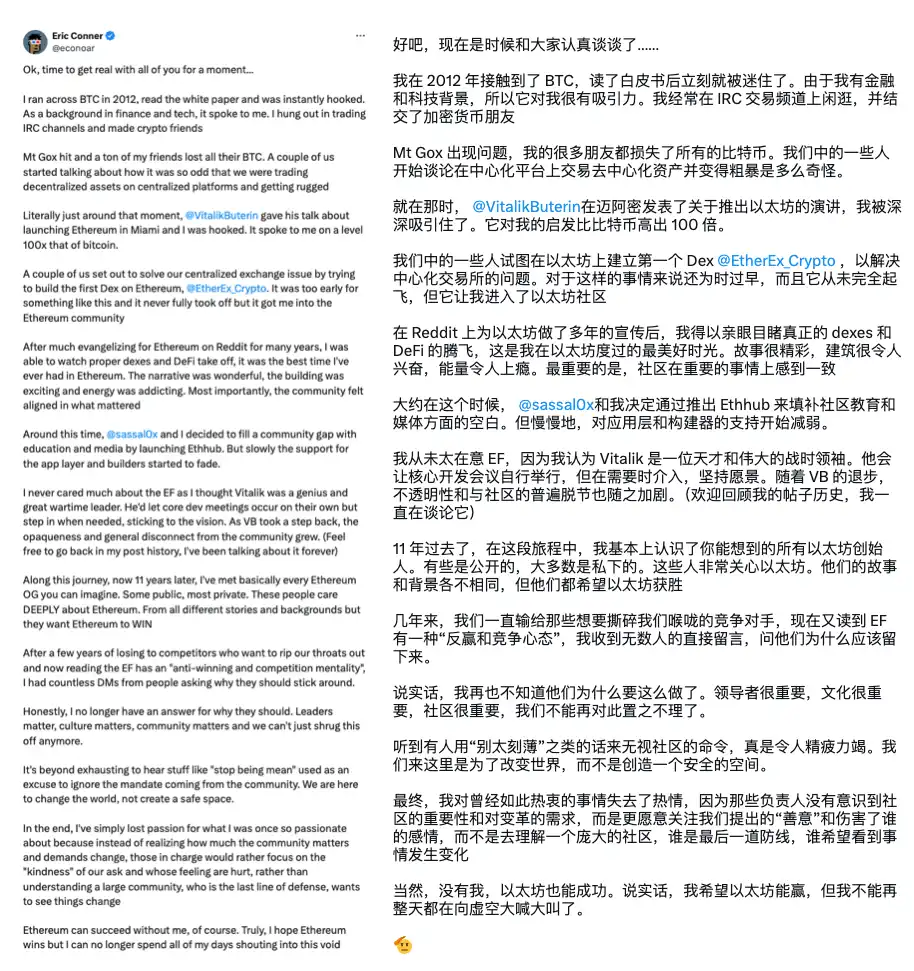
In Eric's view, the power of ideals is the source of driving social change, rather than bowing to the market's whims. Often, leaders should take a long-term view and listen to the voices from the community.
"In the end, I lost my passion for something I was once so enthusiastic about because those in charge failed to realize the importance of the community and the need for change but were more willing to focus on the 'good intentions' we put forward and whose feelings were hurt, rather than understanding a vast community."
The values among early Ethereum members are also constantly colliding and reflecting. All of this seems to hark back to the Ethereum community split of 2014. Faced with the industry's increasingly right-leaning trend, more and more voices are calling for Ethereum to also take the "capitalization route."
This was also a heavily discussed topic not long ago, as Ethereum's income at the protocol layer was too low. "If I could take over the Ethereum Foundation, ETH would rise to $10,000. The first thing I would do after taking over is to optimize revenue," said Justin Sun, whose viewpoint has gained recognition from the majority of the Chinese community.
Arbitrum is charging itself a 10% fee for its L3, while as an L2, it only gives Ethereum a 2% "tax." This has raised doubts among many investors and ecosystem developers, as this ratio is indeed too low.
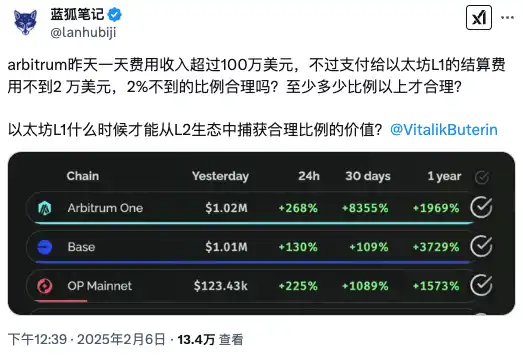
So how much tax should be collected to be reasonable? In response to this question, Odaily BlockBeats once again sought Justin Sun's opinion.
"Personally, I suggest that the annual USD tax revenue for Base and Polygon should not be less than $200 million." Sun Yuchen believes that although the prosperity of the L2 ecosystem will directly enhance Ethereum's value, Ethereum is currently subsidizing L2 excessively. A 2% tax rate may be too low, but if raised to 8%, it could provide more stable income for Ethereum, increase revenue by at least $1 billion a year, and not suppress Layer 2 development.
"If Layer 2 is in the early development stage, some subsidies can be provided. However, for already emerging large-scale L2 solutions like Base and Polygon, I suggest imposing heavy taxes. This is also common at the national level, where ordinary people are tax-exempt or taxed at 10%, but super-rich individuals need to pay a higher level of tax, around 20-30%," further analyzed Justin Sun.
In addition to increasing efficiency, costs must also be reduced.
For example, AAVE founder Stani has also proposed his own suggestion in this regard: "As an organization, the Ethereum Foundation should be a lean and efficient organization. Anyone who has not put in 100% effort should leave the Foundation."
However, there is a huge gap between theory and practice, and change will not come quickly. Everything takes time, and the reform of the Ethereum Foundation is also ongoing, including a series of financial and administrative reforms, introducing more standardization measures.
As for the most concerning topic, the price movement, it definitely lags behind, so just wait.
You may also like

Russia’s Largest Bitcoin Miner BitRiver Faces Bankruptcy Crisis – What Went Wrong?
Key Takeaways BitRiver, the largest Bitcoin mining operator in Russia, faces a bankruptcy crisis due to unresolved debts…

Polymarket Predicts Over 70% Chance Bitcoin Will Drop Below $65K
Key Takeaways Polymarket bettors forecast a 71% chance for Bitcoin to fall below $65,000 by 2026. Strong bearish…

BitMine Reports 4.285M ETH Holdings, Expands Staked Position With Massive Reward Outlook
Key Takeaways BitMine Immersion Technologies holds 4,285,125 ETH, which is approximately 3.55% of Ethereum’s total supply. The company…

US Liquidity Crisis Sparked $250B Crash, Not a ‘Broken’ Crypto Market: Analyst
Key Takeaways: A massive $250 billion crash shook the cryptocurrency markets, attributed largely to liquidity issues in the…

Vitalik Advocates for Anonymous Voting in Ethereum’s Governance — A Solution to Attacks?
Key Takeaways Vitalik Buterin proposes a two-layer governance framework utilizing anonymous voting to address collusion and capture attacks,…

South Korea Utilizes AI to Pursue Unfair Crypto Trading: Offenders Face Severe Penalties
Key Takeaways South Korea is intensifying its use of AI to crack down on unfair cryptocurrency trading practices.…

Average Bitcoin ETF Investor Turns Underwater After Major Outflows
Key Takeaways: U.S. spot Bitcoin ETFs hold approximately $113 billion in assets, equivalent to around 1.28 million BTC.…

Japan’s Biggest Wealth Manager Adjusts Crypto Strategy After Q3 Setbacks
Key Takeaways Nomura Holdings, Japan’s leading wealth management firm, scales back its crypto involvement following significant third-quarter losses.…
CFTC Regulatory Shift Could Unlock New Opportunities for Coinbase Prediction Markets
Key Takeaways: The U.S. Commodity Futures Trading Commission (CFTC) is focusing on clearer regulations for crypto-linked prediction markets,…
Hong Kong Set to Approve First Stablecoin Licenses in March — Who’s In?
Key Takeaways Hong Kong’s financial regulator, the Hong Kong Monetary Authority (HKMA), is on the verge of approving…

BitRiver Founder and CEO Igor Runets Detained Over Tax Evasion Charges
Key Takeaways: Russian authorities have detained Igor Runets, CEO of BitRiver, on allegations of tax evasion. Runets is…

Crypto Investment Products Struggle with $1.7B Outflows Amid Market Turmoil
Key Takeaways: The recent $1.7 billion outflow in the crypto investment sector represents a second consecutive week of…

Why Is Crypto Down Today? – February 2, 2026
Key Takeaways: The crypto market has seen a downturn today, with a significant decrease of 2.9% in the…

Nevada Court Temporarily Bars Polymarket From Offering Contracts in the State
Key Takeaways A Nevada state court has temporarily restrained Polymarket from offering event contracts in the state, citing…

Bitcoin Falls Below $80K As Warsh Named Fed Chair, Triggers $2.5B Liquidation
Key Takeaways Bitcoin’s price tumbled below the crucial $80,000 mark following the announcement of Kevin Warsh as the…

Strategy’s Bitcoin Holdings Face $900M in Losses as BTC Slips Below $76K
Key Takeaways Strategy Inc., led by Michael Saylor, faces over $900 million in unrealized losses as Bitcoin price…
Trump-Linked Crypto Company Secures $500M UAE Investment, Sparking Conflict Concerns
Key Takeaways A Trump-affiliated crypto company, World Liberty Financial, has garnered $500 million from UAE investors, igniting conflict…

Billionaire Michael Saylor’s Strategy Buys $75M of More Bitcoin – Bullish Signal?
Key Takeaways Michael Saylor’s firm, Strategy, has significantly increased its Bitcoin holdings by acquiring an additional 855 BTC…
Russia’s Largest Bitcoin Miner BitRiver Faces Bankruptcy Crisis – What Went Wrong?
Key Takeaways BitRiver, the largest Bitcoin mining operator in Russia, faces a bankruptcy crisis due to unresolved debts…
Polymarket Predicts Over 70% Chance Bitcoin Will Drop Below $65K
Key Takeaways Polymarket bettors forecast a 71% chance for Bitcoin to fall below $65,000 by 2026. Strong bearish…
BitMine Reports 4.285M ETH Holdings, Expands Staked Position With Massive Reward Outlook
Key Takeaways BitMine Immersion Technologies holds 4,285,125 ETH, which is approximately 3.55% of Ethereum’s total supply. The company…
US Liquidity Crisis Sparked $250B Crash, Not a ‘Broken’ Crypto Market: Analyst
Key Takeaways: A massive $250 billion crash shook the cryptocurrency markets, attributed largely to liquidity issues in the…
Vitalik Advocates for Anonymous Voting in Ethereum’s Governance — A Solution to Attacks?
Key Takeaways Vitalik Buterin proposes a two-layer governance framework utilizing anonymous voting to address collusion and capture attacks,…
South Korea Utilizes AI to Pursue Unfair Crypto Trading: Offenders Face Severe Penalties
Key Takeaways South Korea is intensifying its use of AI to crack down on unfair cryptocurrency trading practices.…


 App
App