
- Buy Crypto
- Markets
 Futures
- Spot
- Copy Trade
- Earn
- More
Bitwise CIO expects surge in crypto ETP allocations by year-end, foresees 5% portfolio norm
By: bitcoin ethereum news|2025/05/15 06:30:06
0
Share
Bitwise Chief Investment Officer Matt Hougan said on May 14 that a “big unlock” is occurring across the financial advisory space regarding crypto investments. After attending a major advisory firm’s conference, Hougan shared his expectations that most major firms will enable crypto exchange-traded product (ETP) access by the end of 2025. He added that interest in crypto exposure is intensifying and predicted that the new measure for inflows into crypto ETPs will be “many billions.” After over one year since their launch, collective daily inflows for US-traded crypto ETPs have surpassed $1 billion in five instances so far, according to Farside Investors data. Hougan also said that portfolio allocation norms for crypto are shifting and “5% is the new 1%.” He further explained that institutions are becoming more comfortable with higher crypto weightings in traditional portfolios. Institutions adjust crypto allocations Asset managers have historically advocated modest crypto allocations, citing volatility and risk concentration. In December, BlackRock’s Investment Institute defined a 1% to 2% Bitcoin allocation as a “reasonable range” for multi-asset portfolios. That recommendation has since translated into practice. BlackRock incorporated Bitcoin (BTC) into its $150 billion model portfolio offerings via the iShares Bitcoin Trust (IBIT), assigning a 1% to 2% weight in target allocations. The launch of US spot Bitcoin and Ethereum (ETH) ETPs in 2024 provided regulatory-compliant exposure mechanisms at scale for institutional clients, prompting many advisors to reevaluate their crypto positioning. Hougan also reported increased advisor inquiries about Ethereum, stating he fielded more questions on the asset “in the past few days than the past six months.” Bitcoin and Ethereum draw parallel interest While Bitcoin remains the dominant product by scale, Ethereum has emerged as a key area of curiosity for professionals, according to Hougan. Bitwise shared in April that US spot Bitcoin ETPs held $93.2 billion in assets under management (AUM) as of December 2024, contrasting with spot Ethereum ETPs that totaled $6.3 billion in AUM. Despite the disparity, ownership of both products is dispersed across key institutional categories. In Bitcoin ETPs, hedge funds (36.97%) and investment advisors (33.11%) account for most institutional ownership. On the other hand, Ethereum ETPs show more balanced exposure between investment advisors (29.79%), brokerages (25.25%), and hedge funds (24.74%) , while family offices show a stronger preference for Ethereum . Investment advisors and hedge funds allocated 5.8% and 4.5% of their total crypto allocation to Ethereum, while family offices had 25% of their nearly $173 million crypto allocation targeted to Ethereum. Hougan’s remarks reinforce industry expectations that professional investment access to crypto is entering a new maturity phase. As product availability widens and allocation norms shift upward, crypto may play a more regularized role in portfolio construction. Source: https://cryptoslate.com/bitwise-cio-expects-surge-in-crypto-etp-allocations-by-year-end-foresees-5-portfolio-norm/
You may also like

Particle Founder: The entrepreneurial insights I have gained the most from in the past year
Stop lean startup, stop lightning entrepreneurship, and think carefully about what your product aspirations are.

Huang Renxun's latest podcast transcript: The future of Nvidia, the development of embodied intelligence and agents, the explosion of inference demand, and the public relations crisis of artificial intelligence
The competition in the future is not just about whose model is larger or whose computing power is stronger, but also about who understands the industry better, who can embed AI more deeply into real processes, and who can organize these capabilities into a runnable and scalable system.

OKX Ventures Research Report: AI Agent Economic Infrastructure Research Report (Part 1)
The existing infrastructure is hostile to the Agent economy. Agents can think and act independently at the "capability level," but at the "economic level," they are still locked into infrastructure designed for humans.

The migration of settlement rights: B18 and the institutional starting point of on-chain banks
In the traditional system, banks decide the settlement; in the on-chain system, code begins to take over this responsibility.

From Tencent and Circle: Looking at the Simple and Difficult Questions of Investment
The AI narrative continues to ferment, but the recent performance of related stocks varies, with some in the midst of summer and others as if in winter.

The second half of stablecoins no longer belongs to the crypto circle
What Coinbase doesn't want, Mastercard is eager to buy.

Cursor "Shell" Kimi Controversy Reversed: From Copyright Infringement Allegations to Authorized Collaboration, China's Open Source Model Once Again Becomes a Global AI Foundation
Cursor was accused of being based on Kimi K2.5, which sparked controversy, and was later confirmed to be compliant through Fireworks AI due diligence.

The Real Reason Tokens Don't Sell: 90% of Crypto Projects Overlook Investor Relations
Provide an Investor Relations Best Practices Guide for Crypto Projects.

Is the income of pump.fun real, earning a million dollars a day despite the market downturn?
If it can really earn this much, what is the reason for the low price of $PUMP?

The real reason why tokens are not selling: 90% of crypto projects neglect investor relations
Investor Relations Practice Guide for Cryptocurrency Projects.

Who is the true winner of the "Tokenization" narrative?
Virtually everyone benefits, but the reason for the benefit, the timing, and the underlying logic are completely different.

Moss: The Era of AI-Traded by Anyone | Project Introduction
AI Trading Agent is rapidly growing its infrastructure.

Chip Smuggling Case Exposes Regulatory Loophole | Rewire News Evening Update
AI chips have become a strategic asset more sensitive than missiles

How a Structured AI Crypto Trading Bot Won at the WEEX Hackathon
Ritmex demonstrates how disciplined risk control and structured signals can make an AI crypto trading bot more stable and reliable on WEEX, highlighting the importance of combining execution discipline with scalable AI trading systems.

Old Indicator Fails, Three Major New Signals Emerge: BTC True Bottom May Still Be Below $60K
When the grocery shopping auntie on the subway, or Tony the hairdresser, start asking you about BTC, crypto, and cryptocurrency investments, selling immediately will be the only best option.

Meeting OpenClaw Founder at a Hackathon: What Else Can Lobsters Do?
Imperial College London MetaGame: AI Agent × Web3 Landing Three Major Directions.
Huang Renxun's Latest Podcast Transcript: NVIDIA's Future, Embodied Intelligence and Agent Development, Soaring Demand for Inferencing, and AI's PR Crisis
The future of competition is not only about whose model is bigger, whose computing power is stronger, but also about who understands the industry better, who can more deeply integrate AI into real processes, and who can organize these capabilities into a set of executable, scalable systems
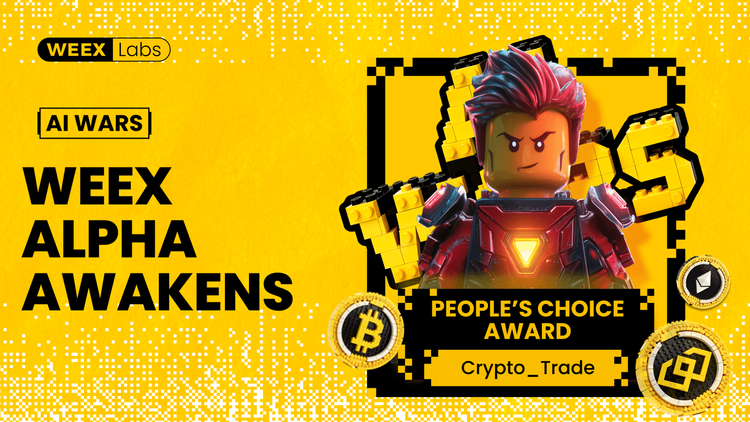
How a Structured AI Crypto Trading Bot Won at the WEEX Hackathon
Crypto_Trade shows how structured inputs and controlled adaptability can build a more stable and reliable AI crypto trading bot within the WEEX AI Trading Hackathon, highlighting a practical path toward scalable AI trading systems.
Particle Founder: The entrepreneurial insights I have gained the most from in the past year
Stop lean startup, stop lightning entrepreneurship, and think carefully about what your product aspirations are.
Huang Renxun's latest podcast transcript: The future of Nvidia, the development of embodied intelligence and agents, the explosion of inference demand, and the public relations crisis of artificial intelligence
The competition in the future is not just about whose model is larger or whose computing power is stronger, but also about who understands the industry better, who can embed AI more deeply into real processes, and who can organize these capabilities into a runnable and scalable system.
OKX Ventures Research Report: AI Agent Economic Infrastructure Research Report (Part 1)
The existing infrastructure is hostile to the Agent economy. Agents can think and act independently at the "capability level," but at the "economic level," they are still locked into infrastructure designed for humans.
The migration of settlement rights: B18 and the institutional starting point of on-chain banks
In the traditional system, banks decide the settlement; in the on-chain system, code begins to take over this responsibility.
From Tencent and Circle: Looking at the Simple and Difficult Questions of Investment
The AI narrative continues to ferment, but the recent performance of related stocks varies, with some in the midst of summer and others as if in winter.
The second half of stablecoins no longer belongs to the crypto circle
What Coinbase doesn't want, Mastercard is eager to buy.


 App
App