
120,000 Bitcoins Seized? In-Depth Analysis of the Regulatory Dilemma Behind the "Prince Group" Case

Introduction
In the current environment of tightening global cryptocurrency regulations, a cross-border "online pursuit" spanning Cambodia, the United States, and the United Kingdom has attracted everyone's attention. In October 2025, the U.S. Department of the Treasury and the Department of Justice joined forces to conduct the largest-ever cryptocurrency enforcement operation against the Prince Group in Cambodia, freezing up to 120,000 bitcoins.
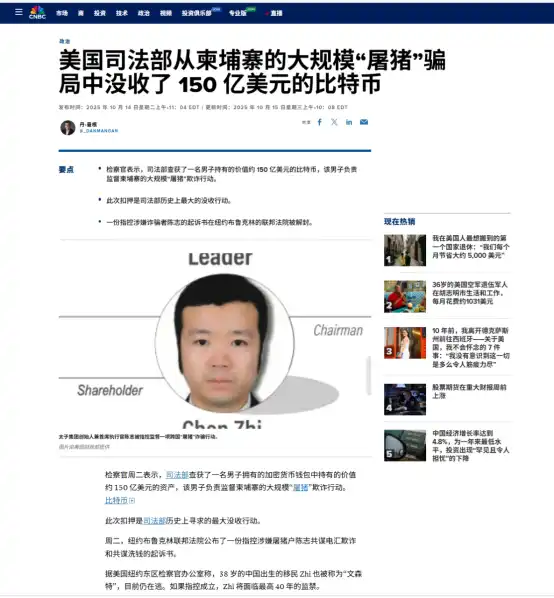
(Image source: U.S. CNBC Channel)
This case has not only shaken the blockchain industry but also challenged our traditional understanding of "financial sovereignty": when digital assets cross borders and flow anonymously, how can a sovereign state technologically track, legally sanction, and take back control in enforcement? When the U.S. is able to extend its law enforcement reach through the financial network, how can we establish our own digital asset tracing and judicial disposal system?
This article will delve into the case review, legal basis, technical vulnerabilities, and regulatory insights to analyze the legal logic and international regulatory dilemma behind the "Prince Group" case and attempt to answer an increasingly urgent question—In the era of digital finance, who truly holds the sovereignty of enforcement?
1. Case Review
First, let us reconstruct the specific details of the Prince Group case as much as possible to analyze its significance.
In October 2025, the U.S. Department of the Treasury's Office of Foreign Assets Control (OFAC) initiated one of the largest single judicial strikes against the "Prince Group International Crime Organization," sanctioning 146 members. Subsequently, the U.S. Department of Justice (DOJ) announced indictments: charging Chen Zhi with organizing and operating a "pig butchering" type of cryptocurrency investment scam based on forced labor campgrounds, while also conspiring in telecommunications fraud and money laundering. What was truly surprising was the DOJ's claim to have seized over 127,000 bitcoins.

(Image source: U.S. Department of Justice website)
How were these bitcoins scammed in the first place? It's actually quite simple. According to the indictment, Chen Zhi led the Prince Group in conducting large-scale online investment scams, deceiving victims to invest in dollars or cryptocurrency, displaying their account balances or profit growth on the surface platform, but the funds had actually been transferred out long ago, concentrated into wallets controlled by Chen Zhi. Additionally, the Prince Group made investments into mining companies such as LuBian Mining or leased real mining rigs, purchasing hash power from the open market to make outsiders believe they were acquiring bitcoin through mining, giving them the appearance of "legitimate generation."
Regarding such a massive scale cryptocurrency scam, there are reports that China established a task force in Beijing five years ago to investigate this case. However, due to the long time span, we were unable to find official information or news on this matter and could only find references from various media outlets, so we cannot easily determine the veracity of these claims. Nevertheless, how did the United States and the United Kingdom suddenly seize such a large amount of Bitcoin and extend their enforcement reach to Cambodia in the Far East?
1. Source of U.S. Jurisdiction
The indictment clearly states that the PlusToken scam network, with global victims including the United States, operated a local network in the Brooklyn area of New York. Victims were deceived into transferring funds to shell company accounts in Brooklyn and Queens, which were then circulated back to PlusToken and accounts controlled by Chen Zhi through international wire transfers or cryptocurrency transactions. This means that these accounts were opened at U.S. financial institutions and cleared through U.S. financial institutions. According to the U.S. Constitution, territorial jurisdiction is established as long as any part of the criminal activity occurs in or has an effect in the United States. The indictment also clearly states that since the criminal conduct and consequences occurred in that area, this case falls under the jurisdiction of the Eastern District of New York federal court.
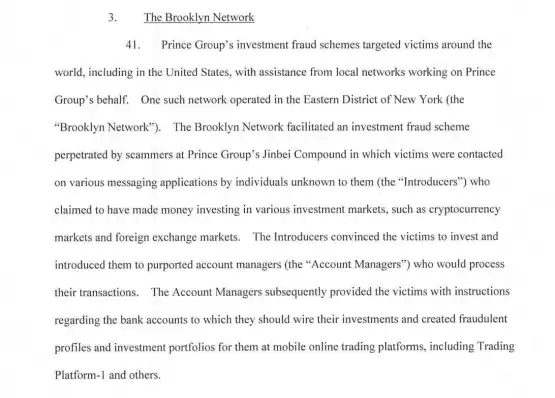
(The above image is excerpted from the original indictment)
2. Why Could Enforcement Proceed Smoothly?
On the criminal front, U.S. law enforcement agencies obtained a restraining order for 127,271 bitcoins controlled by Chen Zhi as proceeds of crime under the Civil Asset Forfeiture Reform Act (18 U.S.C. §§ 981, 982). On the financial sanctions front, the U.S. Treasury Department designated PlusToken and its associated financial network as a "Primary Money Laundering Concern" under section 311 of the Patriot Act (31 U.S.C. § 5318A), enabling the immediate freezing of its U.S.-related accounts and transactions. Combined with the Global Magnitsky Human Rights Accountability Act (22 U.S.C. § 2656), which allows for global asset freezes and transaction bans on the assets of foreign individuals involved in serious human rights abuses or significant corruption.
Additionally, by leveraging Rule 41 of the Federal Rules of Criminal Procedure and the Mutual Legal Assistance Treaty (MLAT) mechanism, the United States was able to smoothly execute seizure, extradition, and asset disposal measures through blockchain custodial nodes, exchanges, and multilateral cooperation.
3. Technical Vulnerabilities Suspicions
Why can the United States easily freeze Bitcoin storage? In addition to the strong on-chain team behind the United States, the encrypted salad also heard an interesting statement from a well-known blockchain forensics and compliance technology institution, Elliptic Blog, which can be shared with all readers:
At the end of 2020, a mining company named LuBian Mining (yes, the one mentioned earlier) experienced a serious security incident. In short, the algorithm for generating the private key for opening the Bitcoin safe had a random number vulnerability (also known as "Milk Sad"), allowing attackers to crack the private key and transfer all the Bitcoins in their mining pool, reportedly totaling exactly 127,000 coins. Until June-July 2024, new activity was detected from these Bitcoins, and the wallets involved in this new activity overlapped or merged with wallets controlled by the Prince Group network and Chen Zhi. Ultimately, in 2025, the U.S. Department of Justice officially seized them.
Undoubtedly, a considerable portion of the 127,000 Bitcoins frozen in the Prince Group had contributions from the Chinese community. However, under the current legal and technical framework, we can hardly recover our own interests from it. Regardless of whether a country has initiated an investigation or taken action, the "Prince Group" case has sounded the alarm for us: in the digital financial era, financial sovereignty is not only reflected in currency issuance but also in the effective exercise of law enforcement sovereignty. When transnational crimes are exposed, we must have clear legal grounds, a mature technical system, and resolute law enforcement capabilities to truly protect and recover assets that rightfully belong to us.
II. Conclusion
The "Prince Group" case is not the first and will not be the last of such cases. It profoundly reminds us that while the original regulatory policies may have achieved their intended goals, they may also cause us to lose some initiative in the new round of global financial competition.
Faced with the inevitable trend of digital assets, we must find a new balance between "strict risk control" and "sovereignty grasp." Establishing a self-controlled digital asset judicial disposal system to ensure that our country's legal dignity and law enforcement capabilities can extend to the digital space is an urgent issue. Only in this way can we truly achieve "asset recovery according to the law" in the future, whether it be confiscating assets to enrich the national treasury or proportionally settling and returning them to victims, thereby completing the final loop of law enforcement and effectively safeguarding the property security of the people.
This article is a submission and does not represent the views of BlockBeats.
You may also like

Raising interest rates to protect STRC and selling coins to maintain credit, this time the strategy has chosen the two most expensive paths
Morning Report | Samsung announces a 265.5 trillion won investment plan, focusing on semiconductor and AI computing power data centers; Vitalik publishes an article detailing the entire technology tree behind the confusion protocol (iO) mainline
In the era of AI, what is left of Bitcoin?
NeoSoul announced plans to integrate with the OKX Agentic Wallet, promoting AI agents' participation in the on-chain economy
Why Is Bitcoin Lagging Stocks in 2026? AI Stocks, ETF Outflows, and the Nasdaq Rally Explained
What you bought on CEX is really not US stocks: Analyzing the 94% liquidation monopoly and the evaporation of equity under a five-layer pipeline
In such a crowded cross-border payment arena, where is the next stop for the future?
Why Is Bitcoin Down in 2026? What We Can Learn From 2022
The large models in the United States are moving towards closure in the name of security
From the white-haired stock god to the billionaire fund mogul, the smart people shorting Nvidia are all getting rich using the same framework
Morning Report | CoinEx becomes a key hub for Iran to evade sanctions, involving over $3.8 billion in funds; Kalshi seeks a new round of financing, with a valuation potentially rising to $40 billion
Global Launch: As predictions become the most scarce asset in the AI era, Manadia is defining the next generation of the value internet
Why do cryptocurrency projects always like to change their names?
Who is footing the bill for the $64 billion accounting frenzy?
I never expected that the first application of AI x Crypto would be in security auditing
What is your view on Binance's competitive advantages?
ETH has entered a non-consensus phase, and the turning point is approaching!
The shift in the cloud of the air: from despising stablecoins a year ago to the high-profile entry of capital today
Raising interest rates to protect STRC and selling coins to maintain credit, this time the strategy has chosen the two most expensive paths
Morning Report | Samsung announces a 265.5 trillion won investment plan, focusing on semiconductor and AI computing power data centers; Vitalik publishes an article detailing the entire technology tree behind the confusion protocol (iO) mainline
In the era of AI, what is left of Bitcoin?
NeoSoul announced plans to integrate with the OKX Agentic Wallet, promoting AI agents' participation in the on-chain economy
Why Is Bitcoin Lagging Stocks in 2026? AI Stocks, ETF Outflows, and the Nasdaq Rally Explained
What you bought on CEX is really not US stocks: Analyzing the 94% liquidation monopoly and the evaporation of equity under a five-layer pipeline