
How Does Quantitative Trading Work? A Simple Step-by-Step Guide

 Prefer us on Google


Quantitative trading turns a trading idea into clear rules that a computer can follow. The program reads market data, checks whether the rules are met, and may then place an order. For example, a strategy may buy Bitcoin when a short-term moving average crosses above a long-term average. It may sell when the opposite crossover happens.
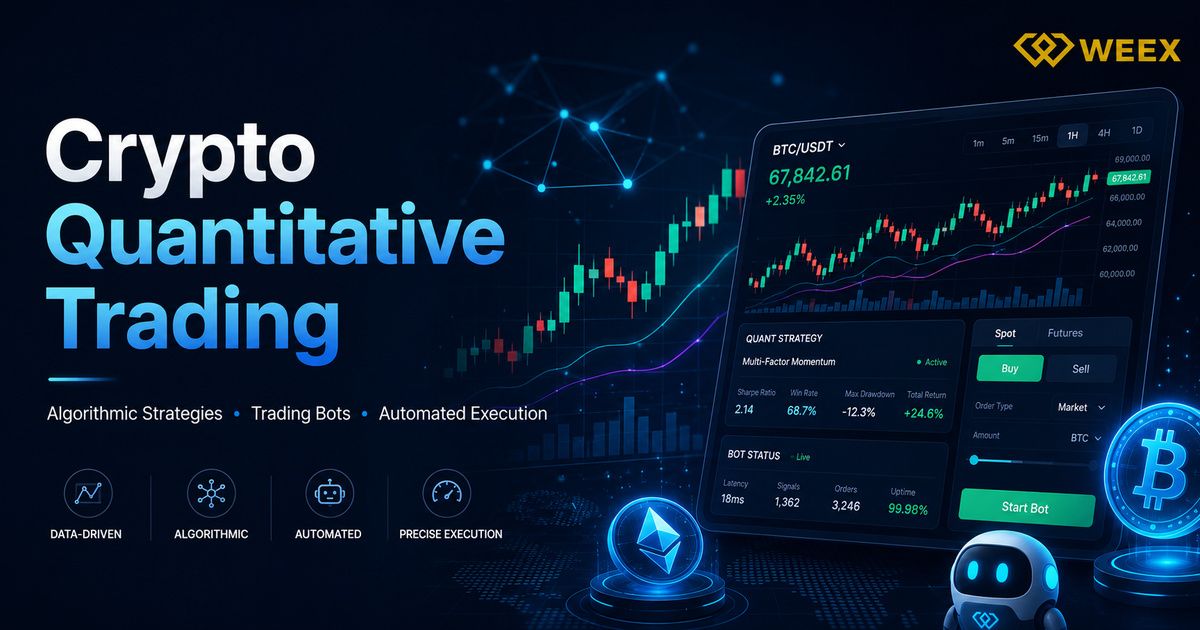
Quantitative trading can improve speed and consistency, but it does not guarantee profits. Market changes, fees, slippage, and technical problems can all affect results.
The Quantitative Trading Process
A typical quantitative trading system includes the following stages:
| Stage | Purpose |
|---|---|
| Data collection | Read prices, candles, volume, and order books |
| Strategy design | Define entry and exit rules |
| Backtesting | Test the rules on historical data |
| Risk control | Limit positions and losses |
| Signal generation | Decide whether to buy or sell |
| Order execution | Send orders through an exchange API |
| Monitoring | Check fills, errors, and account status |
The basic workflow is:
Collect data → analyze it → generate a signal → check risk → submit an order → monitor the result.
Step 1: Collect Market Data
A quantitative strategy needs reliable market data.
Common inputs include prices, candlestick data, trading volume, recent trades, and order book depth. Futures strategies may also use funding rates, mark prices, and position data.
Programs usually receive this information through REST APIs or WebSocket connections. REST APIs are useful for requesting historical candles, balances, and order information. WebSocket is more suitable for continuous price and trade updates.
Poor or delayed data can produce incorrect signals, so data quality is an important part of the system.
Step 2: Create Clear Trading Rules
“Buy when the price is low” is not a usable quantitative rule because a computer does not know what “low” means. A complete rule should define the trading pair, time frame, entry condition, exit condition, order size, and maximum risk.
For example:
Generate a buy signal when the 20-period moving average crosses above the 60-period moving average. Generate a sell signal when it crosses below.
Clear rules are easier to test and automate. However, adding more indicators does not always make a strategy better.
Step 3: Backtest the Strategy
Backtesting applies the strategy to historical data to see how it might have performed in the past. Useful metrics include total return, maximum drawdown, win rate, profit-to-loss ratio, and number of trades. Maximum drawdown shows how far the account could fall from a previous peak. A realistic backtest should also include trading fees and slippage. Without these costs, historical results may appear better than live results.
Backtesting can help evaluate a strategy, but it cannot predict future performance.
Step 4: Add Risk Controls
The strategy finds possible trades. The risk system limits potential losses. Common controls include maximum position size, stop-loss rules, daily loss limits, and total exposure limits. Futures strategies must also consider leverage and liquidation risk. For example, an account with 10,000 USDT may limit the maximum risk on each trade to 1% of the account.
Risk controls cannot remove losses, but they can reduce the damage caused by a bad signal or technical error.
Step 5: Generate and Check the Signal
When market data meets the strategy conditions, the program generates a buy, sell, or hold signal. The signal may include the direction, quantity, price, and order type. Before placing an order, the system should check the available balance, current position, minimum order size, and risk limits.
If the account already holds its maximum permitted position, the risk module may reject a new buy signal.
Step 6: Submit the Order Through an API
After the signal passes the risk checks, the program can send the order through an exchange API. An API connects the trading program with the exchange. It can provide market data, account information, and order functions, but it does not decide whether a strategy is effective.
For example, developers can use the WEEX API page to access relevant documentation and API management tools. A basic integration process is:
Read the documentation → create an API Key → connect market and trading endpoints → test orders and error handling.
Based on the currently provided WEEX information, developers should use the latest symbol format, such as BTCUSDT. Different orders should not share the same newClientOrderId, and the UA parameter may be defined by the developer.
The currently described API does not provide transfer or withdrawal endpoints, and batch order submission is not yet available. Spot, futures, and broker use cases may have different limitations, so developers should review the latest WEEX API documentation before deployment.
Step 7: Monitor Orders and Errors
A submitted order is not always a completed trade. A limit order may be partially filled, remain open, or be rejected. The program should continue checking the order status and record the actual filled price and quantity. The system should also save order IDs, signals, exchange responses, and error codes. After a network timeout, it should check whether the original order exists before sending another one.
API Keys must be protected. Only necessary permissions should be enabled, and Secret Keys should never be shared or stored in public code.
A Simple Example
Consider a BTCUSDT moving-average strategy.
The program receives hourly candles and calculates the 20-hour and 60-hour moving averages. When the shorter average crosses above the longer one, it creates a buy signal.
The risk module then checks the balance and current position. If the trade is within the limits, the program submits an order through the exchange API.
After submission, the system checks whether the order was filled. If it was completed, the program records the execution price and waits for an exit signal. If it was rejected, the system reads the error code and follows its error-handling rules.
This is the basic path from market data to a real trade.
Can Quantitative Trading Guarantee Profits?
No. Quantitative trading automates rules, but it does not remove market risk. A trend strategy may perform well in a strong market but lose money during sideways movement. A mean-reversion strategy may work in a trading range but suffer when the price continues moving in one direction. Beginners should understand the strategy, run realistic backtests, and test the system before using significant capital.
Frequently Asked Questions
Is quantitative trading the same as using a trading bot?
Not exactly. Quantitative trading is the method, while a trading bot is software used to apply the rules.
Can individuals use quantitative trading?
Yes. Individuals can build basic systems with Python, historical data, and exchange APIs. Programming and risk management knowledge are still required.
Can an API trading system run without supervision?
It should still be monitored. Data interruptions, rejected orders, and software errors can create unexpected positions.
-- Price
Conclusion
Quantitative trading works by turning a trading idea into clear and testable rules.
The system collects data, tests the strategy, applies risk limits, sends orders through an API, and monitors the results. Exchange APIs such as WEEX OPENAPI can provide data and execution functions, but they cannot guarantee that a strategy will be profitable.
Developers should always review the latest documentation, protect API credentials, and test carefully before live trading.
This content is provided for general informational purposes only and doesn't constitute financial, investment, legal, or tax advice. Any events, rewards, online promotions, or related information mentioned herein should not be considered a recommendation, solicitation, or invitation to purchase, sell, trade, or otherwise deal in any crypto assets. Crypto assets are highly volatile and may result in loss. The availability of WEEX services, products, and related events may vary by region. You are responsible for ensuring that your participation is in accordance with applicable local laws and regulations.
You may also like

CyberLeek Is Trending—but Why Are People Searching for CYBERLINK?

Nvidia After-Hours Stock Price: What Moved NVDA After the Earnings Report?

Bank Account Freeze Risk for Crypto Traders in Pakistan 2026

Crypto Tax in Pakistan: What FBR Rules Mean for PKR Traders
Humanity Protocol Unlocked 266 Million H Tokens Today—Where Did They Go?
DGAI Has Trading Volume but No Reported Circulating Supply—So What Is Its Real Market Cap?

MORTY After Viral Meme Rally: Overvalued or Growth Story?

Best Futures Exchange in Pakistan for 2026? What Leverage, Liquidity, and Liquidation Risk Actually Require
XST Coin Liquidity Risk: What Low DEX Depth Actually Means for Buyers Who Want to Exit

MSTR Stock Surges 12% in a Single Session: What Strategy Inc's Bitcoin Treasury Model Actually Amplifies
Is SOXL a Good Investment? What 3x Leverage Actually Does to Your Returns in Both Directions

XST Coin and Stargate: What XSolut's AI Infrastructure Narrative Has to Do With the $500 Billion OpenAI Project
XST Coin Rebounds From Its Post Peak Low: What the Recovery to a $45M Market Cap Actually Signals
Why Did Sahara AI (SAHARA) Drop? The 600M Token Transfer, Tokenomics and What Comes Next
Can XST Crypto Reach $0.10? XSolut Price Prediction 2026
USDT vs BTC Settlement for Crypto Broker Partners: Which Currency Is Better for Your Business
Before Swapping XSolut (XST): How to Check Liquidity, Price Impact, and Failed-Trade Risk 2026
How to Buy Niulai Coin: Where to Trade NIULAI and What to Check Before Buying
Lenovo Stock (0992): The German Subsidiary, the Pension Liability and the Segments That Report
SPCX Stock Closes Above Its $135 IPO Price for the First Time in Weeks: What the Recovery Actually Signals
Is AMD Stock a Buy After Falling 9% on Record Earnings? What the Setup Actually Looks Like
Is Samsung Stock a Buy After Falling 30% From Its All Time High? What the July Selloff Left Behind

KOSPI Falls 5% as Samsung and SK Hynix Each Drop 9%: What Is Happening to South Korea's Stock Market?
South Korea Apologizes for SK Hynix Leveraged ETFs: What It Means for SKHA SKHN Holders
Crypto Exchange API Key Leaked? What Attackers Can Actually Do
SPCX Stock Price Hits All Time Low After Starship Flight 13 Success: What Is Going On?
AMD Stock Falls 6% as Wedbush Raises Target to $600: What the Disconnect Means for Investors

Samsung Stock vs Samsung ETF: Which Is the Better Way for International Investors?
SK Hynix Stock Before July 29 Earnings: What Investors Should Watch
New SK Hynix 2X ETFs Launch: Who Should Use Them and Who Should Not
CyberLeek Is Trending—but Why Are People Searching for CYBERLINK?
Nvidia After-Hours Stock Price: What Moved NVDA After the Earnings Report?
Bank Account Freeze Risk for Crypto Traders in Pakistan 2026
Crypto Tax in Pakistan: What FBR Rules Mean for PKR Traders
Humanity Protocol Unlocked 266 Million H Tokens Today—Where Did They Go?
DGAI Has Trading Volume but No Reported Circulating Supply—So What Is Its Real Market Cap?
Contents
Popular coins
Latest articles


